
Report
2 min read
• Sept. 17, 2026Projections vs. scenarios
Report
2 min read
• Sept. 17, 2026Projections vs. scenarios: What's the difference?
A projection like the Outlook starts with current factors such as public policy and commercially available technology and then evaluates how they might change over time. In contrast, many scenarios start with a hypothetical outcome and work backward to identify the factors that need to occur to achieve that outcome. Both are important views. Back-casted scenarios help society understand the actions that may be needed to achieve a hypothetical outcome while projections help society understand the current path.
How do scenarios inform?
ExxonMobil considers a range of scenarios – including those we view as remote – to help inform the company’s strategic thinking. No single pathway can be reasonably predicted, given the wide range of uncertainties. Key unknowns include yet-to-be-developed government policies and advances in technology that may influence the cost, pace, and potential availability of certain pathways. Scenarios that employ a full complement of technology options are likely to provide the most economically efficient pathways. What also remains uncertain is how quickly and to what extent businesses and consumers will be willing to pay for carbon reductions in the products and services they use, which is essential to creating a market that incentivizes an accelerated path to net zero.
Unlike the Company’s Outlook, many scenarios, such as the IPCC Likely Below 2°C start with a hypothetical outcome and work backward to identify the factors that need to occur to achieve that outcome.
Views to 2050: Different assumptions produce dramatically different paths
Global energy-related emissions
CO2 Billion metric tons
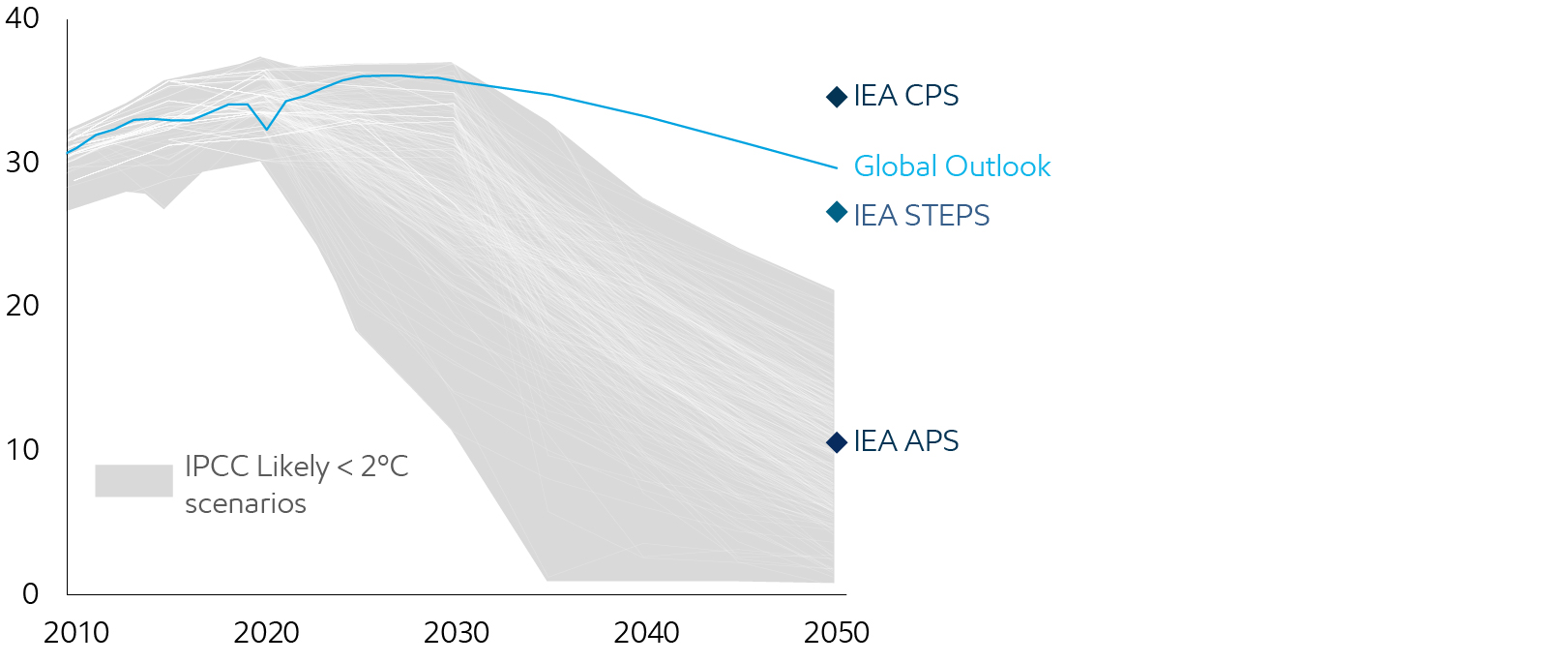
Source: 2024 IEA World Energy Outlook, 2025 IEA World Energy Outlook; IPCC: AR6 Scenarios Database hosted by IIASA release 1.0 average IPCC C3: “Likely Below 2°C” scenarios
Emissions do not contain industry process emissions or land use and natural sinks
Views of the future path of the world’s energy system and emissions levels can be grouped into two categories.
- Society’s current trajectory
- ExxonMobil’s Global Outlook bases its view of energy demand and supply through 2050 on observable trends in population, economic development, policy, technology, and consumer preferences.
- The International Energy Agency Current Policies Scenario (CPS) reflects a sector-by-sector assessment of policies currently in place.
- The International Energy Agency’s Stated Energy Policies Scenario (STEPS) reflects a sector-by-sector assessment of current policy in place or announced by governments around the world.
- Paris aligned scenarios
- The U.N. Intergovernmental Panel on Climate Change’s (IPCC) database contains 311 scenarios defined as pathways with a 67% likelihood of limiting peak warming to below 2°C throughout the 21st century. These are labelled IPCC Likely Below 2°C scenarios.
- The International Energy Agency’s Announced Pledges Scenario (APS) assumes that all aspirational targets announced by governments are met on time and in full, including their long-term net zero and energy access goals.
It is important to note that according to the 2025 U.N. Environment Programme Emissions Gap Report, the current Nationally Determined Contributions (NDCs) to emissions reductions that countries have pledged to make are not yet within a Likely Below 2°C pathway. It further states that G20 members as a group do not have policies in place to achieve their current NDCs.
ExxonMobil’s view is that while any one scenario may be remote in probability, all of these projections and scenarios are useful in informing the Company’s long-term strategic thinking.
Global Outlook



Cautionary statement
The Global Outlook includes ExxonMobil Holdings Corporation’s internal estimates of both historical levels and projections of challenging topics such as global energy demand, supply, and trends through 2050 based upon internal data and analyses as well as publicly available information from many external sources including the International Energy Agency. Separate from ExxonMobil’s analysis, we discuss a number of third-party scenarios such as the Intergovernmental Panel on Climate Change Likely Below 2°C and the International Energy Agency scenarios. Third-party scenarios discussed in this report reflect the modeling assumptions and outputs of their respective authors, not ExxonMobil, and their use and inclusion herein is not an endorsement by ExxonMobil of their results, likelihood, or probability. Work on the Outlook and report was conducted during 2025 and 2026. The report contains forward-looking statements, including projections, targets, expectations, estimates, and assumptions of future behaviors. Actual future conditions and results (including but not limited to energy demand, energy supply, the growth of energy demand and supply, the impact of new technologies, the relative mix of energy across sources, economic sectors and geographic regions, imports and exports of energy, emissions, and plans to reduce emissions) could differ materially due to changes in a number of factors, including: economic conditions, the ability to scale new technologies on a cost-effective basis, unexpected technological developments, the development of new supply sources, changes in law or government policy, political events, demographic changes and migration patterns, trade patterns, trade tariffs and trade sanctions, the development and enforcement of global, regional or national mandates, changes in consumer preferences, escalating geopolitical volatility, including regime changes, war, civil unrest, and other political or security disturbances, including disruption of land or sea transportation routes, decoupling of economies, realignment of global trade and supply chain networks, and disruptions in military alliances and other factors discussed herein and under the heading “Factors Affecting Future Results” in the Investors section of our website at https://corporate.exxonmobil.com/.
The Outlook was published in September 2026. ExxonMobil assumes no duty to update these statements or materials as of any future date, and neither future distribution of this material nor the continued availability of this material in archive form on our website should be deemed to constitute an update or re-affirmation of this material as of any future date. The Global Outlook is a voluntary disclosure and is not designed to fulfill any U.S., foreign, or third party required reporting framework. This material is not to be used or reproduced without the express written permission of ExxonMobil Holdings Corporation. All rights reserved.