
Report
4 min read
• Sept. 17, 2026Electricity demand projected to increase 65%
- The industrial sector accounts for 40% of electricity demand growth.
- Data centers and electrification of transportation have impacts in many markets, although there will be significant regional variation.
- Generation from solar and wind is projected to grow >4x by 2050, meeting ~85% of global power demand growth.
- Natural gas power generation will also grow ~25% by 2050, playing an increasingly important role in grid stability.
Report
4 min read
• Sept. 17, 2026Global electricity demand
K TWh
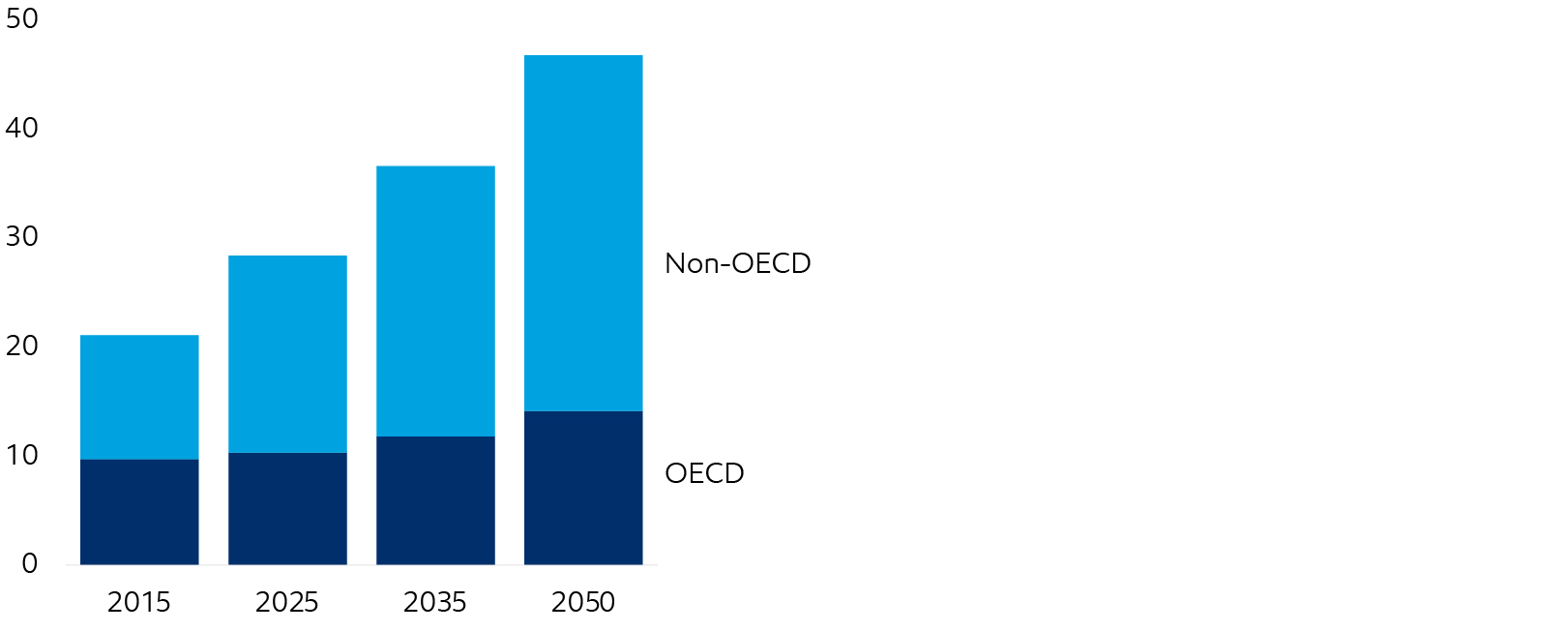
Global electricity demand is projected to increase ~65% by 2050, driven by economic growth and improving living standards in the developing world.
However, electricity demand growth is not limited to developing countries. In the OECD, electricity demand is projected to grow ~35% by 2050 with increasing electrification of industry and transportation and rising data center demand. This will be a marked shift, as OECD electricity demand has plateaued for the past ~20 years as efficiency improvements offset the impact of population and economic growth.
Global end-use energy demand
Quadrillion Btu
Source: ExxonMobil analysis
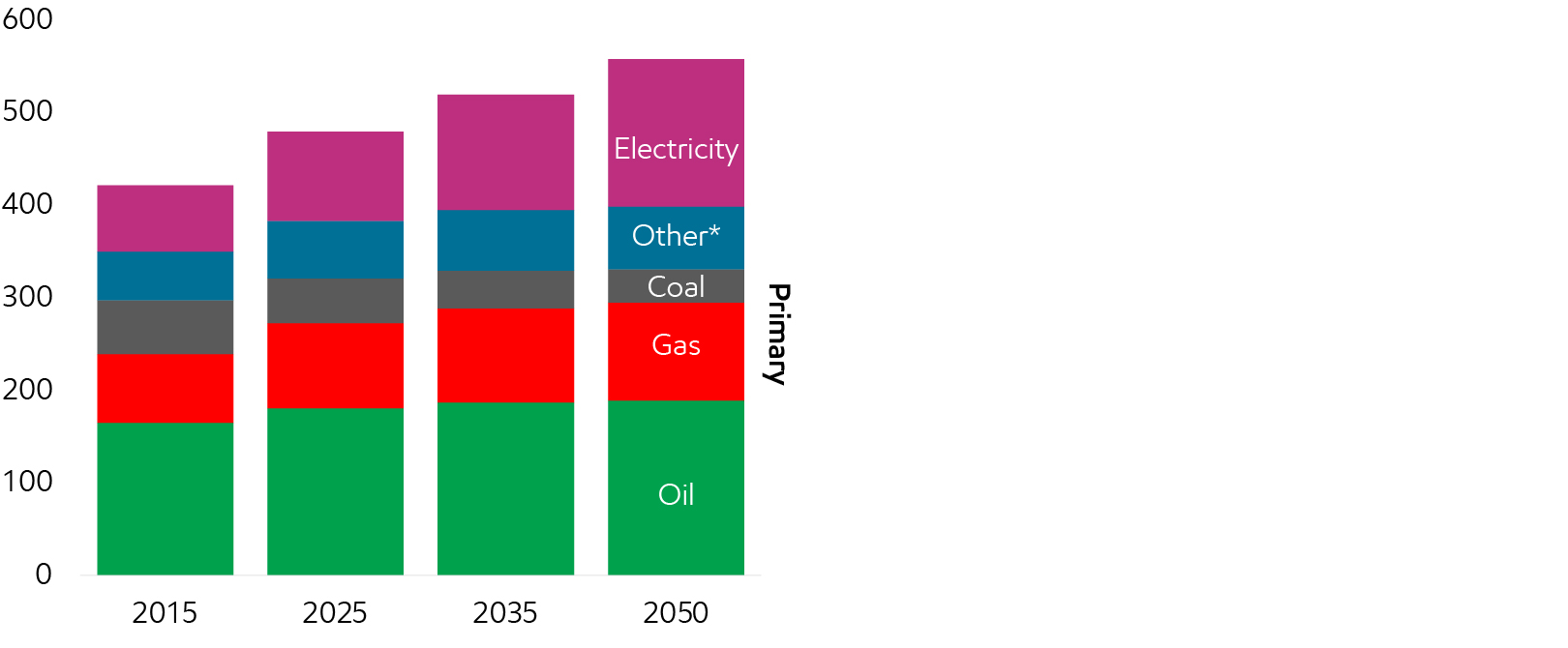
Globally, electricity is projected to meet nearly all end-use energy demand growth across all sectors from now through 2050.
The industrial sector is projected to drive ~40% of the growth in global electricity demand. Industrial electricity demand growth will occur due to both more industrial activity and higher levels of electrification of industrial production, primarily of low-temperature processes. Where there are viable technologies, such as the use of electric arc furnaces for steel recycling, we expect to see moderate amounts of electrification of higher temperature processes.
Global electricity demand by sector
K TWh
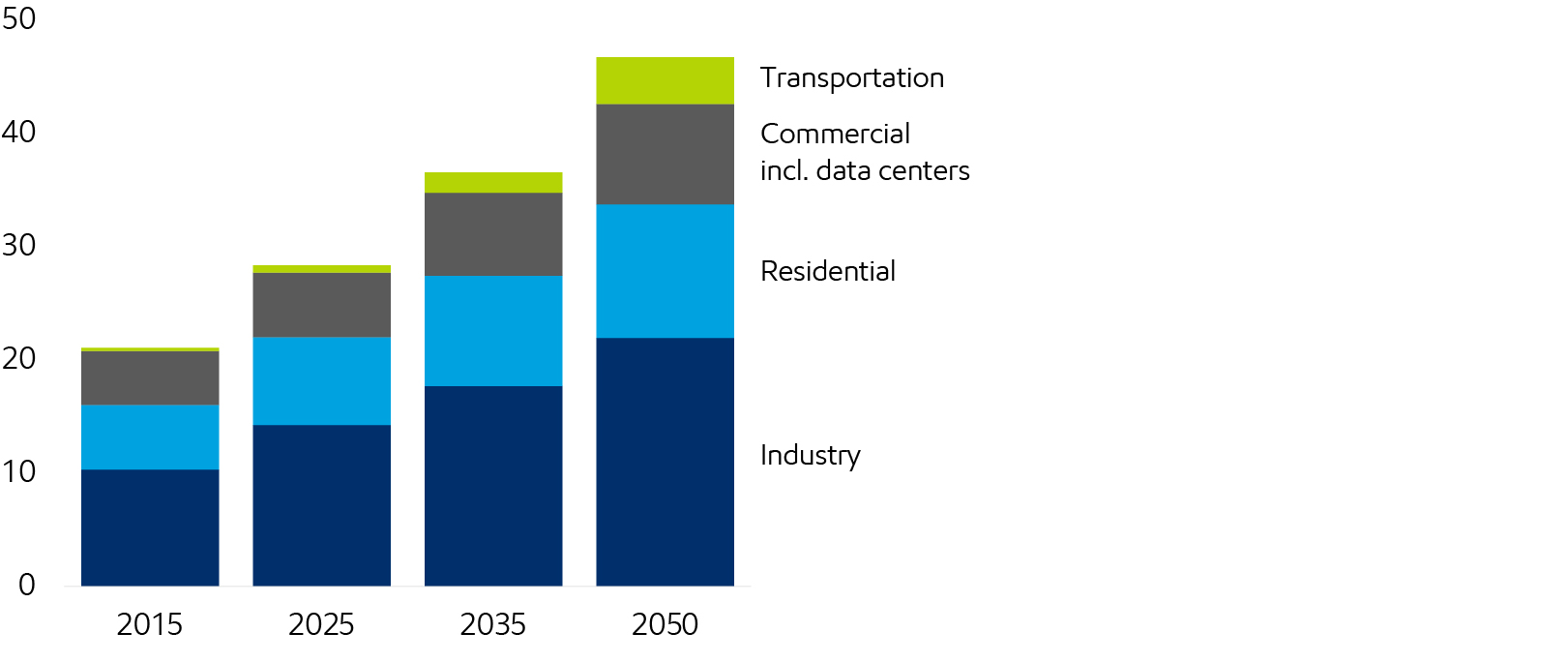
Residential buildings are projected to account for ~20% of electricity demand growth through 2050. Electricity use in residential buildings will rise with growing populations and increased demand for cooling and heating, particularly in developing countries. This growth occurs even as energy efficiency of buildings and appliances continues to improve and heat pumps are increasingly used in both residential and commercial buildings.
Globally, commercial electricity demand is projected to rise with economic growth, as well as through the rise in data centers. The commercial sector (including data centers) is projected to account for ~20% of global electricity demand growth through 2050, similar to residential buildings and about half of the growth from the industrial sector. The growth in commercial electricity demand is partly offset by continued improvements in data center/chip efficiency, and also through continued efficiency improvements in other aspects of commercial electricity demand, such as offices and warehouses. While data centers often have a material impact on electricity demand in specific regions/power grids, they have a more moderate impact at the national and global level.
Electrification of transport is projected to account for the remaining 20% of global electricity demand growth through 2050 (similar in magnitude to residential and commercial buildings). Increasing use of electricity in passenger cars is the largest factor; however, smaller regional trucks and buses also see substantial growth.
Global power generation mix
K TWh
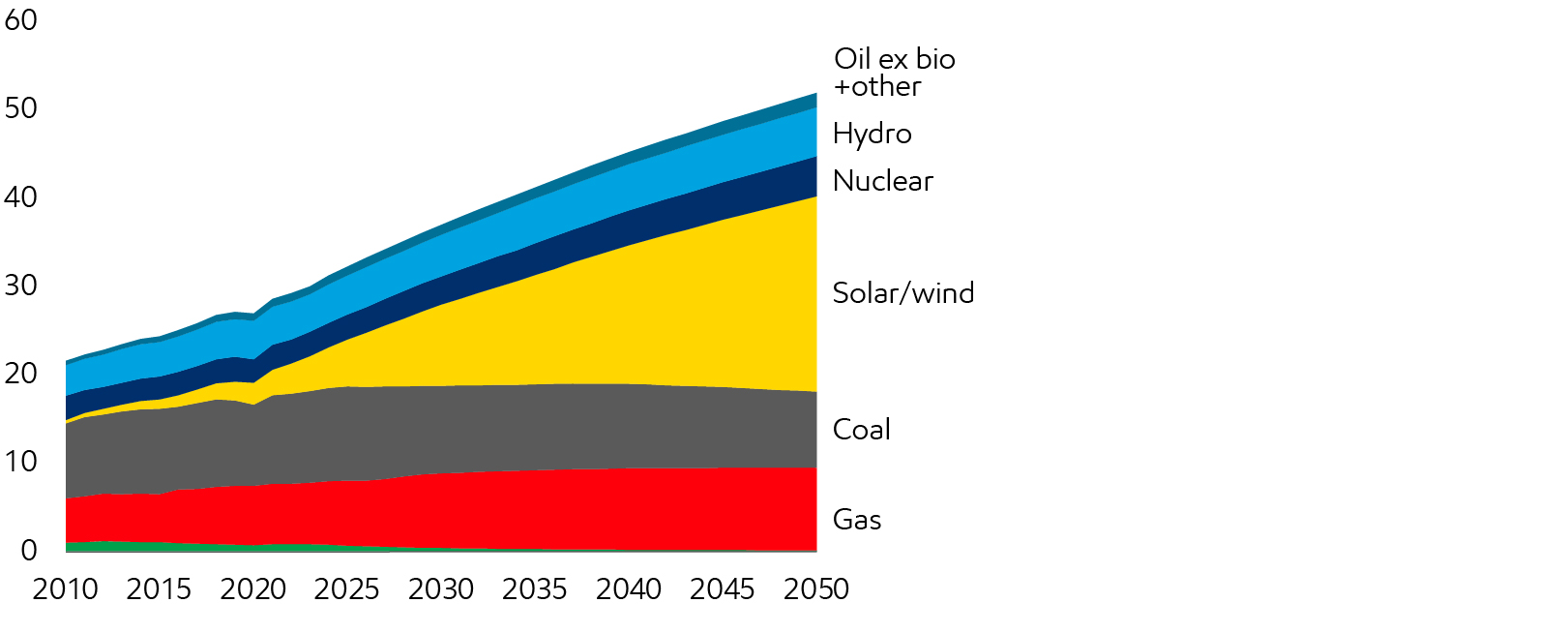
Meeting the growing demand for electricity will require a wide range of generation sources. Generation from solar and wind is projected to grow more than 4x by 2050, meeting ~85% of global power demand growth. Gas power generation will also grow ~25% by 2050, playing an increasingly important role in grid stability as the share of variable renewable energy increases, while also providing a lower emissions alternative vs. coal.
Generation from nuclear power is projected to grow ~60% by 2050, driven by increasing demand for firm, low-emission power generation and enabled by technology advancements, including small modular reactors. However, growth in nuclear power is likely to be tempered by the need to replace or upgrade aging reactors, many of which are approaching or have already exceeded 40 years of operation.
Power generation mix varies by region
(% Share)
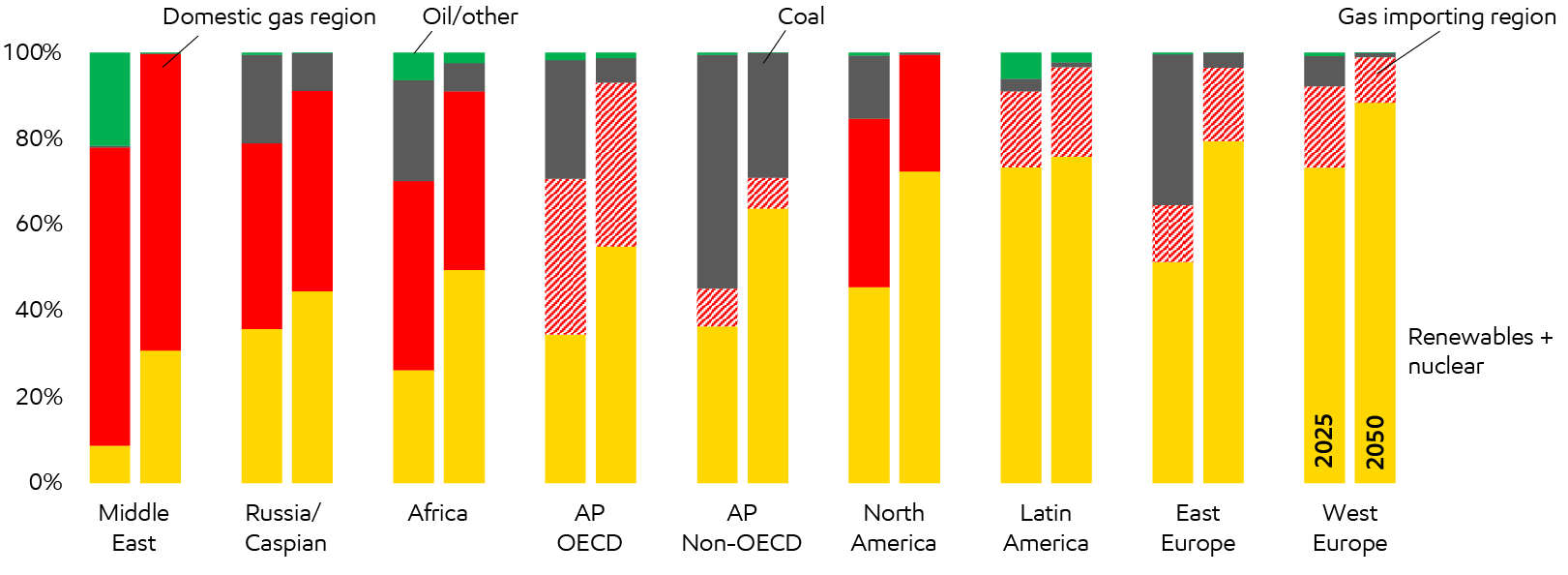
There are significant regional variations in how power is generated, now and through 2050. These differences are driven by regional variables including resource endowments for gas, coal, and renewable energy (e.g., wind, solar, hydro); economics; policy; and energy security.
While renewables grow in all regions, gas maintains a larger share of the power mix in regions with abundant domestic gas supplies. On the other hand, regions that rely on imported fuels are projected to see stronger renewables growth along with sustained coal use.
Spotlight: The role of data centers in U.S. power demand growth
U.S. power demand
K TWh
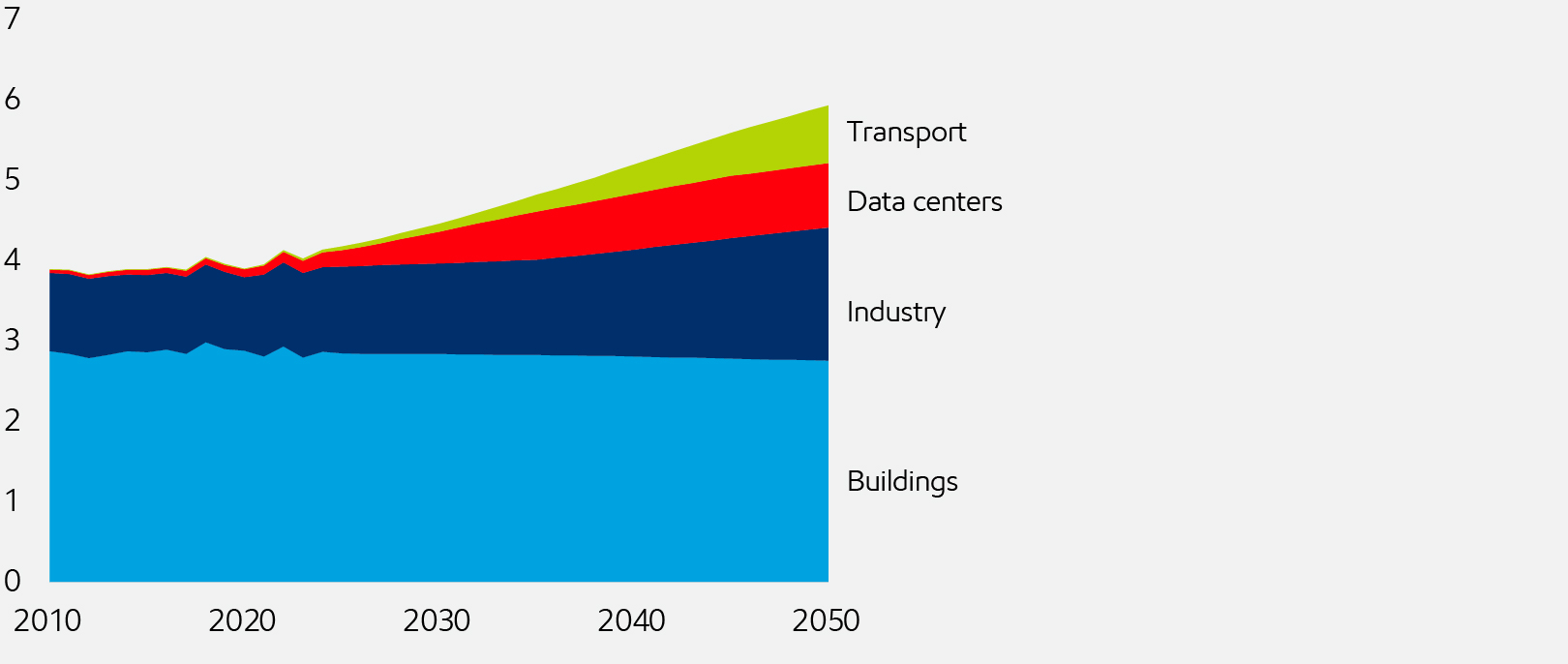
In the U.S., electricity demand is beginning to rise after remaining approximately flat for nearly two decades. By 2050, our Outlook projects that U.S. electricity demand will increase by more than 40% vs. 2025 levels. This demand growth will be driven by a range of factors, and it will also vary significantly by region within the U.S.
Industry and transportation are projected to account for ~2/3 of U.S. electricity demand growth, mirroring global trends.
Electricity demand for buildings (both residential and commercial, excluding data centers) is projected to remain at approximately 2025 levels through 2050. While the total number of residential and commercial buildings is projected to continue to grow with population and economic activity, this is offset by continued efficiency improvements and by shifting commercial building use cases. For example, with the growth of online retail, commercial floor space is increasingly shifting toward warehouses, which have ~50% the energy intensity of the average U.S. commercial building.
Wide range of data center demand outlooks
K TWh
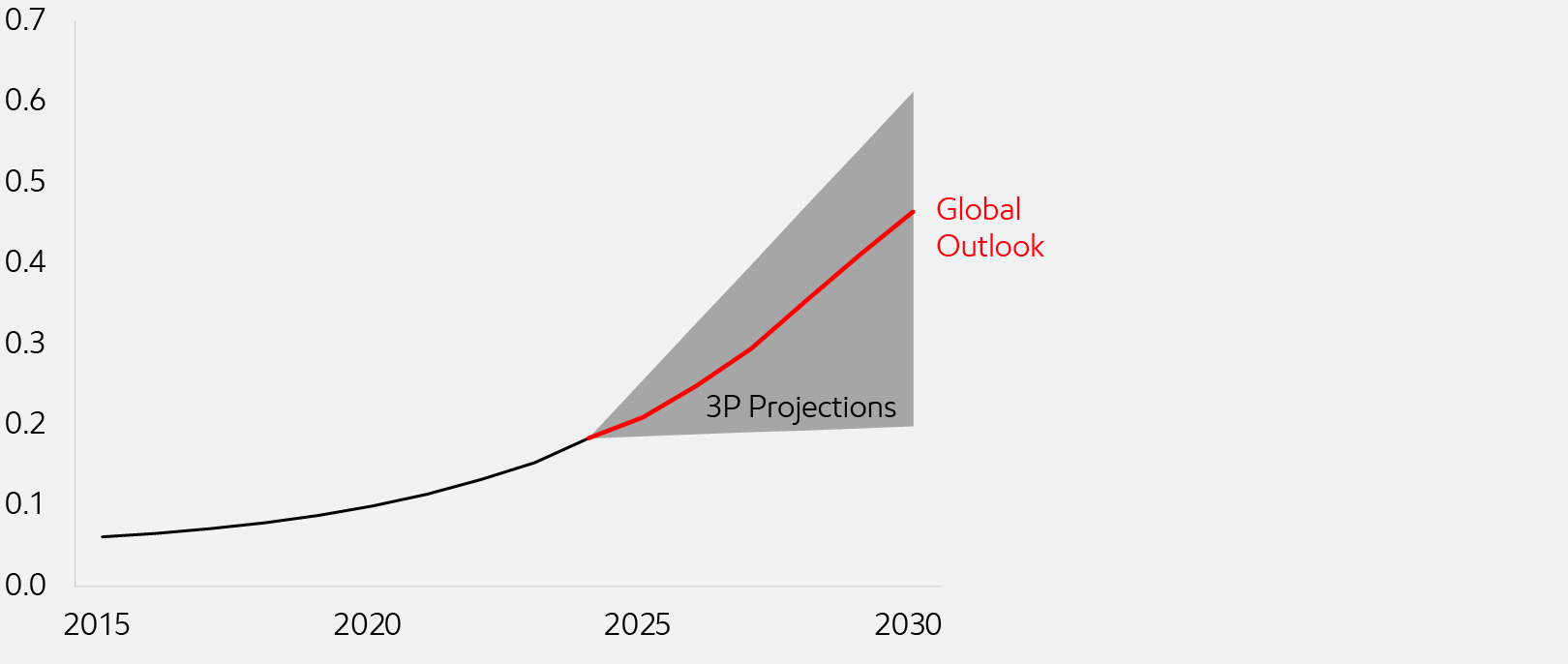
Sources: BNEF, LBNL, JP Morgan, EPRI, IEA, McKinsey, Goldman Sachs
While AI-driven data center growth is expected to be a key factor driving electricity demand growth in the U.S., there is significant uncertainty on how quickly this power demand will increase, in both the medium and longer term. Key drivers for the near to medium term uncertainty include access to power (incl. gas turbines), grid interconnection, local land-use constraints, availability of skilled labor, construction timelines, and potential for phased startups. Over the longer term, AI-driven data center power demand will be characterized by a balance between continued improvements in chip efficiency and the growth of demand for AI-driven tools across the economy.
-
Industry and commercial transportation drive economic growth
Learn more- Industry and manufacturing are critical to the global economy and modern living standards.
- Global commerce relies on efficiently moving goods and services across and between continents.
-
CO2 emissions projected to fall 20% by 2050, but more progress is needed
Learn more- Efficiency improvements and renewables are necessary but not a complete solution.
- Technologies like hydrogen, carbon capture and storage, and biofuels have yet to reach their full potential but are needed to reduce emissions on a global scale.
Global Outlook
Explore more






Cautionary statement
The Global Outlook includes ExxonMobil Holdings Corporation’s internal estimates of both historical levels and projections of challenging topics such as global energy demand, supply, and trends through 2050 based upon internal data and analyses as well as publicly available information from many external sources including the International Energy Agency. Separate from ExxonMobil’s analysis, we discuss a number of third-party scenarios such as the Intergovernmental Panel on Climate Change Likely Below 2°C and the International Energy Agency scenarios. Third-party scenarios discussed in this report reflect the modeling assumptions and outputs of their respective authors, not ExxonMobil, and their use and inclusion herein is not an endorsement by ExxonMobil of their results, likelihood, or probability. Work on the Outlook and report was conducted during 2025 and 2026. The report contains forward-looking statements, including projections, targets, expectations, estimates, and assumptions of future behaviors. Actual future conditions and results (including but not limited to energy demand, energy supply, the growth of energy demand and supply, the impact of new technologies, the relative mix of energy across sources, economic sectors and geographic regions, imports and exports of energy, emissions, and plans to reduce emissions) could differ materially due to changes in a number of factors, including: economic conditions, the ability to scale new technologies on a cost-effective basis, unexpected technological developments, the development of new supply sources, changes in law or government policy, political events, demographic changes and migration patterns, trade patterns, trade tariffs and trade sanctions, the development and enforcement of global, regional or national mandates, changes in consumer preferences, escalating geopolitical volatility, including regime changes, war, civil unrest, and other political or security disturbances, including disruption of land or sea transportation routes, decoupling of economies, realignment of global trade and supply chain networks, and disruptions in military alliances and other factors discussed herein and under the heading “Factors Affecting Future Results” in the Investors section of our website at https://corporate.exxonmobil.com/.
The Outlook was published in September 2026. ExxonMobil assumes no duty to update these statements or materials as of any future date, and neither future distribution of this material nor the continued availability of this material in archive form on our website should be deemed to constitute an update or re-affirmation of this material as of any future date. The Global Outlook is a voluntary disclosure and is not designed to fulfill any U.S., foreign, or third party required reporting framework. This material is not to be used or reproduced without the express written permission of ExxonMobil Holdings Corporation. All rights reserved.