
Report
4 min read
• Sept. 17, 2026Introduction and insights from historic energy trends
Report
4 min read
• Sept. 17, 2026For decades, ExxonMobil has published an Outlook that describes where we see global supply and demand for energy and products headed in the future.
We employ a dedicated team of experts in energy and product markets to make projections decades ahead — in the latest version, out to the year 2050.
The Global Outlook serves multiple purposes. First and foremost, it establishes the basis for our long-term business planning. Our industry is capital intensive and long term by nature. We need to understand what the world could look like in coming decades to plan and deploy capital wisely.
Yet the Global Outlook serves a broader purpose as well. Energy and products are inseparable from modern life. Access to affordable and reliable energy drives unprecedented economic progress and improved living standards. They also contribute to global emissions. Our Global Outlook provides important insights into the economic advantages and environmental considerations that play a part in the future of energy.
This year’s Global Outlook has been developed as the world faces one of the largest energy supply shocks in history, impacting ~20% of global oil and LNG supplies, as well as a wide range of products that are essential to the global economy such as fertilizer, aluminum, and petrochemicals. These events have reemphasized the fundamental importance of reliable access to affordable energy for enabling economic growth.
While the situation continues to evolve and the full impacts of a supply shock of this magnitude will not be known for many years, we continue to learn from historic events to improve our insights and models and inform our long-term projections.
Over the last decade, world events contributed to significant shifts in energy supply, including the reemergence of the U.S. as an exporter of both oil and natural gas; Russia’s invasion of Ukraine, which significantly altered global natural gas flows; and huge growth in deployment of renewable energy. The world also experienced a global pandemic that temporarily reduced global energy demand by ~5%. Yet, over this period, the global energy mix has remained largely unchanged.
Policy priorities have also seen substantial shifts over the past decade, beginning with the 2015 Paris Agreement. More recently, many policymakers have been increasingly focused on balancing emissions reductions with the need for affordable and reliable energy that is essential for economic growth.
The global energy mix has remained largely constant in a dynamic world (2015 - 2025)
Quadrillion Btu
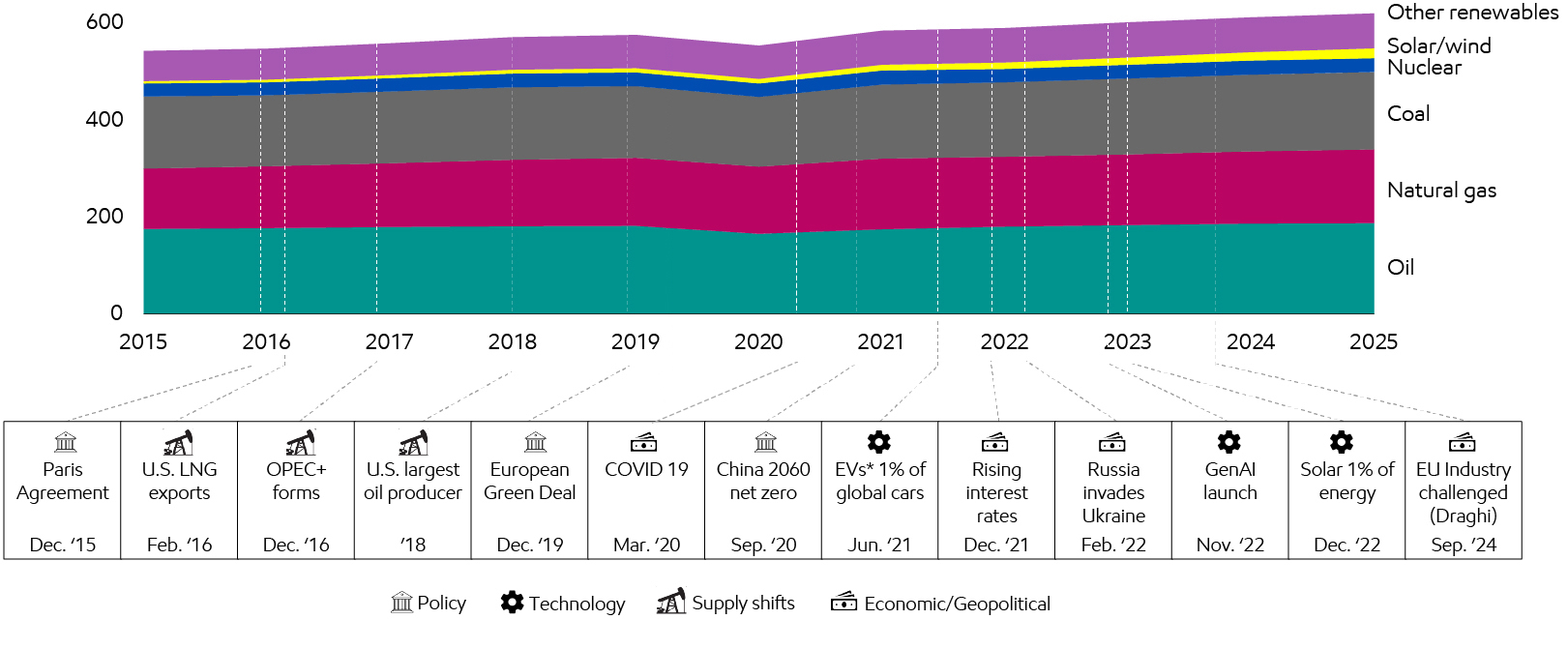
Sources: UNFCC, EIA, OPEC, EU Commission, EIA, US Federal Reserve, Grantham Institute
*EVs include Battery Electric and Plug-in hybrids
The immense scale and inertia of the energy system are evident when looking back at our 2015 Outlook. Despite major economic and geopolitical events over the past decade, impacts were largely near-term or localized and had only a modest effect on the long-term projections. While our 2015 Outlook was not perfect, it provided a sound basis for our strategies and plans through a decade of enormous change.
Energy trends over the past decade validate our 2015 Outlook
Quadrillion Btu
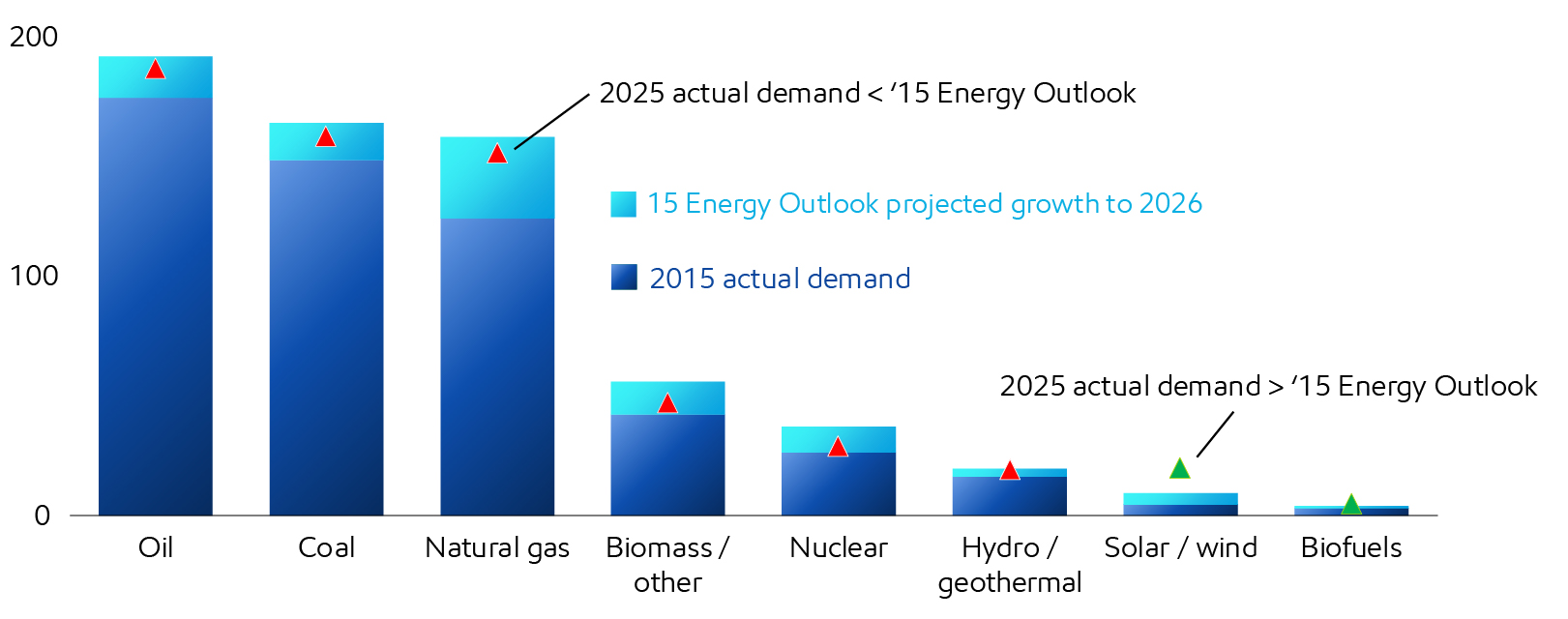
’15 Energy Outlook refers to ExxonMobil’s 2015 Energy Outlook
2025 actual demand is an estimate and may be revised as full country reporting lags 12-18 months
See “About the ExxonMobil Global Outlook” for history data sources
Over the longer term, we see that every source of energy has seen growth in absolute terms for more than 200 years, even as technological advancements have driven significant shifts in their relative share of the energy mix.
All energy types have grown for more than 200 years
Quadrillion Btu
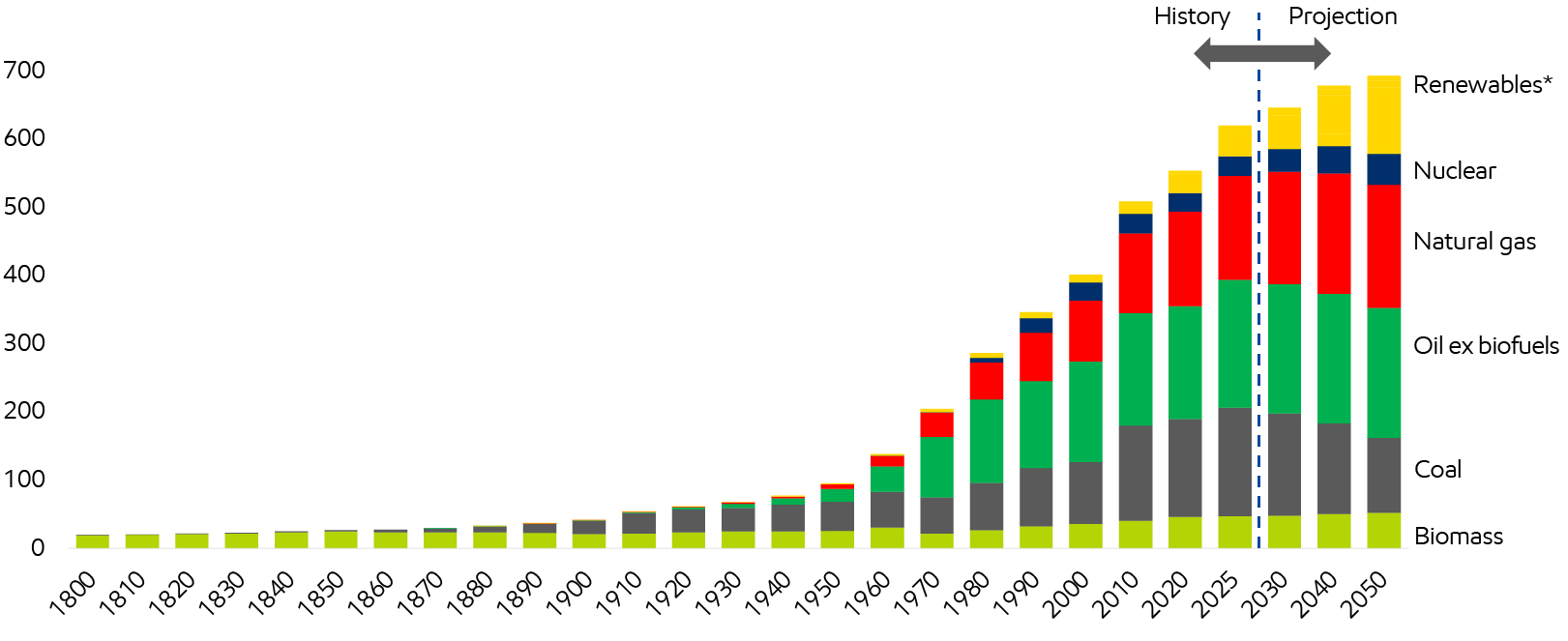
Sources: Smil, Energy Transitions (1900-1960), 2026 ExxonMobil Global Outlook (1970-2050)
*includes liquid biofuels
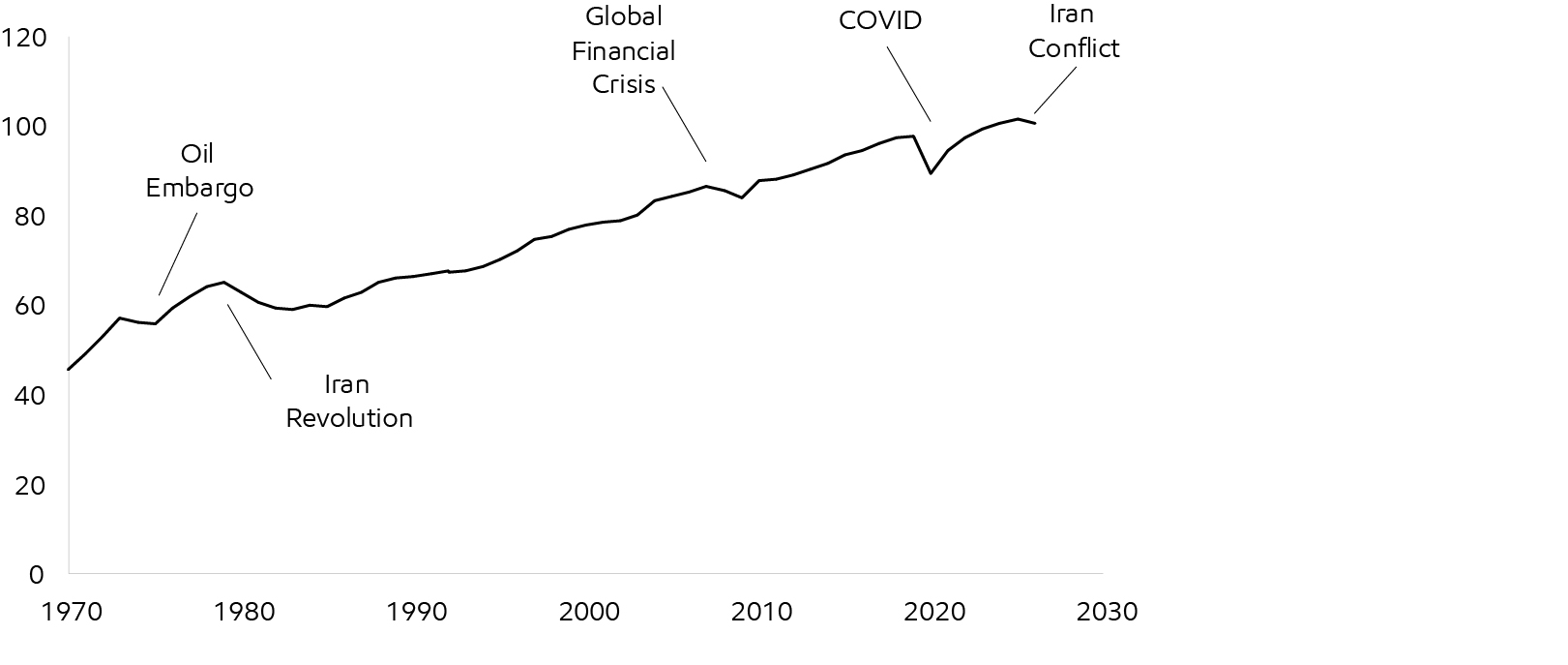
Within these longer-term trends, both technology improvements and economic events have led to temporary shifts in demand. For example, the twin oil supply shocks of 1973 and 1978/79 led to a structural shift in oil demand, as high oil prices slowed economic growth and in the longer term drove significant efficiency improvements. However, from the mid-1980s through 2025 global oil demand continued to rise at an average of ~1 million barrels per day per year.
Global oil demand
Million barrels per day
Growing global population and prosperity have been the biggest factors driving increased demand for energy and products. There has also been substantial variability in income and energy growth across different regions. In the wealthier OECD economies, per capita energy demand grew until the early 2000s, after which technological efficiency improvements, improving productivity, and shifting economic patterns (e.g., the growing share of the service sector) have allowed average per capita energy demand to decline ~20% over the past 25 years — even as incomes continue to rise.
Energy consumption per person vs. income (1970 – 2025)
MMBtu per person
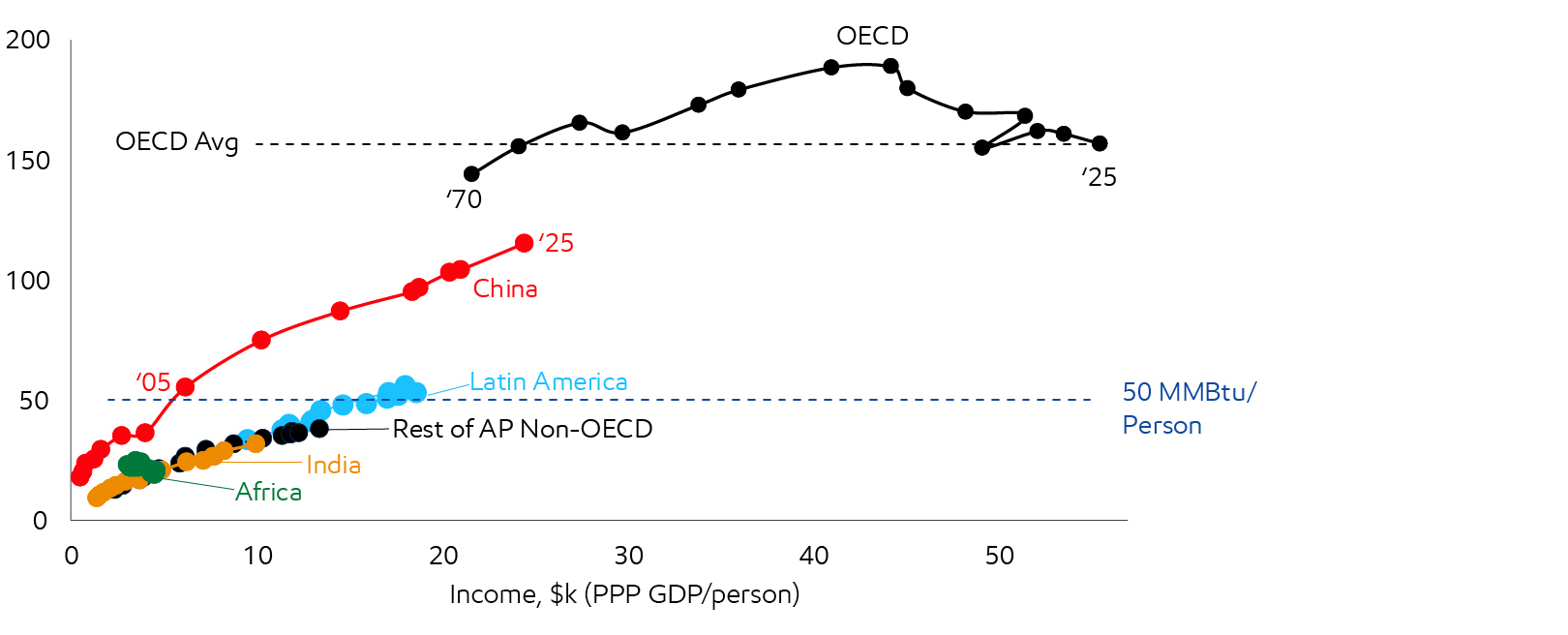
In the Non-OECD, energy demand continues to rise with economic growth; however, outside of China per capita energy demand remains <1/3 the level of the OECD while average incomes are ~4x lower. Growing energy demand in the Non-OECD is driven by increasing economic activity, including manufacturing and transport of the products essential for modern living.
Given the uncertainty inherent in any projection, we consider a range of sensitivities and scenarios — including those we view as remote — to help inform strategic thinking. No future projection could exactly predict every new government policy, its effectiveness, or its unintended consequences. Similarly, the pace of technology advancements and extent of public support for more expensive lower-emission solutions can influence how quickly or cost-effectively different energy pathways might develop.
The projections at the heart of the Global Outlook represent our most likely view of the world in 2050. It is scientifically grounded, based on our detailed analysis of a variety of data sources and long-term assessments of market fundamentals, economic trends, technology advancements, consumer behavior and climate-related public policy and other government policies. It is not an endorsement of a particular outcome, nor is it advocating for what ExxonMobil hopes will happen.
We make the Global Outlook publicly available because we feel it is an important contribution to a wide range of policy discussions — about energy, about economic development, and about the environment. By offering a clear-eyed, thoughtful view, the Outlook can enhance those discussions and — hopefully — lead to better policy outcomes.
-
Download the Global Outlook executive summary
Download the summary -
Developing countries projected to use 25% more energy as living standards improve
Learn more
Global Outlook
Explore more




Cautionary statement
The Global Outlook includes ExxonMobil Holdings Corporation’s internal estimates of both historical levels and projections of challenging topics such as global energy demand, supply, and trends through 2050 based upon internal data and analyses as well as publicly available information from many external sources including the International Energy Agency. Separate from ExxonMobil’s analysis, we discuss a number of third-party scenarios such as the Intergovernmental Panel on Climate Change Likely Below 2°C and the International Energy Agency scenarios. Third-party scenarios discussed in this report reflect the modeling assumptions and outputs of their respective authors, not ExxonMobil, and their use and inclusion herein is not an endorsement by ExxonMobil of their results, likelihood, or probability. Work on the Outlook and report was conducted during 2025 and 2026. The report contains forward-looking statements, including projections, targets, expectations, estimates, and assumptions of future behaviors. Actual future conditions and results (including but not limited to energy demand, energy supply, the growth of energy demand and supply, the impact of new technologies, the relative mix of energy across sources, economic sectors and geographic regions, imports and exports of energy, emissions, and plans to reduce emissions) could differ materially due to changes in a number of factors, including: economic conditions, the ability to scale new technologies on a cost-effective basis, unexpected technological developments, the development of new supply sources, changes in law or government policy, political events, demographic changes and migration patterns, trade patterns, trade tariffs and trade sanctions, the development and enforcement of global, regional or national mandates, changes in consumer preferences, escalating geopolitical volatility, including regime changes, war, civil unrest, and other political or security disturbances, including disruption of land or sea transportation routes, decoupling of economies, realignment of global trade and supply chain networks, and disruptions in military alliances and other factors discussed herein and under the heading “Factors Affecting Future Results” in the Investors section of our website at https://corporate.exxonmobil.com/.
The Outlook was published in September 2026. ExxonMobil assumes no duty to update these statements or materials as of any future date, and neither future distribution of this material nor the continued availability of this material in archive form on our website should be deemed to constitute an update or re-affirmation of this material as of any future date. The Global Outlook is a voluntary disclosure and is not designed to fulfill any U.S., foreign, or third party required reporting framework. This material is not to be used or reproduced without the express written permission of ExxonMobil Holdings Corporation. All rights reserved.