
Report
4 min read
• Sept. 17, 2026Developing countries projected to use 25% more energy as living standards improve
- >4 billion people currently live in countries where access to energy is below what is needed to address basic human development needs.
- Access to sufficient, affordable energy enables economic development.
- Efficiency gains from new technology help slow the growth of energy use from rising prosperity and a growing population.
Report
4 min read
• Sept. 17, 2026In 2050, more people and growing economies will drive higher demand for the energy sources that enable modern living, even as efficiency gains enable per capita energy use to decline in developed economies.
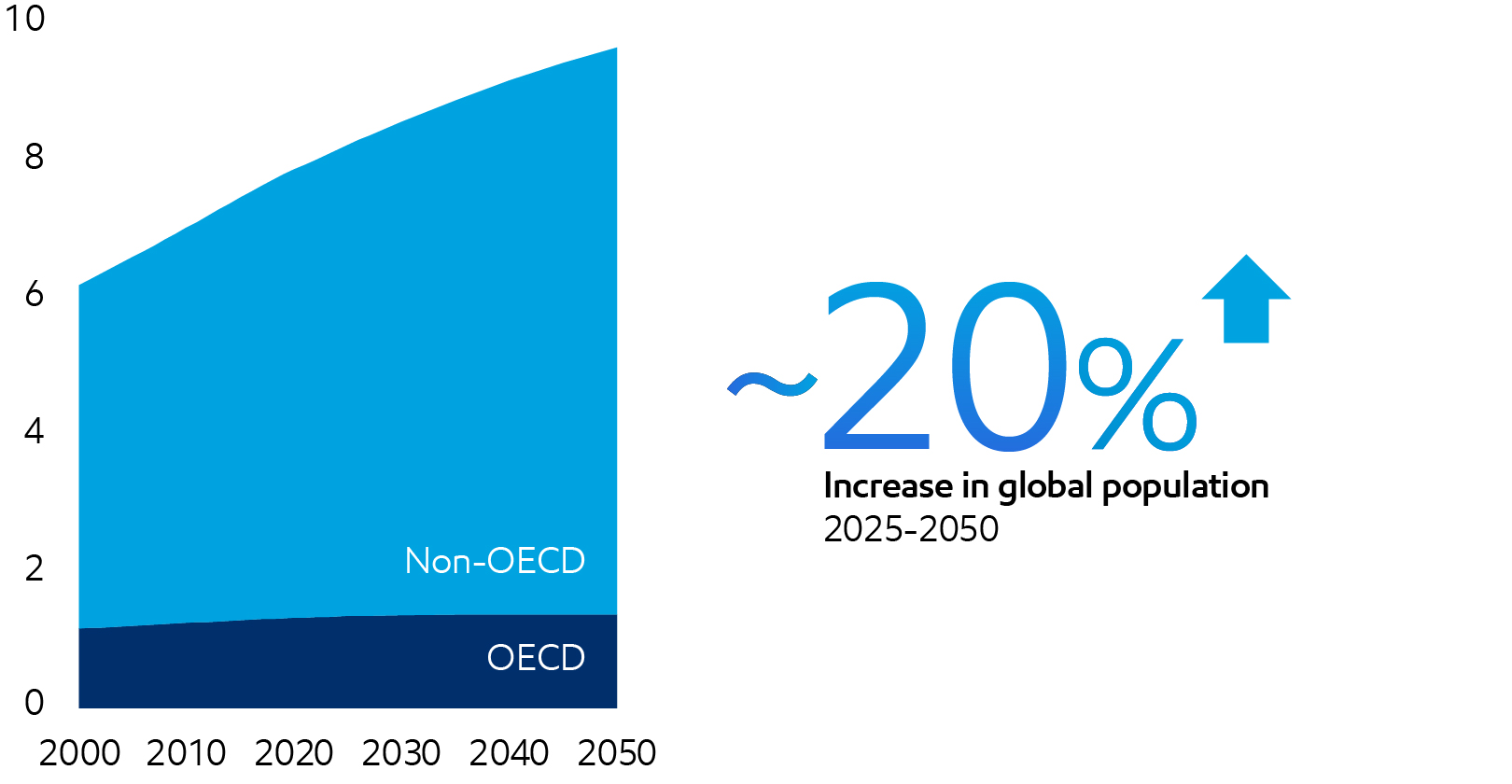
Population
Billions
Source: ExxonMobil analysis
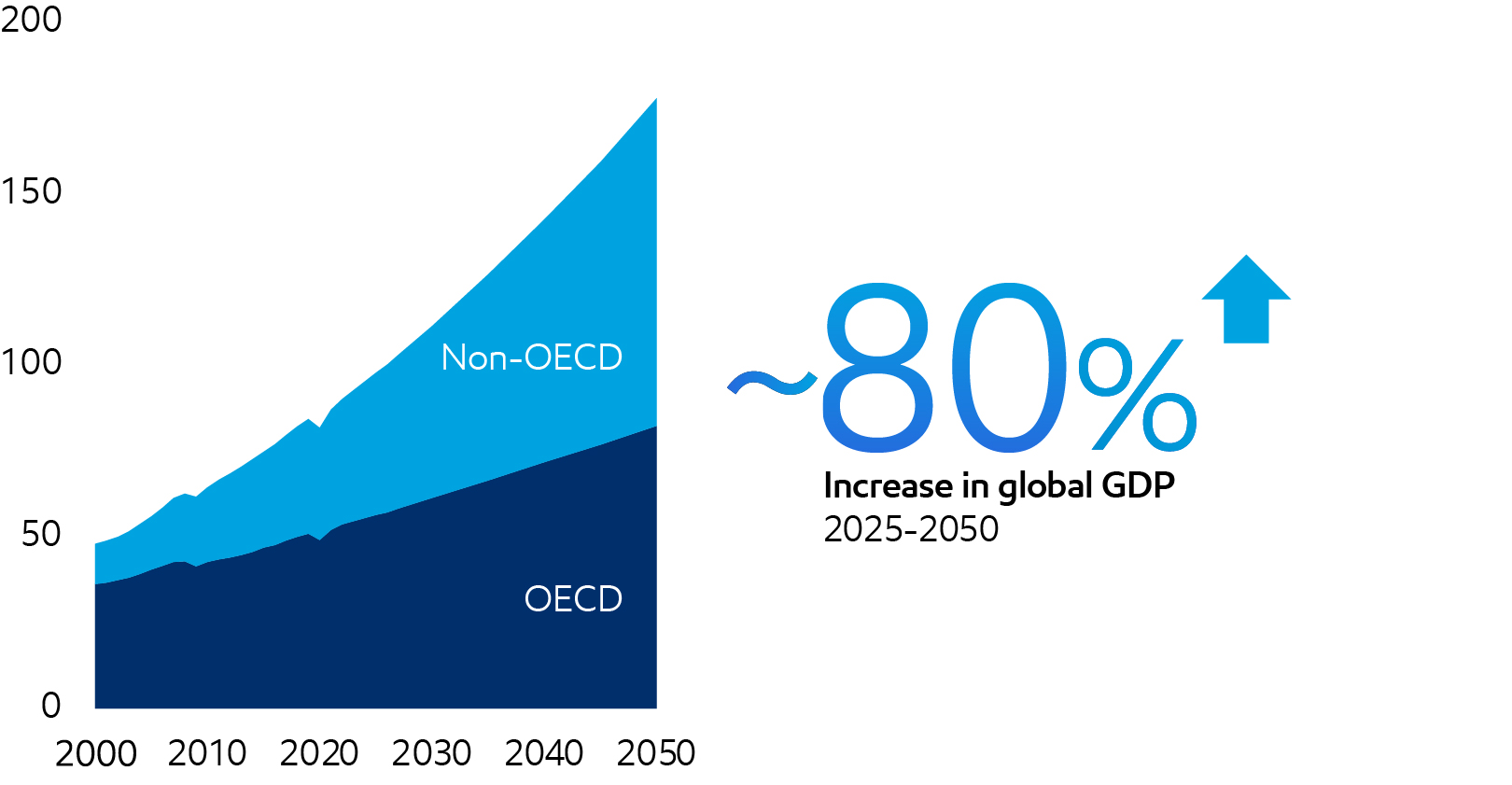
GDP
Trillions 2015$
The global population is projected to rise by ~1.5 billion people by 2050, a ~20% increase from today. Nearly all that growth will occur in developing countries.
Over that same period, global gross domestic product (GDP) is projected to grow ~80%, with developing nations growing twice as fast as developed nations. By 2050, developing countries will account for more than half of global GDP, up from ~40% today.
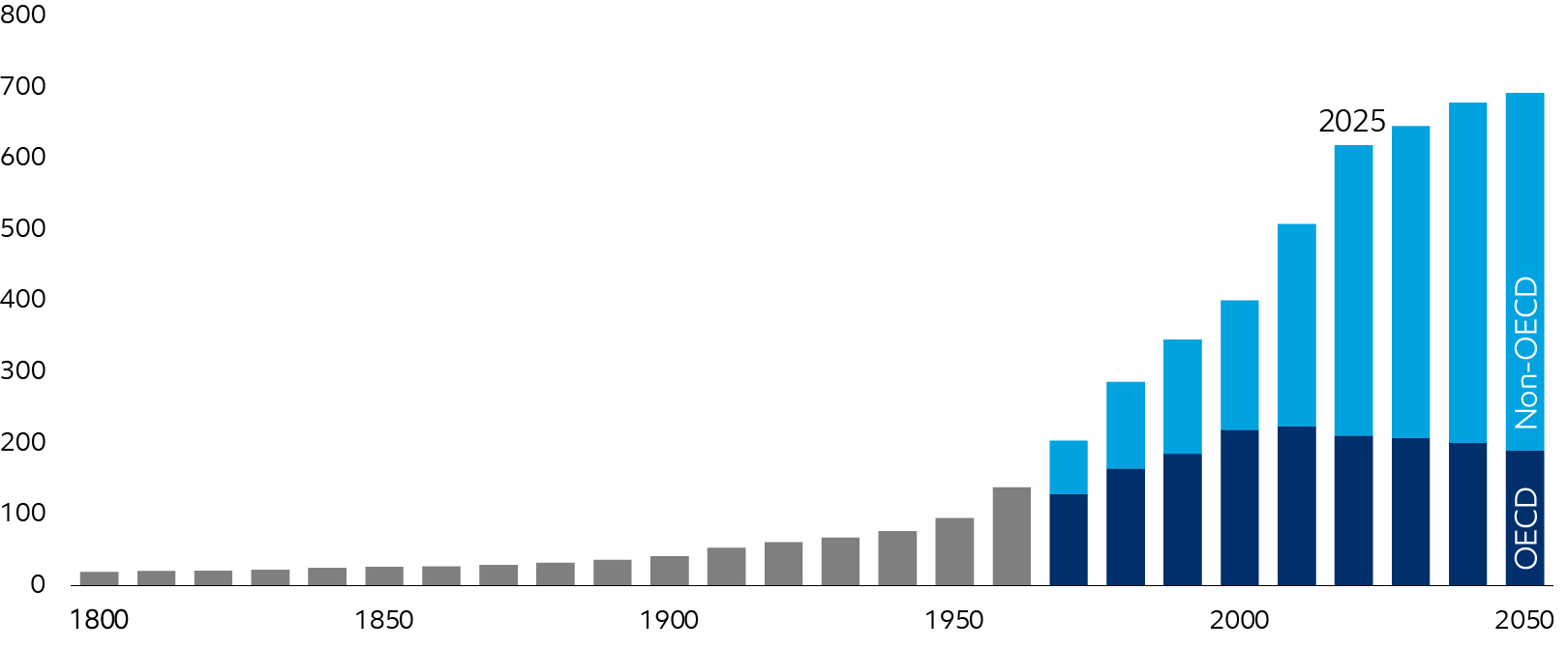
The combination of 1.5 billion more people and a global economy that is projected to grow by ~80% drives ~25% higher energy use in developing countries in 2050 versus today.
Global energy demand
Quadrillion Btu
Sources: Smil, Energy Transitions (1900-1960), 2026 ExxonMobil Global Outlook (1970-2050)
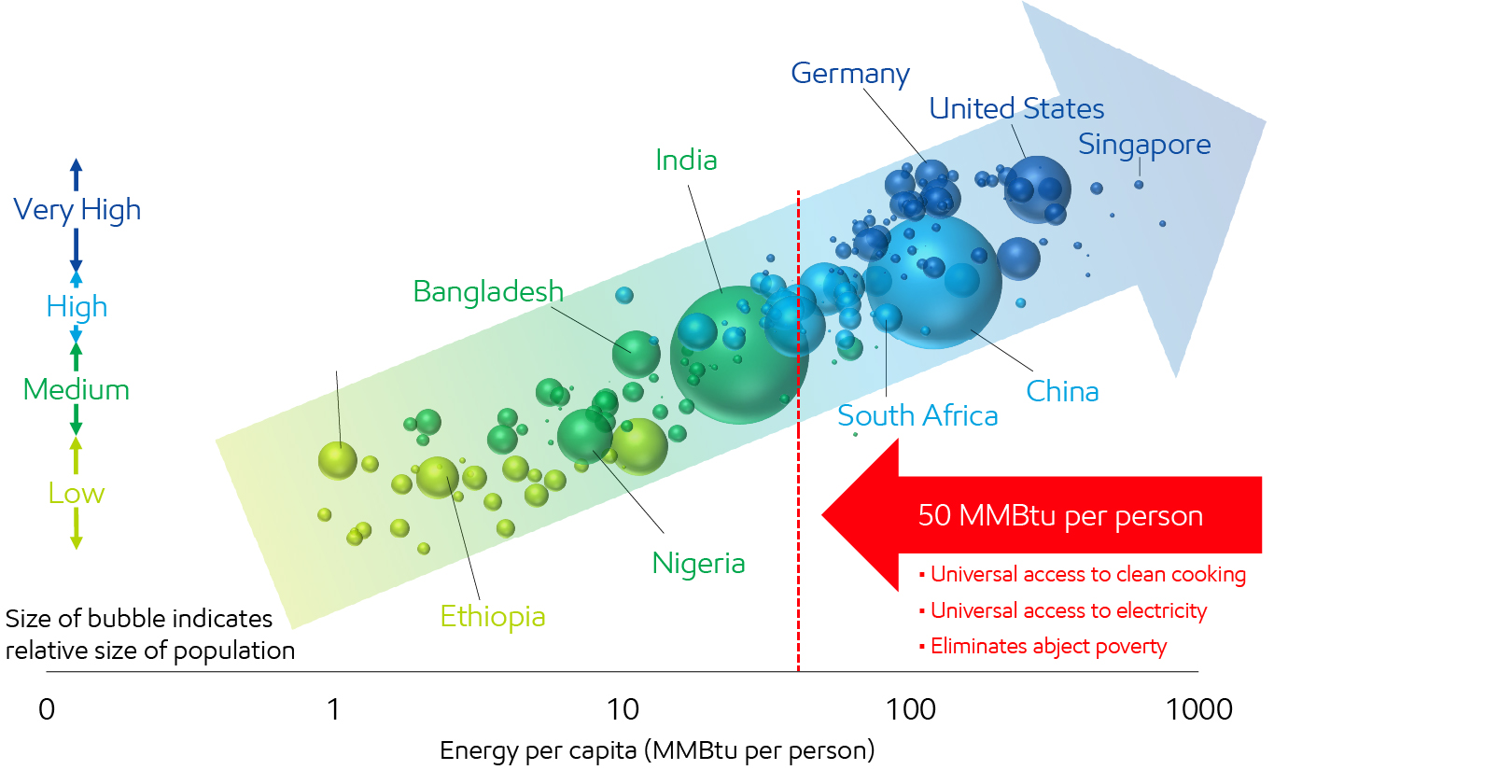
Energy use and improved living standards go hand in hand. It is impossible to have one without the other. Data from the United Nations Human Development Index (U.N. HDI) shows that countries with higher energy use tend to have higher life expectancies, education levels, and income per person. Rising energy use fuels higher incomes that enable people to own homes, purchase labor- and time-saving appliances, travel, and obtain needed medical services.
Energy improves quality of life
U.N. Human Development Index, 2023
Sources: U.N. Human Development Reports, EIA, ExxonMobil analysis
The U.N. HDI data show us that the opposite is also true: A lack of access to affordable, reliable energy means diminished living standards.
Our analysis estimates that basic living standards require at least 50 million British thermal units (MMBtu) per person per year. To put that in perspective, developed countries around the world, on average, use more than three times that amount, about 160 MMBtu per person, with ~75% of this energy going toward manufacturing, business, and commercial transportation.
Energy use
MMBtu per person per year
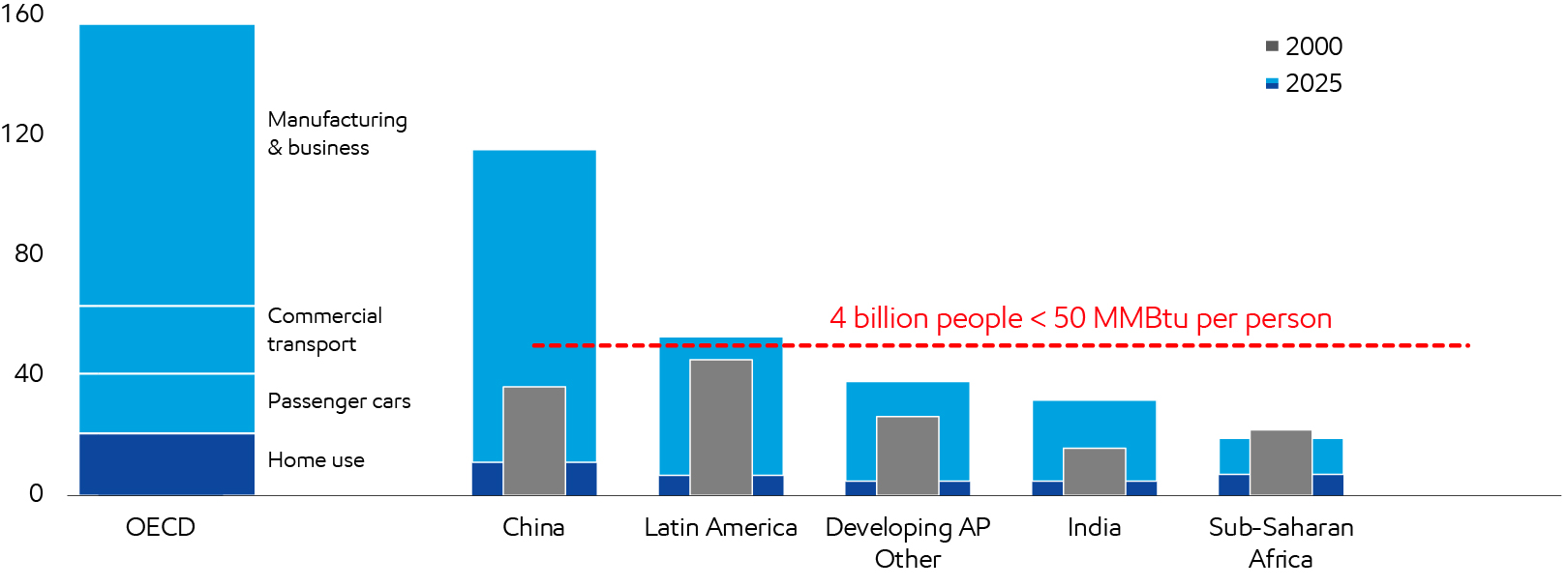
Based on our analysis, and the U.N. HDI data, we determined that >4 billion people live in countries where access to energy is below what is needed to support basic human development, including access to housing, infrastructure, jobs, and mobility.
For example, today in countries with limited access to energy, cooking often involves burning wood, coal, or kerosene indoors. According to the World Health Organization (WHO, Household air pollution), ~3 million people die every year from indoor air pollution, largely associated with burning these fuels. It isn’t until a country has access to reliable and affordable energy that households also get access to clean cooking fuels such as electricity or natural gas.
Comparison to third-party analyses of minimum energy needs
Many prominent third-party analyses of minimum energy needs focus more narrowly on electricity and/or household use. As a result, they tend to report lower per capita energy needs than our Global Outlook, which takes a comprehensive view and considers the total energy needed. Notably, electricity makes up only about 20% of the world’s total energy consumption, with the majority of energy demand being driven by the hard-to-electrify industry and commercial transportation sectors.
Commonly cited thresholds for electricity poverty include:
- The Energy for Growth Hub (Moss et al., 2021) has identified 1,000 kWh per person per year as the electricity consumption needed to support modern living standards. 75% of that is consumed in the wider economy, outside of households. Despite its narrower focus, the analysis of Energy for Growth Hub provides a similar insight as our analysis: >4 billion people around the world live in countries where per capita energy and electricity use is less than needed to meet basic human development needs.
- The United Nations Sustainable Development Goal 7.1 limits its focus to household “access to electricity,” defined by the International Energy Agency (IEA) as at least 50-100 kWh per household per year. It does not consider the broader energy needs outside the home. To put this in context, 50-100 kWh per household per year is sufficient to provide about four hours of electricity per day with a system capable of running basic devices such as lights and phone chargers (IEA, 2025). While access to electricity is a necessary and important first step to addressing energy poverty, this minimum threshold of 50-100 kWh per household per year is less than 1% of the total amount of energy that is needed to address basic human development needs, based on our analysis.
Even though developing countries are expected to use significantly more energy through 2050, we predict that total worldwide energy growth will slow as efficiency improves. From 2000 to 2010, total global energy demand grew by nearly 30%. In the past decade, energy demand grew by ~15%. Between 2040 and 2050, we project energy demand will grow by ~2%. Because technology will become more efficient, we expect the next decade will be the first time in history where the world will see expanding economic growth, with lower per capita energy demand.
Energy per capita
MMBtu per person
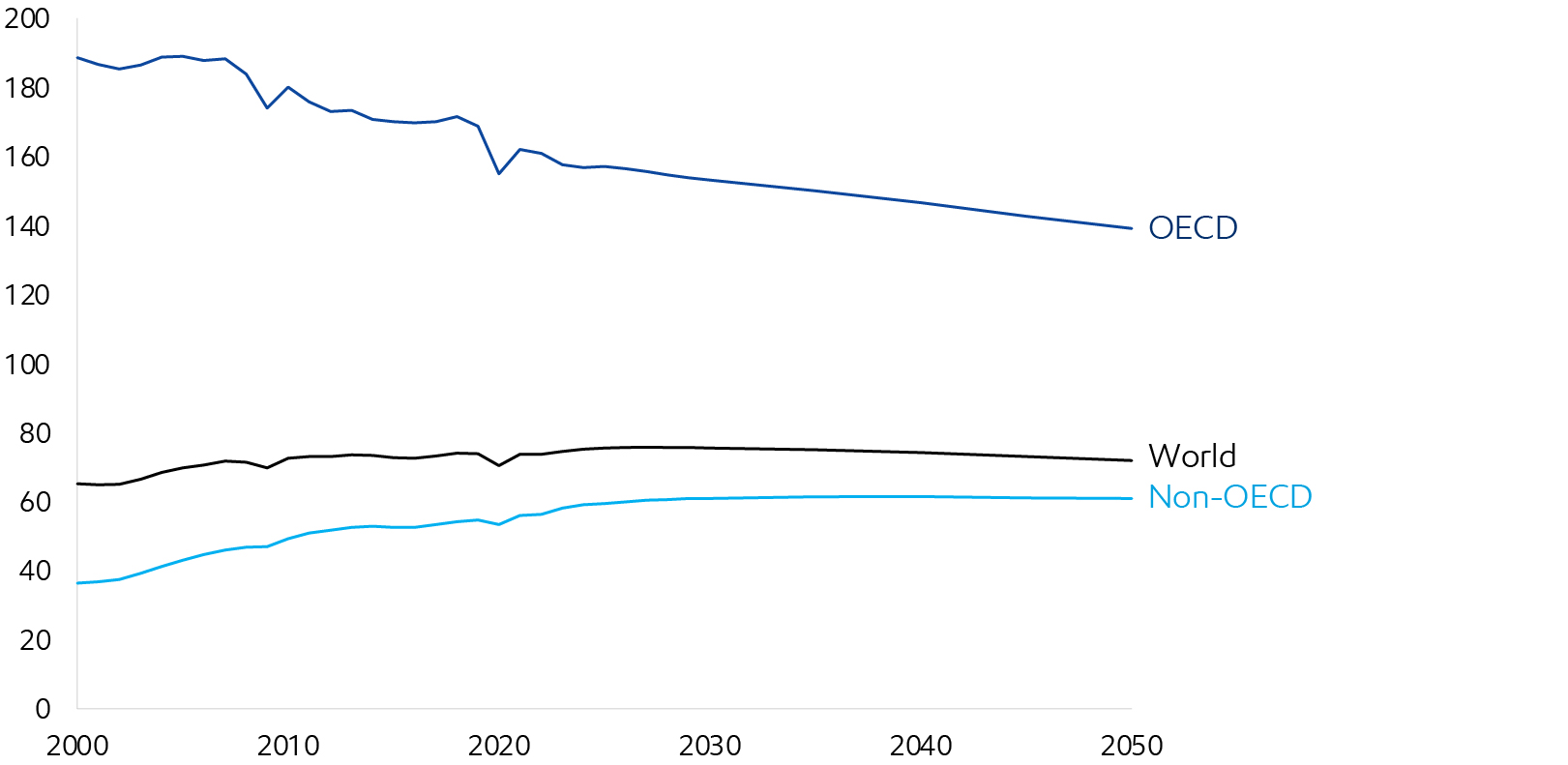
However, our Outlook also projects limited growth in per capita energy demand in developing countries, even as overall energy demand in developing countries grows by 25%.
Sensitivity: How much energy would the world need for all countries to achieve basic living standards (50 MMBtu per person) in 2050? Even with the significant projected efficiency gains, we estimate that providing the energy needed for the developing world to universally achieve basic living standards would require nearly 20% more energy in 2050 than our Global Outlook projects.
-
Introduction and insights from historic energy trends
Learn moreOur Global Outlook provides important insights on the economic advantages and environmental considerations that play a part in the future of energy.
-
Industry and commercial transportation drive economic growth
Learn moreThese sectors, which make up ~65% of global energy use, have unique needs that cannot be fully replaced with electricity or renewables.
Global Outlook
Explore more



Cautionary statement
The Global Outlook includes ExxonMobil Holdings Corporation’s internal estimates of both historical levels and projections of challenging topics such as global energy demand, supply, and trends through 2050 based upon internal data and analyses as well as publicly available information from many external sources including the International Energy Agency. Separate from ExxonMobil’s analysis, we discuss a number of third-party scenarios such as the Intergovernmental Panel on Climate Change Likely Below 2°C and the International Energy Agency scenarios. Third-party scenarios discussed in this report reflect the modeling assumptions and outputs of their respective authors, not ExxonMobil, and their use and inclusion herein is not an endorsement by ExxonMobil of their results, likelihood, or probability. Work on the Outlook and report was conducted during 2025 and 2026. The report contains forward-looking statements, including projections, targets, expectations, estimates, and assumptions of future behaviors. Actual future conditions and results (including but not limited to energy demand, energy supply, the growth of energy demand and supply, the impact of new technologies, the relative mix of energy across sources, economic sectors and geographic regions, imports and exports of energy, emissions, and plans to reduce emissions) could differ materially due to changes in a number of factors, including: economic conditions, the ability to scale new technologies on a cost-effective basis, unexpected technological developments, the development of new supply sources, changes in law or government policy, political events, demographic changes and migration patterns, trade patterns, trade tariffs and trade sanctions, the development and enforcement of global, regional or national mandates, changes in consumer preferences, escalating geopolitical volatility, including regime changes, war, civil unrest, and other political or security disturbances, including disruption of land or sea transportation routes, decoupling of economies, realignment of global trade and supply chain networks, and disruptions in military alliances and other factors discussed herein and under the heading “Factors Affecting Future Results” in the Investors section of our website at https://corporate.exxonmobil.com/.
The Outlook was published in September 2026. ExxonMobil assumes no duty to update these statements or materials as of any future date, and neither future distribution of this material nor the continued availability of this material in archive form on our website should be deemed to constitute an update or re-affirmation of this material as of any future date. The Global Outlook is a voluntary disclosure and is not designed to fulfill any U.S., foreign, or third party required reporting framework. This material is not to be used or reproduced without the express written permission of ExxonMobil Holdings Corporation. All rights reserved.