
Report
4 min read
• Sept. 17, 2026Industry and commercial transportation drive economic growth
- Industry and manufacturing are critical to the global economy and modern living standards.
- Global commerce relies on efficiently moving goods and services across and between continents.
- These sectors, which make up ~65% of global energy use, have unique needs that cannot be fully met with electricity or renewables.
Report
4 min read
• Sept. 17, 2026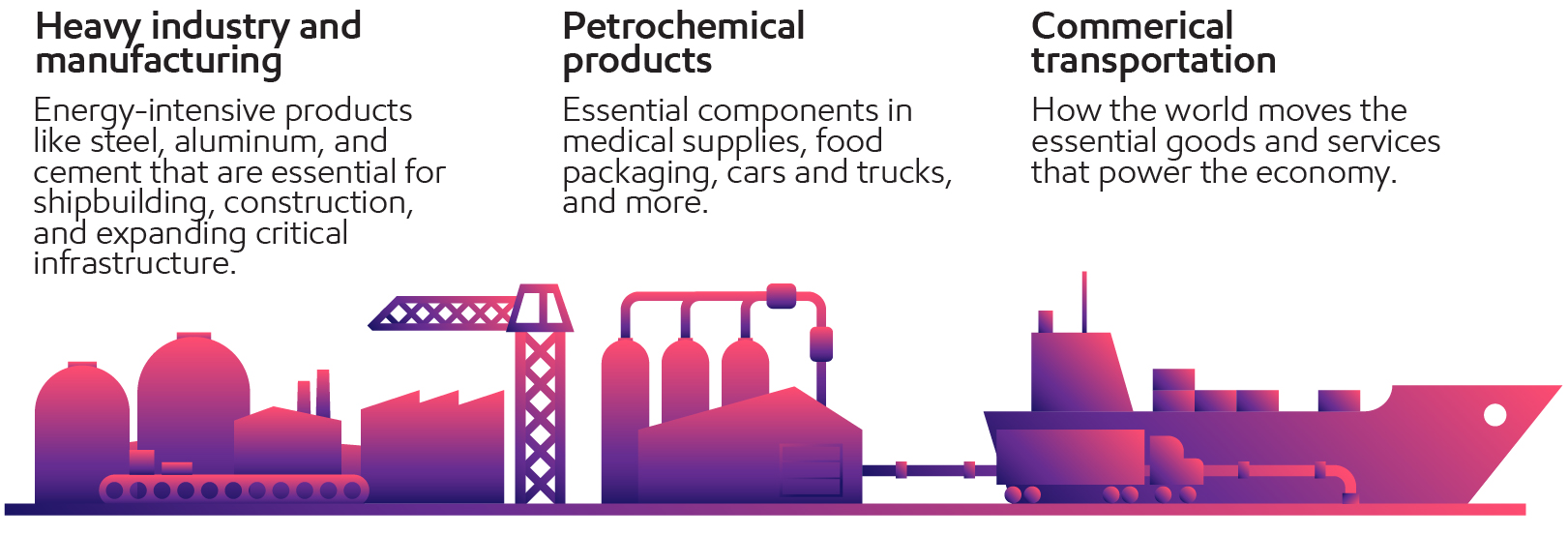
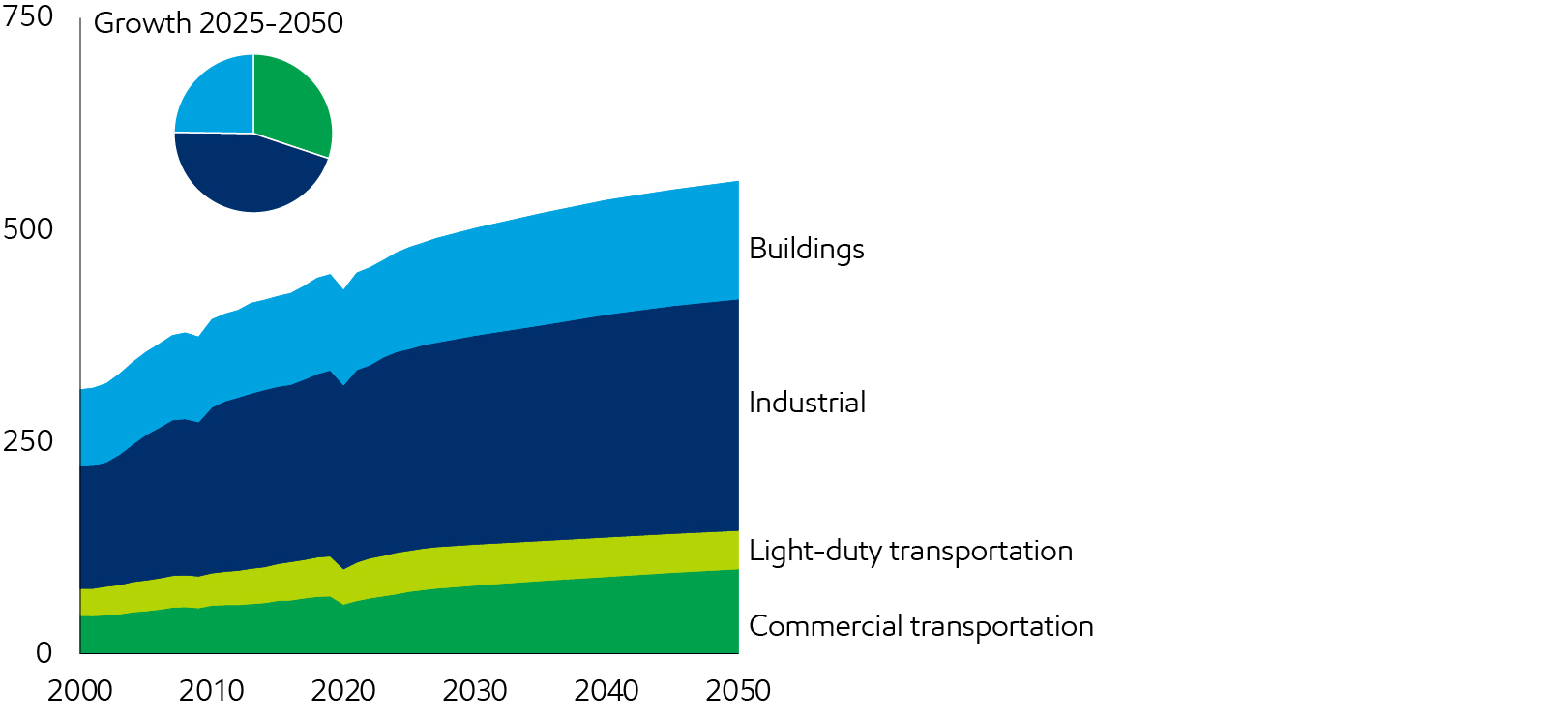
Today, industry and manufacturing make up 40% of the global economy (World Bank Development Indicators) and account for ~50% of energy use (including their share of electricity). When we add the energy required to move goods and services between producers and consumers through commercial transportation, these sectors account for ~65% of global energy use today.
End-use energy demand by sector
Quadrillion Btu
Industry
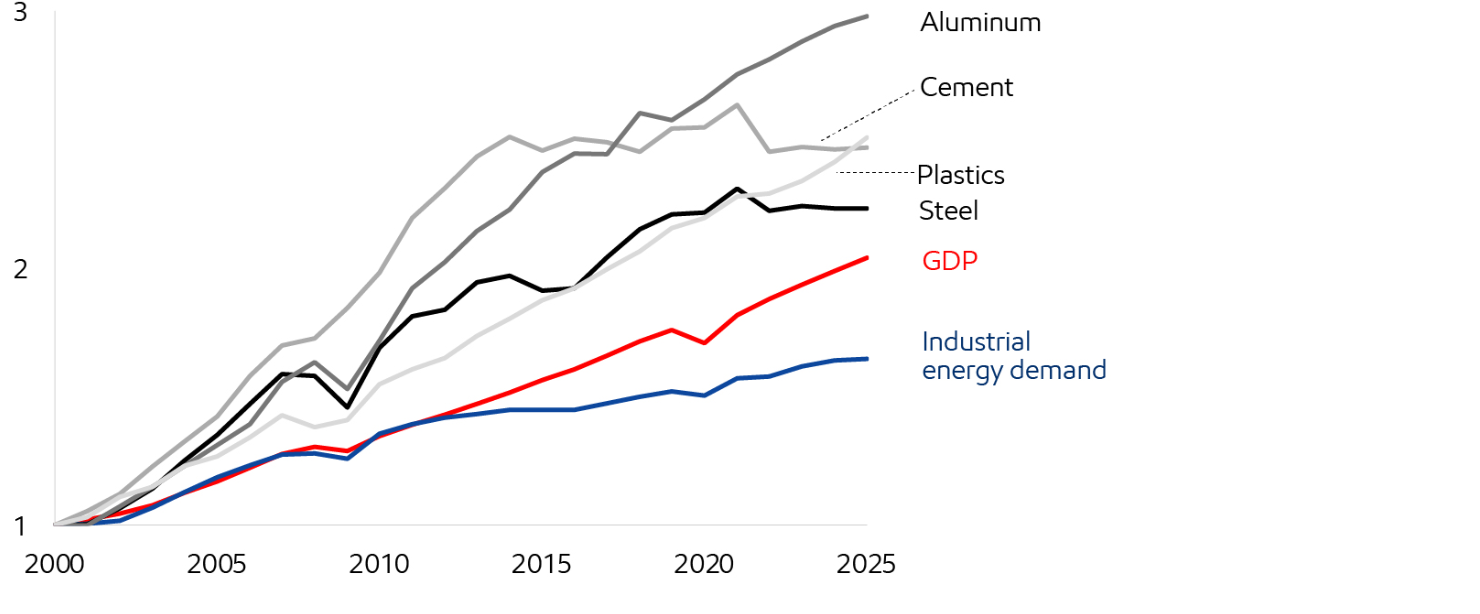
With the rise in living standards, demand for the industrial products that enable modern living has grown enormously in recent decades.
Global industrial production
Indexed to 2000
Source: ExxonMobil analysis
These industrial products provide materials that are critical to modern economies and quality of life:
- Plastics are used in medical supplies, food storage, vehicles, and many household goods.
- Cement is needed to build roads, dams (hydropower), buildings, and more.
- Aluminum is used in power grids, construction, and vehicles.
- Steel is used for large-scale construction, shipping containers, trains, and ships.
Global industrial energy demand
Quadrillion Btu
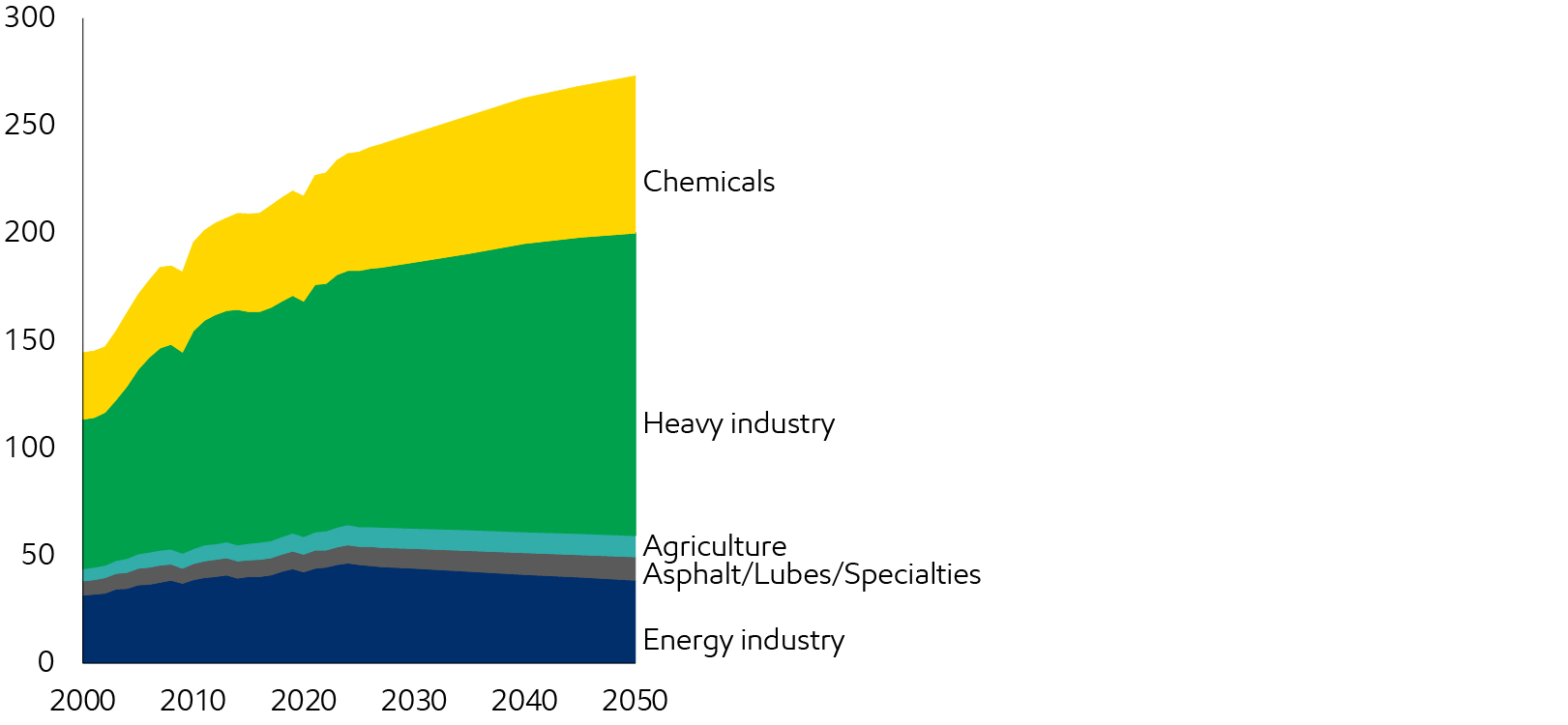
We project industrial demand for energy and feedstocks to grow by ~15% through 2050, with all of the growth coming from developing countries.
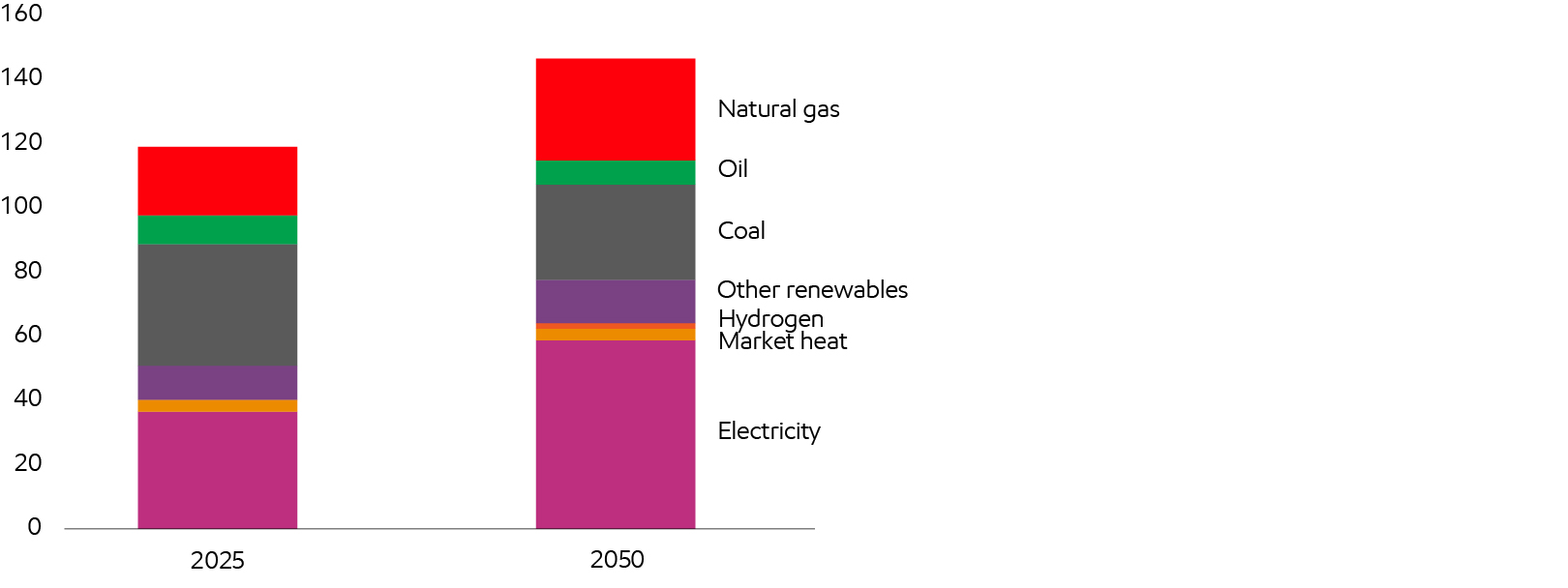
The industrial sector has unique energy needs. Industrial processes for making steel, cement, glass, and chemical production require high heat and temperatures from ~400 to >1500°C (~750 to 2700°F). Reliably and/or cost effectively producing that much heat from electricity is challenging or completely unfeasible with most current technologies (U.S. Department of Energy Liftoff Reports, 2023).
For example, electric arc furnaces provide a viable option for recycling steel; however, producing new steel from raw materials continues to rely on blast furnaces. Other sectors such as chemicals and glass do not currently have viable commercialized technologies for electrification (U.S. Department of Energy Liftoff Reports, 2023). In these sectors, natural gas will continue to play an essential role in the cost-effective generation of high heat needed to produce a wide range of industrial goods.
Heavy industry has diverse energy needs
World – Quadrillion Btu
Excludes hydrogen products used outside of heavy industry
Source: ExxonMobil analysis
Our Outlook projects significant electrification in the industrial sector by 2050 for a wide range of processes. This includes increasing electricity use for processes that rely on low to medium heat (up to ~400°C or ~750°F) and for on-site power for manufacturing facilities.
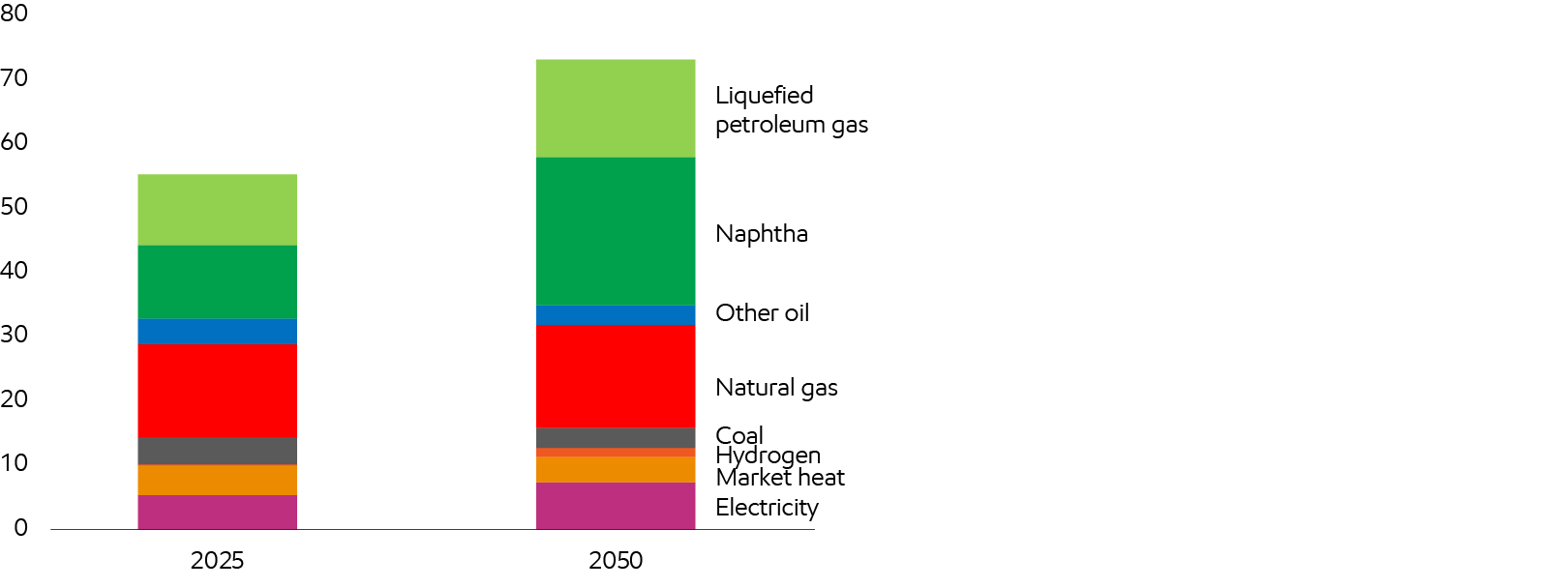
Chemicals production relies on oil and natural gas
World – Quadrillion Btu
Source: ExxonMobil analysis
The chemical industry also relies on oil and natural gas as feedstocks due to their unique chemical characteristics. Naphtha (an oil-based product) is projected to remain the dominant feedstock in Asia; North America and the Middle East are expected to continue to rely on natural gas liquids and natural gas.
Commercial transportation
In addition to producing goods, global commerce relies on efficiently moving large quantities of essential supplies and services across and between continents.
Global transportation energy demand
Million barrels per day of oil equivalent
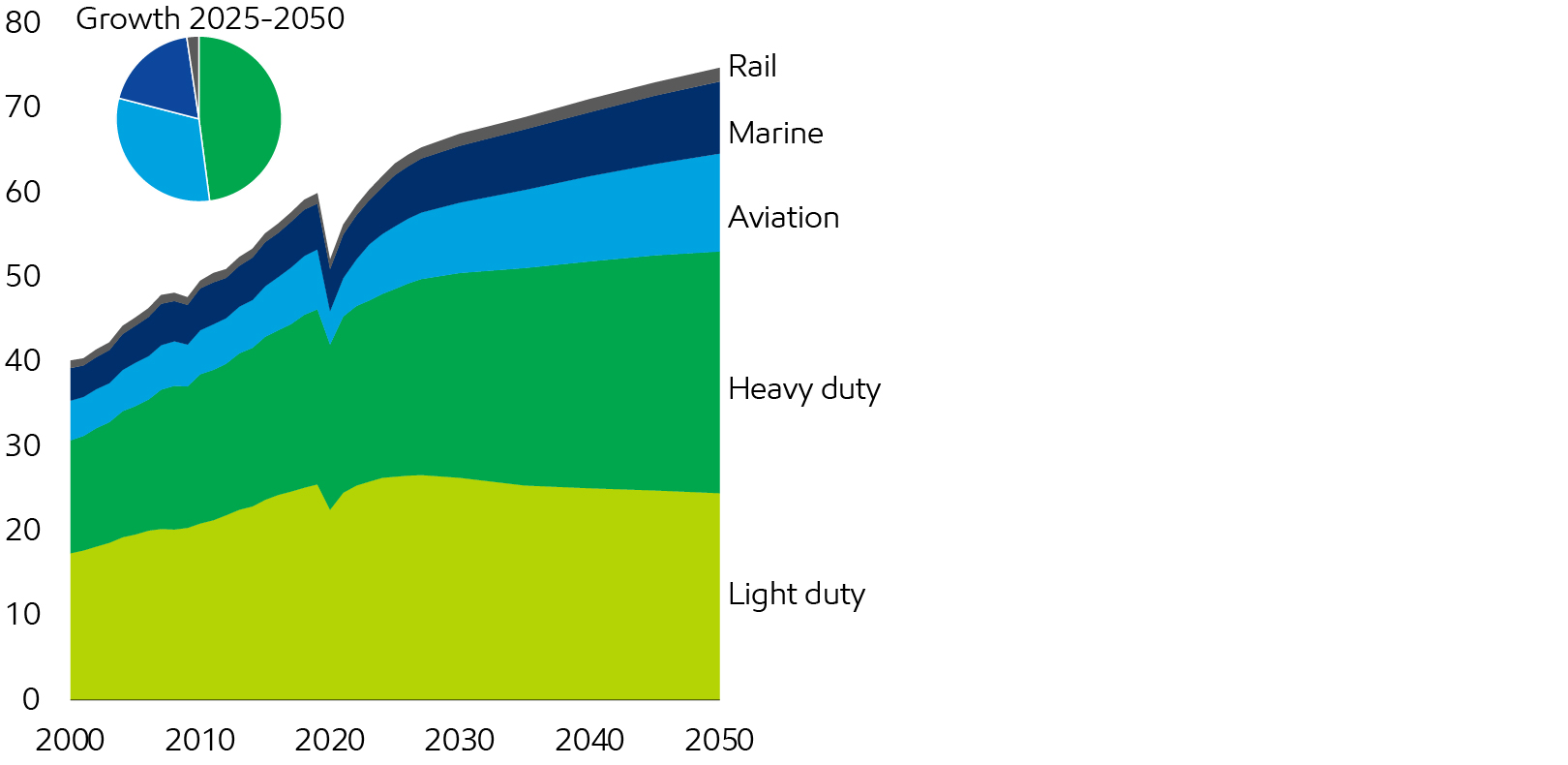
Trade and commercial activity require significant, high-density sources of energy to transport goods and people around the world. The Outlook projects energy demand for commercial transportation (including heavy trucks, aviation, marine, and rail) to grow nearly 40% to 2050, making the commercial sector the primary driver of energy growth in transportation. 90% of this growth is in developing countries, driven by increases in population and economic activity.
Commercial transportation energy demand
Million barrels per day of oil equivalent
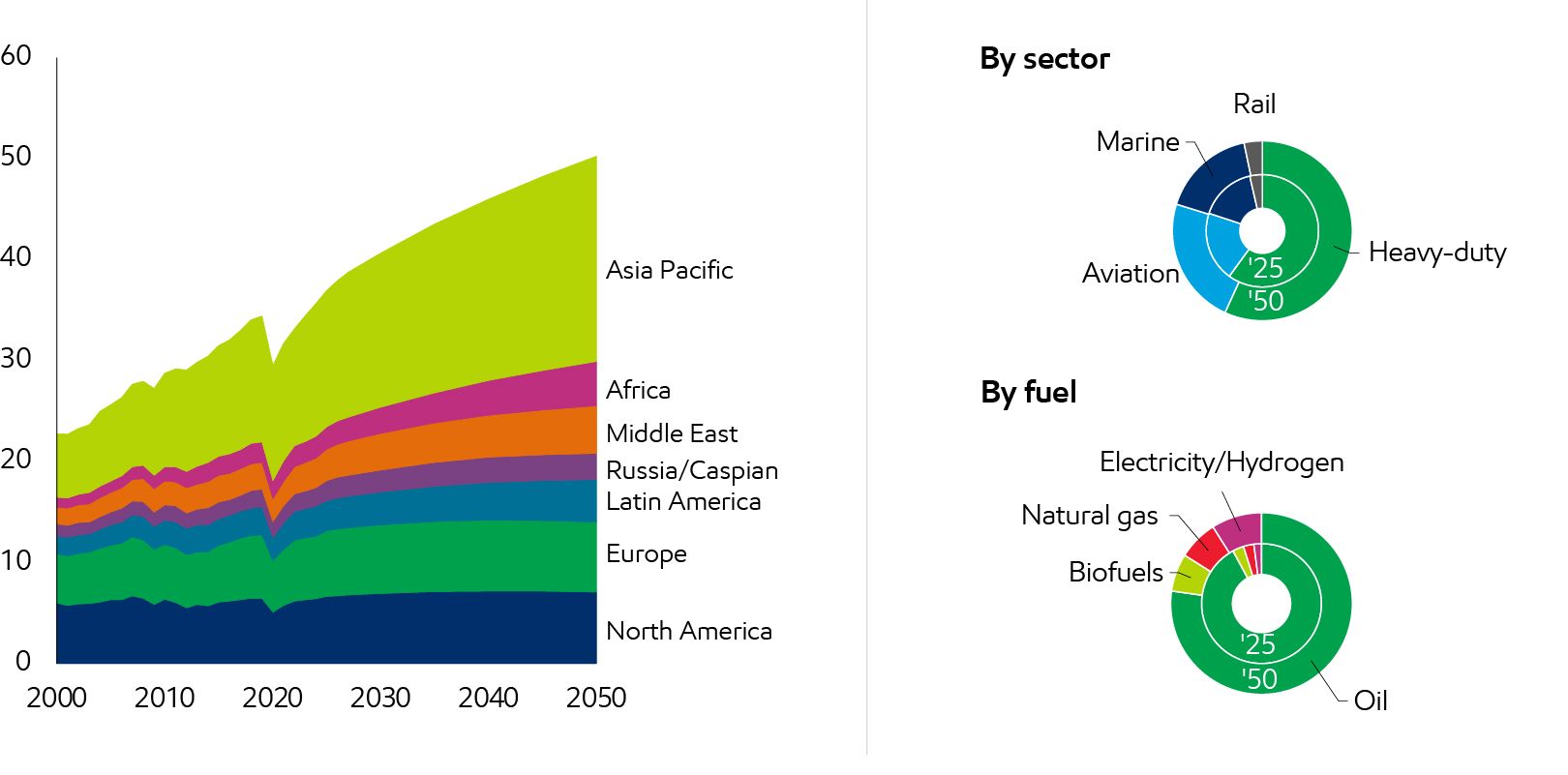
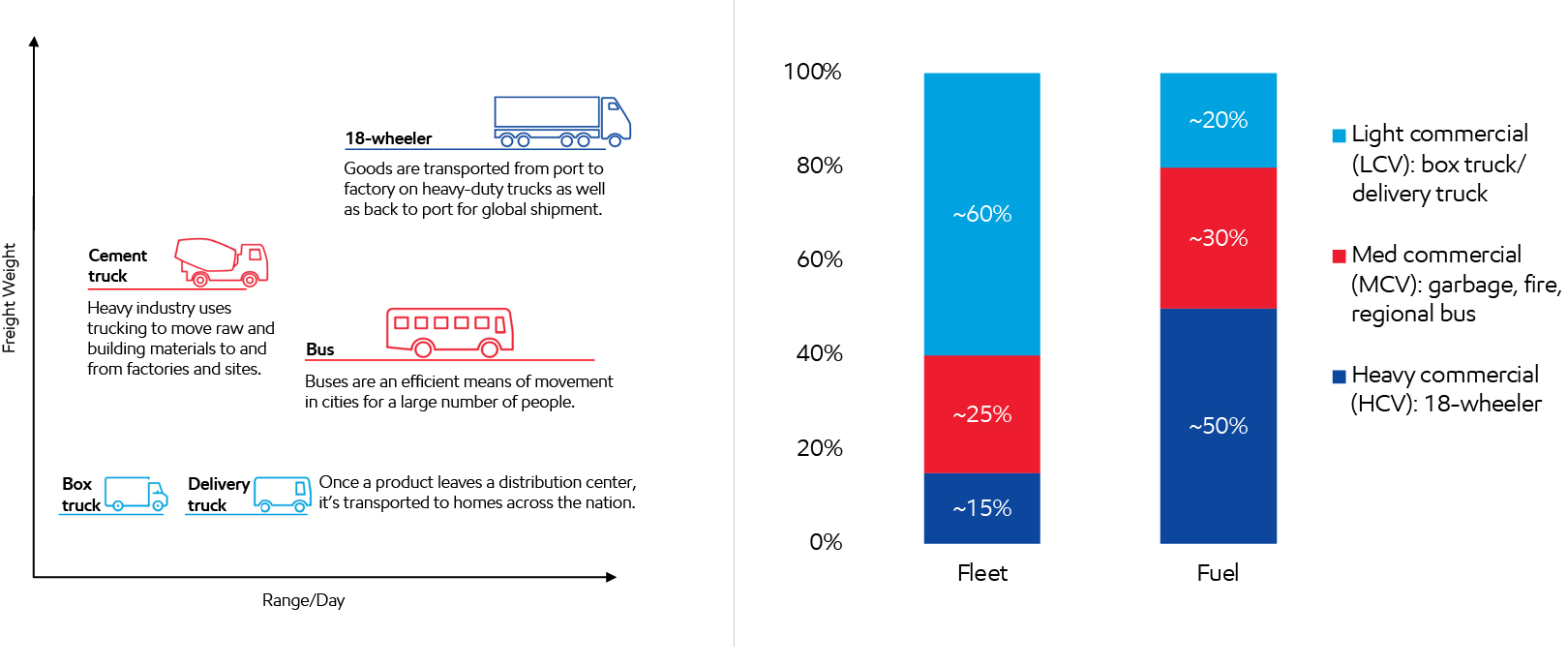
Electric vehicles are playing a growing role in deliveries within cities, where shorter routes and stop/start driving of last-mile deliveries are well suited for electrification. However, long-haul trucks need to carry much heavier loads and travel much farther distances. Today, these heavy-duty, long-haul trucks make up ~15% of the commercial road vehicle fleet but use ~50% of the fleet’s fuel usage.
2025 Heavy-duty fleet/fuel usage mix
Sources: IEA Transport Project, ExxonMobil analyses
Aviation and commercial shipping also require high energy density to move goods and people long distances, favoring liquid fuels. For example, with today’s technology, a Boeing 737 flying for five hours would require an electric battery weighing more than 200 metric tons, or nearly 3x the plane’s maximum takeoff weight (see supplemental information for methodology and sources).
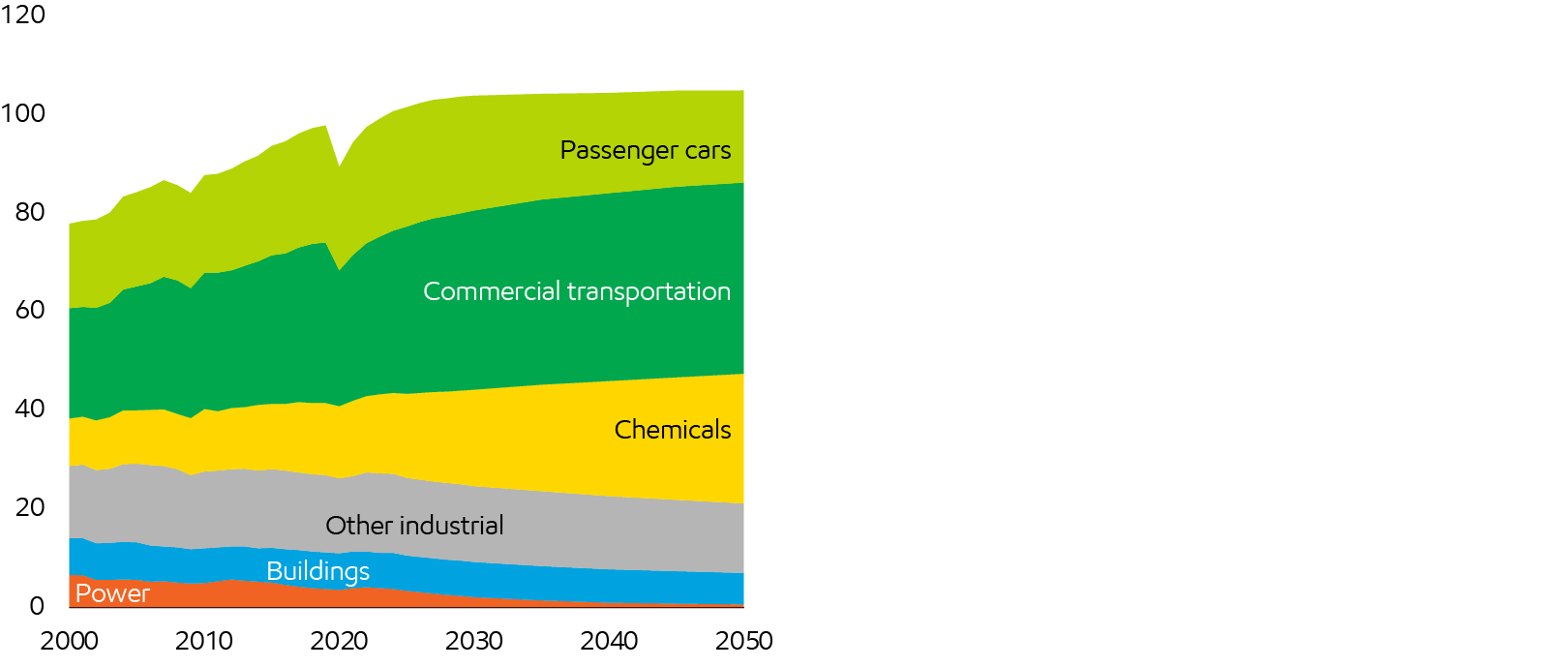
Oil demand (excluding biofuels)
Million barrels per day
Natural gas demand
Billion cubic feet per day
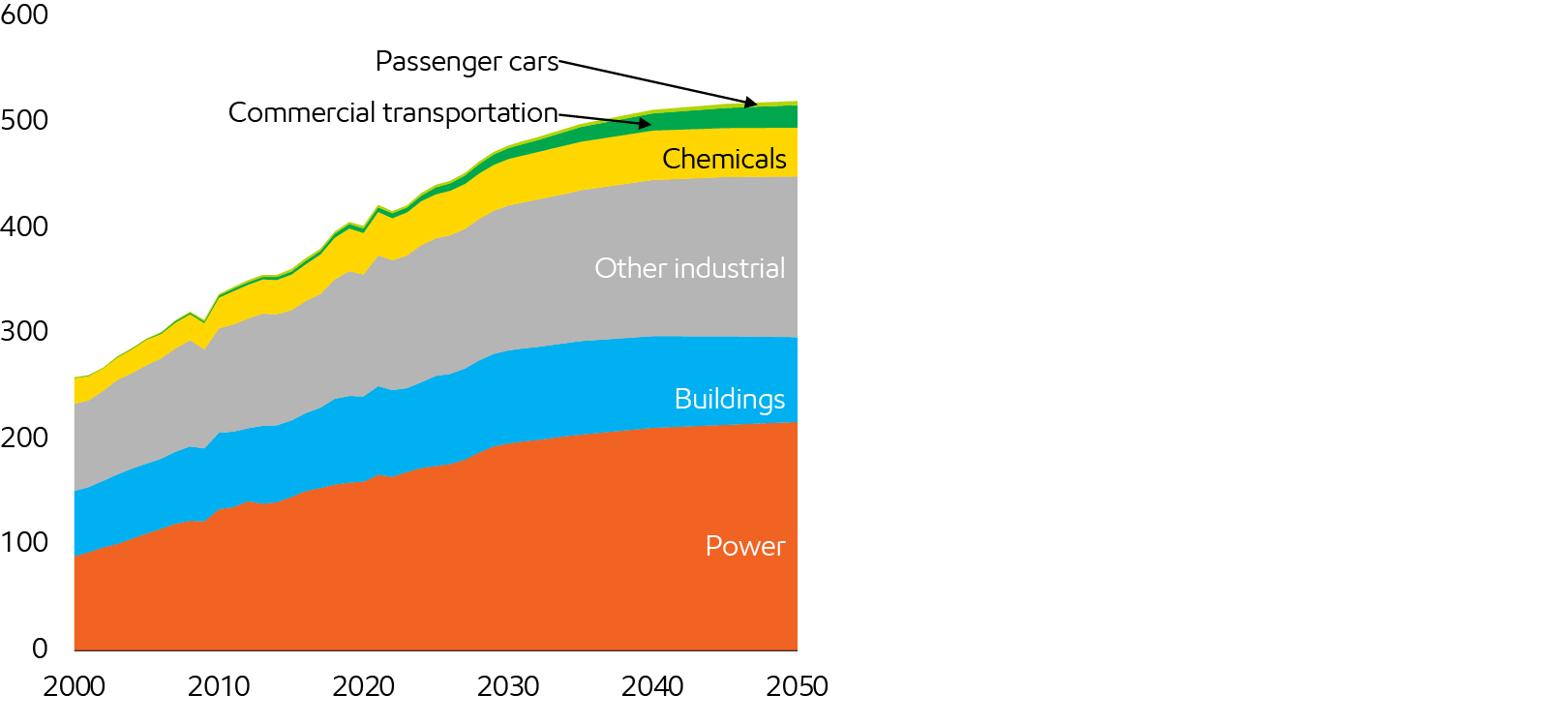
The utility of oil and natural gas in meeting the world’s needs for industry and commercial transportation remains unmatched — they are energy dense, portable, available, and affordable. For example, diesel, which is commonly used for long-haul trucking, has >30x the energy density of today’s lithium ion batteries (see supplemental information for methodology and sources). By 2050, the industrial and commercial transportation sectors are projected to make up 75% of global oil demand (vs. 65% today) and 60% of global natural gas demand (including their share of electricity).
-
Developing countries projected to use 25% more energy as living standards improve
Learn more>4 Billion people currently live in countries where access to energy is below what is needed to address basic human development needs.
-
Global electricity demand is projected to increase ~65% by 2050
Learn moreThe industrial sector accounts for 40% of electricity demand growth; data centers and electrification of transportation have material impacts in many markets, although there will be significant regional variation.
Global Outlook
Explore more






Cautionary statement
The Global Outlook includes ExxonMobil Holdings Corporation’s internal estimates of both historical levels and projections of challenging topics such as global energy demand, supply, and trends through 2050 based upon internal data and analyses as well as publicly available information from many external sources including the International Energy Agency. Separate from ExxonMobil’s analysis, we discuss a number of third-party scenarios such as the Intergovernmental Panel on Climate Change Likely Below 2°C and the International Energy Agency scenarios. Third-party scenarios discussed in this report reflect the modeling assumptions and outputs of their respective authors, not ExxonMobil, and their use and inclusion herein is not an endorsement by ExxonMobil of their results, likelihood, or probability. Work on the Outlook and report was conducted during 2025 and 2026. The report contains forward-looking statements, including projections, targets, expectations, estimates, and assumptions of future behaviors. Actual future conditions and results (including but not limited to energy demand, energy supply, the growth of energy demand and supply, the impact of new technologies, the relative mix of energy across sources, economic sectors and geographic regions, imports and exports of energy, emissions, and plans to reduce emissions) could differ materially due to changes in a number of factors, including: economic conditions, the ability to scale new technologies on a cost-effective basis, unexpected technological developments, the development of new supply sources, changes in law or government policy, political events, demographic changes and migration patterns, trade patterns, trade tariffs and trade sanctions, the development and enforcement of global, regional or national mandates, changes in consumer preferences, escalating geopolitical volatility, including regime changes, war, civil unrest, and other political or security disturbances, including disruption of land or sea transportation routes, decoupling of economies, realignment of global trade and supply chain networks, and disruptions in military alliances and other factors discussed herein and under the heading “Factors Affecting Future Results” in the Investors section of our website at https://corporate.exxonmobil.com/.
The Outlook was published in September 2026. ExxonMobil assumes no duty to update these statements or materials as of any future date, and neither future distribution of this material nor the continued availability of this material in archive form on our website should be deemed to constitute an update or re-affirmation of this material as of any future date. The Global Outlook is a voluntary disclosure and is not designed to fulfill any U.S., foreign, or third party required reporting framework. This material is not to be used or reproduced without the express written permission of ExxonMobil Holdings Corporation. All rights reserved.