
Report
4 min read
• May 5, 2026Managing socioeconomic impacts
Our Environment Policy and Protect Tomorrow. Today. guiding principle are the cornerstones of our efforts to be a good corporate citizen in the places we operate worldwide. The same discipline and focus that drive our excellent reliability and safety performance also shape how we advance our work to promote economic development and manage socioeconomic impacts everywhere we operate.
Report
4 min read
• May 5, 2026Navigate to:
Our goal is to contribute to the social and economic progress of the communities where we operate worldwide. We believe respecting human rights, managing our impacts, and making valuable social investments are essential to our business success. And we are dedicated to running safe and environmentally responsible operations.

United Nations Sustainable Development Goals related to this content.
Our approach
We are committed to being a good corporate citizen in the places we operate worldwide.
We maintain high ethical standards; obey applicable laws, rules, and regulations; and respect local and national cultures.
We base our actions on a scientific understanding of the environmental impacts (human and natural environment) of our operations.
We engage with communities, governments, and others early in project planning and during operations to understand the social and economic needs of the communities where we operate.
The key elements of our integrated approach include:
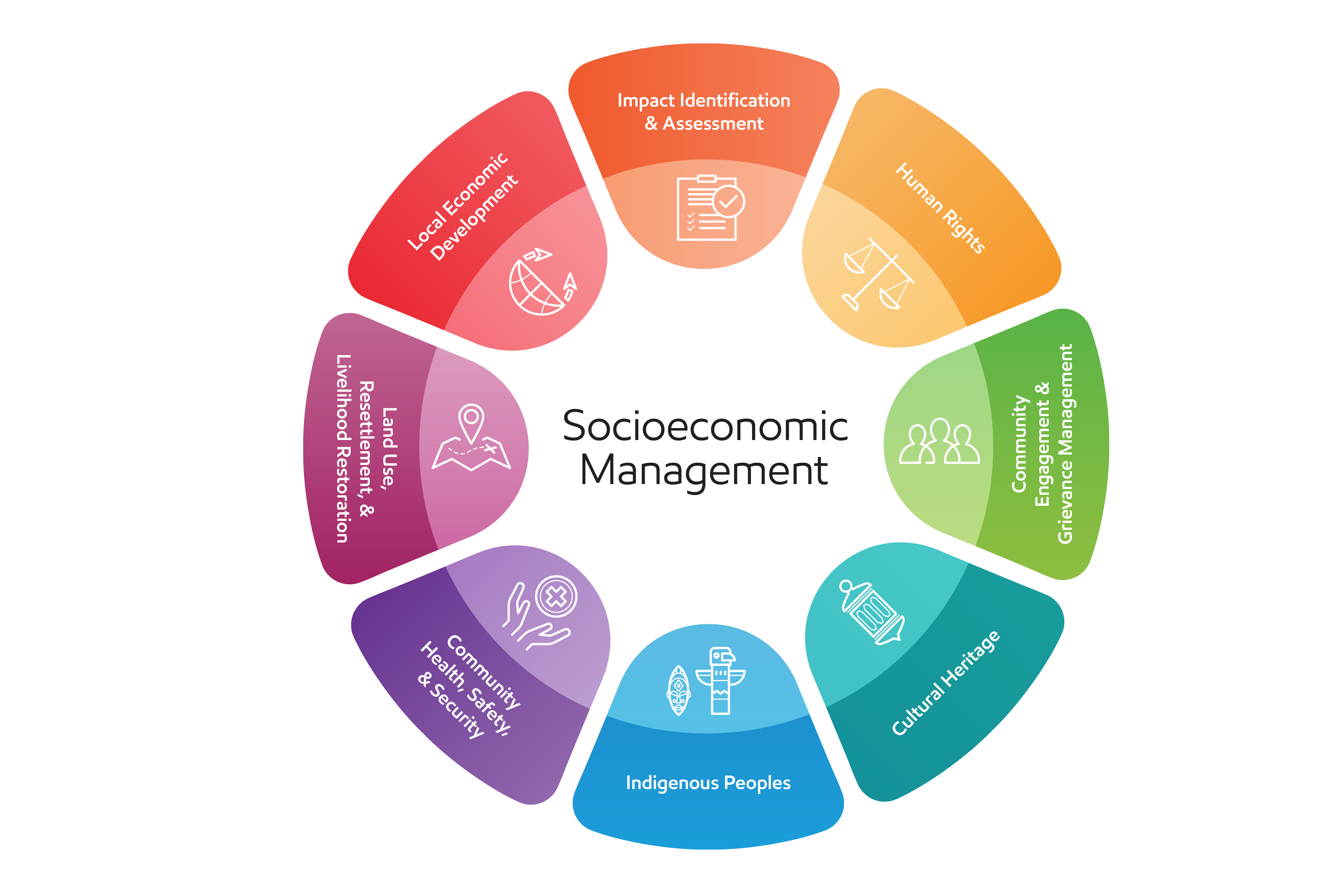
Impact identification and assessment
Our projects and operations around the world provide socioeconomic benefits to the communities where we operate and beyond. While there are inherent risks in any development or operation, we aim to avoid them, reduce them to acceptable levels, or remedy the impacts.
We use core processes and internal frameworks to manage our operations. Our Operations Integrity Management System (OIMS), for example, with its integrated risk management system, helps us to identify, assess, manage, and monitor environmental and socioeconomic impacts, risks, and opportunities throughout the life cycles of our assets.
We use our Environmental Aspects Guide to identify and assess significant environmental and socioeconomic aspects, in line with our Environment Policy. Environmental aspects are activities, products, or services that can interact with the environment. This also covers the “human environment,” which includes social and economic aspects beyond just climate and nature.
Our processes include:
- Environmental Aspects Assessment (EAA).
- Project Environmental Standards (PES) including our Socioeconomic Management Standard.
- Environmental, Socioeconomic, and Health Impact Assessment (ESHIA).
- Environmental, Socioeconomic, and Health Management Plans.
We engage with local communities and stakeholders to understand the local socioeconomic setting and incorporate feedback, data, and other due diligence information into these processes. We periodically update our assessments and plans to reflect changes in operational complexity or socioeconomic sensitivities. When needed, we adjust our management plans accordingly.
Spotlight
Environmental and Social Management Plan in Papua New Guinea
At PNG LNG in Papua New Guinea, operated by ExxonMobil PNG Limited, the Environmental and Social Management Plan (ESMP) guides the management and mitigation of environmental, social, and community health, safety and security impacts associated with production activities. And it helps to ensure PNG LNG meets all legislative and regulatory requirements. This involves complying with more than 1,300 regulatory obligations.
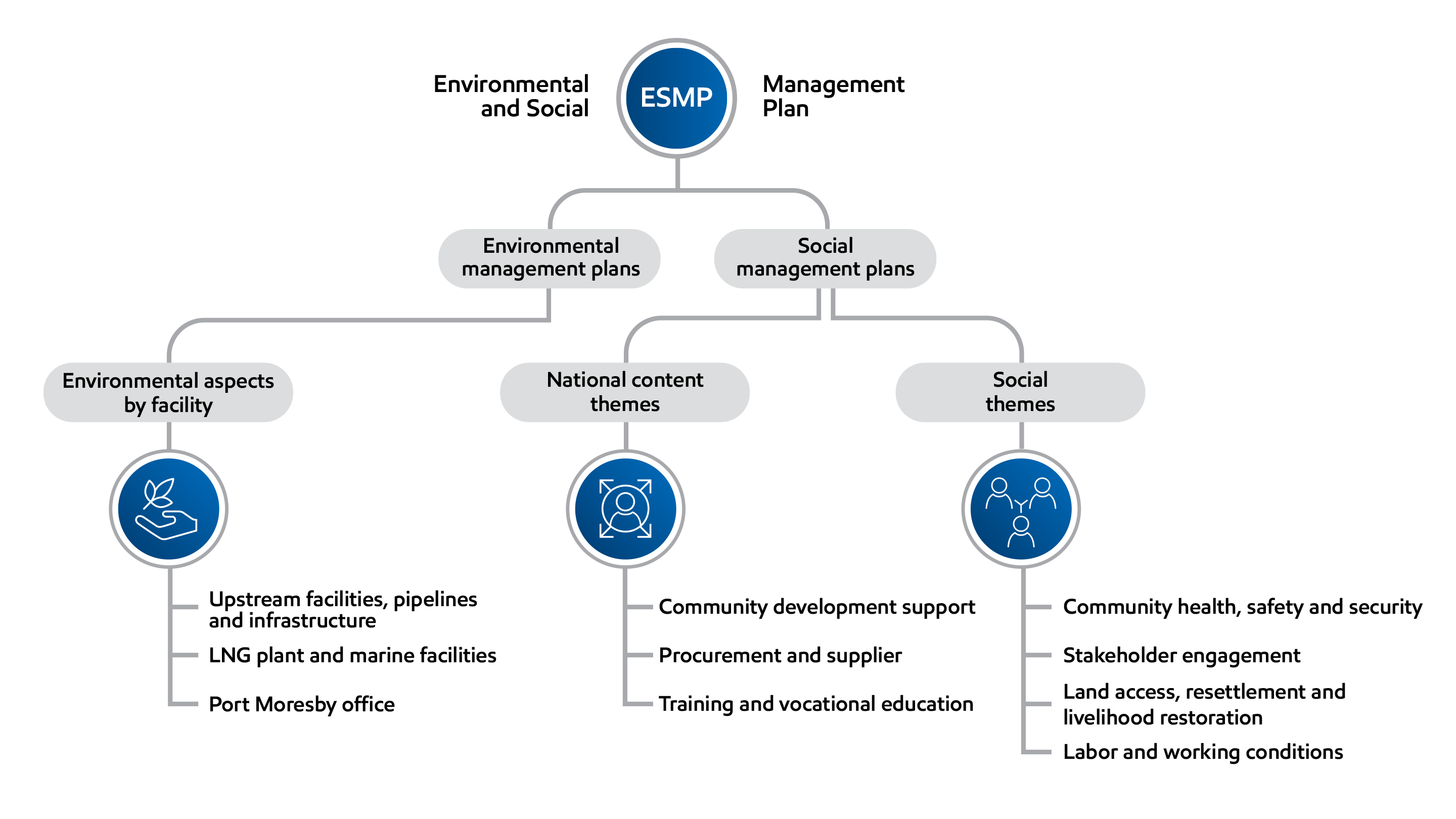
The ESMP was developed through extensive consultation with stakeholders and is periodically reviewed based on further stakeholder consultation. It includes environmental and social monitoring, mitigation, and management measures identified in the PNG LNG Environmental Impact Statement, and lessons learned from the project’s construction phase. It also incorporates OIMS, and international standards such as International Finance Corporation Performance Standards, and the Equator Principles.
The ESMP consists of three environmental and seven social management plans covering all PNG LNG facilities. Production ESMP requirements apply during normal operating conditions, as well as in reasonably foreseeable abnormal operating conditions or emergency situations. More information can be found in the PNG LNG Environmental page.
Community engagement and grievance management
We believe in meaningful engagement with communities to build positive, long-term relationships. We regularly consult with local groups and individuals to ensure their voices are heard and their concerns received and considered. Our engagement process is designed to be locally and culturally appropriate. We provide accessible and inclusive channels for exchanging information. This includes activities like open houses, community gatherings, and individual meetings.
By integrating results of these discussions into our decisions, we aim to avoid or reduce potential impacts on communities. This approach helps us enhance benefits, support effective investments, avoid delays, and resolve issues locally.
Grievance management
Our grievance-management process offers platforms for individuals and communities to raise concerns. Depending on the location and nature of our activities, the process may include direct, in-person, and electronic engagement and the use of third-party proxies such as civil society organizations and nongovernmental associations. We have dedicated personnel to map, track, analyze, respond to, and resolve community grievances promptly and in a way that supports confidentiality and non-retaliation.
Our grievance-management approach involves five core steps:
- Publicize the process and support accessibility for stakeholders.
- Receive, register, and acknowledge grievances, respecting confidentiality.
- Review and investigate with the help of external input and qualified personnel.
- Develop resolution options and respond to or close out grievances.
- Monitor and evaluate outcomes.
Our practices are informed by the guidance of International Finance Corporation and Ipieca. Individual processes may be complex or simple, driven by the characteristics of each location, type of activity, local sensitivities, potential impacts, and other factors. Our key performance indicators reflect these attributes.
Managers across business lines steward programs in their areas. They are supported by community relations and subject matter experts. Management endorses and monitors these programs. This includes regular reviews of stakeholder reports, grievance summaries, and project responses.
For more information on our stakeholder engagement and grievance-management processes, see the section on Human Rights.
In practice: Environmental justice in the U.S.
We are part of the communities where our employees live and work, surrounded by their friends, families, and neighbors. Their lived experiences reinforce our belief that every community has a unique culture and history that should be respected.
We believe everyone, regardless of race, color, national origin, or income, deserves to be treated fairly. And we understand the importance of our activities to the communities where we operate and to their social and economic progress.
In places like Baytown, Beaumont, and Baton Rouge, communities have grown up around us for more than a century.
Built along the banks of the Neches River in 1903, ExxonMobil’s Beaumont operations have developed into an integrated petrochemical manufacturing complex and one of the largest refineries in the U.S. Since the early days of the Spindletop oil boom, ExxonMobil in Beaumont has contributed to the economic and social landscape of Southeast Texas.
Recent highlights include:
- Over $355,000 in contributions to local education providers in 2025 to provide funding, school supplies, technology equipment, host STEM events, fund scholarships, and more.
- Mentoring more than 70 high-school seniors in our 409 Energy Scholars program since it began in 2022. This two-week summer immersive learning program gives students the opportunity to experience STEM careers firsthand.
- Collaborating with Workforce Solutions of Southeast Texas in 2025 to host 10 teachers for a four‑day externship in which teachers learn about the education pathways and skills students need for industry careers.
- Announcing a 10-year, $10 million grant from ExxonMobil to the University of Texas MD Anderson to support Be WellTM Beaumont in 2025, following success of the Be WellTM Baytown initiative launched in 2016.
- In early 2025, ExxonMobil Beaumont announced a scholarship for graduating high school seniors with ties to its fenceline neighborhoods to pursue a Process Operating Technology degree at Lamar Institute of Technology (LIT). The scholarship will cover the cost of a typical course load designed to graduate from the program in two years. Scholarship recipients will have the opportunity to pursue internships with ExxonMobil during their program at LIT which could lead to full-time employment upon graduation.
In other places, communities existed long before we arrived. The Gulf Coast Growth Ventures (GCGV) facility that we operate near Corpus Christi, Texas, is one example. Projects like this involve hundreds of outreach meetings with local organizations, chambers, government agencies, civic groups, and neighborhoods. The GCGV Good Neighbor Program was initiated to address topics that local residents identified as most important, with four pillars: Health & Safety, Education & Workforce, Environmental Stewardship, and Quality of Life.
Recent highlights include:
- More than $750,000 in STEM education grants from ExxonMobil and the ExxonMobil Foundation in 2025.
- More than $7.5 million spent with local businesses in 2024.
- 26 paid interns, including 20 in the second annual Process Technology Internship Program from Del Mar College in 2024.
- $237,000 in total contributions to United Way of the Coastal Bend, and $125,000 in donations to local environmental organizations in 2024.
Across our operations, we regularly consult with local groups and individuals so that range of relevant stakeholders are represented as we work alongside our communities, building on the best aspects of our operations while mitigating any potential negative impacts.
As described in the Caring for land and biodiversity section of this report, the environmental and socioeconomic setting of our operations includes a wide range of interconnected aspects of nature, regulation, and socioeconomic sensitivities. Our policies, practices, and expectations of employees support our efforts to:
- Foster a culture of trust through inclusivity and transparency.
- Identify, mitigate, and respond effectively to the potential impacts of our operations.
- Make financial contributions and develop programs in communities to address needs or opportunities where we have some expertise or value to add.
- Work to ensure local communities directly and indirectly benefit from our presence.
As part of our engagement process, we identify and consult with potentially impacted community members including potentially vulnerable community members to understand barriers that may limit their participation. We tailor our processes to be accessible, open to all, and effective in exchanging information and identifying issues.
Our top priority is running safe facilities for our employees and nearby residents. That’s what we’ve done for more than 140 years, and it’s what we will continue to do as we work to be an integral part of the communities in which we operate.
Community health, safety, and security
We integrate community health, safety, and security aspects into our impact assessments as a key part of our socioeconomic management approach. Our Community Health, Safety, and Security Management Plans typically include:
- Identified risks.
- Mitigation and management measures.
- Monitoring of outcomes.
Risks assessed may include:
- Road traffic.
- Diseases spread by vectors such as mosquitoes, ticks, and fleas.
- Soil, water, and sanitation-related diseases.
- Cultural health practices.
- Population shifts.
We also look for opportunities to improve health, safety, and security in the communities where we operate.
Spotlight
Road safety in China

Community footbridge, Huizhou, China.
Our petrochemical complex in Huizhou, China, started up in 2025 after years of development and community engagement. To help improve safety and reduce congestion, ExxonMobil China’s socioeconomic team collaborated with local communities to plan and construct a new footbridge. The bridge includes elevators to support accessibility for elderly residents. It also features landscaping and rainwater collection and an auto-watering system.
The project’s success encouraged the local government to formalize a process for public/private community development projects, which is expected to facilitate future socioeconomic initiatives for ExxonMobil China and other companies.
Spotlight
The Greater Guyana Initiative

Poultry and egg production in Guyana.
The Greater Guyana Initiative (GGI) is a ten‑year, $100 million commitment by ExxonMobil Guyana and its coventurers, Hess Guyana Exploration Limited, and CNOOC Nexen Petroleum Guyana Limited. It supports long‑term capacity development across the country.
Through its Sustainability Enablers Project, GGI is working with communities in Imbotero and Smith Creek in Region 1 to address high-priority challenges identified by the residents, including:
- Seasonal saltwater intrusion, which has made freshwater increasingly hard to access, often requiring long trips upriver.
- Limited lighting at night, which has constrained daily life, reducing both evening activities and children’s study time.
GGI provided 200 household water‑storage tanks and installed eight 500‑gallon tanks at a central processing facility to provide consistent access to freshwater. These tanks support expanded agricultural activity – including pepper cultivation, an important source of income source for women in the region.
Households also received solar installations, including 200 solar LED lights allowing families to safely carry out tasks after dark.
Another example of GGI’s work is the Hinterland Poultry Project, also known as the Egg Sandwich Project, supported in part by ExxonMobil Guyana. The project aims to expand poultry and egg production in outlying parts of Regions 8 and 9 in Guyana, while strengthening local producers’ skills. In collaboration with the Rupununi Livestock Producers Association and The Consultancy Group, the GY$120 million project has built the region’s first hatchery and supported nearly 2,000 farmers, including women and youth groups. To date, it has produced more than 25,000 chicks and over 350,000 broiler eggs, reducing reliance on imports and supporting local economies. Watch the video to learn more.
These efforts are helping communities secure dependable freshwater, cleaner cooking fuels, and new opportunities for economic stability – core elements of GGI’s commitment to community‑driven development.
Local economic development
We work closely with local communities to understand their unique needs. Our goal is to contribute to long-term economic and social development. Our approach aims to integrate local content and community investment into every stage of our projects.
Local content
We take a strategic, long-term approach to building human, social, and economic capacity. This approach delivers tangible, lasting benefits for people, communities, and businesses in host countries.
We focus on:
- Employing and training local personnel.
- Supporting local suppliers and contractors.
- Improving the livelihoods of community members.
As part of our project planning, we create a relevant local content plan. These plans set objectives for long-term economic development, considering social and economic conditions, the nature of the project, and community needs.
Local hiring and development
We aim to enhance the long-term capability of the local workforce through recruitment, training, and succession planning. We focus on developing national talent who can contribute meaningfully to local operations, while also building a global pool of skilled professionals who can meet our evolving business needs and support broader economic development.
We hire local individuals and help them develop technical and leadership skills. These skills benefit them throughout their careers with ExxonMobil or other future employers. Our development program includes training in:
- Relevant technical and vocational skills.
- Health and safety.
- Environmental protection.
- Management skills.
- Business conduct.
For more information on how we’re Investing in People, visit our website.
Building the talent pipeline in Guyana
ExxonMobil Guyana Limited takes a multi-tiered approach to local content and local economic development that includes workforce development, supplier development, and strategic investments. We focus on building workforce and supplier capabilities in conjunction with strategic investments in the local community.
Our strategy to develop a local and talented workforce has two components – the recruitment and development of Guyanese personnel who can play a role in our local operations, and the continued development of a local pool of talent capable of meeting our future business needs in Guyana. We apply proven training curriculums, industry best practices, and leading technology to support local workforce development.

The Guyana STEM Initiative is a $100 million, 10‑year education program launched by ExxonMobil to support the development of Science, Technology, Engineering, and Mathematics (STEM) capabilities across Guyana. The program aims to strengthen the country’s long‑term talent pipeline by improving STEM teaching, expanding student access to high‑quality resources, and establishing clear pathways from education to technical careers.
The initiative is organized around three core pillars:
- Teacher STEM training through collaborations with the Ministry of Education, the University of Guyana, and the University of Houston, beginning in September 2026.
- Expanded student STEM opportunities, including classroom and extracurricular programs, hands‑on activities, and a new network of two STEM Centres and satellite sites across the country starting with the first STEM Centre to open in 2029.
- College and career pathways that provide pre‑college courses, transition support, mentoring, and tutoring to help students connect STEM learning to future careers.
Additional information about local content efforts in Guyana can be found at our Guyana Local Content website and in ExxonMobil Guyana’s 2024 annual report.
Spotlight
"MozUp" in: Fostering Local Supplier Development with MozUp
The MozUp Enterprise Development Center (MozUp) launched in Maputo, Mozambique, in 2020, to offer training, advisory, and mentorship opportunities to businesses and people across the country. In 2023, MozUp’s second office opened up more than a thousand miles away in Pemba, extending the program’s reach even farther. The Rovuma LNG joint venture that our affiliate operates has helped fund the program since its creation.
The goal is to help small- and medium-sized business enterprises obtain the skills and certifications they need to become suppliers to the Rovuma LNG Project, the oil and gas industry, and other growing sectors of the Mozambican economy.
This work can enable transformative growth of participating companies. One example comes from a local fire engineering company, which turned to MozUp for assistance in finance, procurement, human resources, and health and safety training. With this support, it evolved from a single site providing fire extinguisher maintenance into a four-branch business that offers a full range of fire engineering and safety systems.
Another example involves a catering company established and managed by a mother-and-daughter team. With MozUp’s help, the business earned International Food Safety (ISO 22000) certification – becoming the first women-owned catering company in Mozambique to do so. That certification opened doors for the company to expand its catering services into sectors such as cruise ships and private air transport.
Local supplier development and utilization
We know the importance of building a strong, competitive supply chain in the countries where we operate. Our approach includes buying goods and services from local suppliers and helping them grow their capabilities. This helps to create a competitive local industrial base.
We collaborate with host governments, NGOs, and local communities to support local businesses. To become a supplier for ExxonMobil, a local business must meet our safety, technical, environmental, and human rights expectations. Our efforts support the long-term economic progress of the community.
Investments in local communities
Our investments support the economic development of local communities. We engage with community members, host governments, and others to develop meaningful projects. These projects aim to build and sustain economic growth while improving social conditions. We consider each community’s development goals when deciding where, when, and how to invest.
Supporting women entrepreneurs
Women-owned small- and medium- sized enterprises in Guyana and Nigeria see advanced business skills and financing as a major need to grow and sustain their businesses. With funding from the ExxonMobil Foundation, the Cherie Blair Foundation for Women trains women in these countries to build successful businesses.
In Nigeria and Guyana, the Road to Growth program supports local women entrepreneurs to build business and financial literacy skills and grow their networks. In Guyana, the Road to Finance program further trains ambitious Guyanese women to expand their knowledge and confidence to secure financing, grow their businesses, and achieve their potential.
In 2025, we took a look back, surveying and interviewing program participants to assess the impact of these programs. After completing the program, participating entrepreneurs saw improved results for their businesses, including:
-
Road to Finance – Guyana (two-year impact study)
95% reported increase in revenue
95% reported increase in profit
-
Road to Growth – Guyana (2025)
79% reported increase in revenue
80% reported increase in profit
-
Road to Growth – Nigeria (2025)
90% reported increase in revenue
93% reported increase in profit
For more information about this program and other philanthropic activities, visit the Community page of our website.
Land use, resettlement, and livelihood restoration
We respect property rights in the countries and communities where we operate. We aim to avoid involuntary resettlement and minimize voluntary resettlement through careful site selection. When resettlement is unavoidable, our objective is to restore or improve the living standards and livelihoods of displaced people.
Site selection process
We assess multiple potential locations for our operations based on availability, accessibility, safety, and environmental, and social considerations. Our screening process includes factors specific to each country, community, and area, such as:
- Local demographics.
- Employment sources and levels.
- Housing.
- Gender relations.
- Marginalized groups.
- Ecosystem services.
- Regional conflicts or tensions.
- Religious and cultural sites.
Land acquisition
If land is necessary for a project, we follow host-country regulations and our internal standards. For externally financed projects, we also adhere to lender requirements regarding land use, access, and resettlement. Resettlement is considered “involuntary” when affected individuals or communities cannot refuse, such as in cases of eminent domain. Projects requiring resettlement undergo heightened review by senior management.
Resettlement and livelihood restoration
When physical or economic displacement occurs, we implement fair and transparent resettlement and compensation plans. These plans comply with regulatory requirements and recognized benchmarks like International Finance Corporation Performance Standard 5. They are tailored to the specific geographies and cultures of each location, informed by engagement with affected landowners and supported by detailed surveys of housing, gardens, wildlife, sources of nature-based products, harvesting areas, and other assets. We maintain transparency and offer a community grievance mechanism throughout the process.
Spotlight
Papua New Guinea
Wherever possible, our affiliate in Papua New Guinea aims to avoid resettlement from construction activities. Where resettlement is unavoidable, the aim is to improve, or at least restore, the livelihoods and standards of living of displaced persons. Pre-construction surveys help us assess potential project impacts and determine compensation for affected families.
In 2024, one household received compensation after being relocated to accommodate extra workspace required at the Kilometre Point 65.9 river crossing. The extra space was for storing materials that were needed for work at the river crossing and to provide a safe path for machinery access.
A pre-construction survey was conducted along the pipeline at the Kilometre Point 25.2 river crossing during 2024 to assess households in areas identified for pipeline remediation works. Seven households were confirmed as eligible for compensation. By the end of 2024, four households received compensation and the remaining three were compensated in 2025.
All resettlement activities are managed under the Environmental and Social Management Plan (ESMP), which is informed by international best practice, including the International Finance Corporation (IFC) Performance Standards and the Equator Principles. Engagement with affected households is maintained to support fair compensation outcomes and the restoration of livelihoods.
For more information on our resettlement and livelihood restoration programs in Papua New Guinea, see the PNG LNG Environmental page.
Indigenous peoples
In locations inhabited or historically used by Indigenous peoples, we work closely with these communities to respect their cultures and customs. We support employment initiatives and cultural heritage programs through local content development and strategic community investments.
Meaningful engagement
We are committed to meaningful engagement and open consultation with Indigenous peoples. We incorporate traditional knowledge and land use practices into our plans and promote community programs that respect traditions and cultures. Meaningful engagement is a key aspect of Free, Prior, and Informed Consent, as recognized in the United Nations Declaration on the Rights of Indigenous Peoples.
No two communities are the same. We start by establishing tailored engagement methods that align with local customs and preferences. Communities decide how they want us to engage, whether with elected leaders, community elders, or other representatives. They also choose the format – public forums, formal or informal meetings, and the frequency of these engagements.
Global frameworks
Our interactions with Indigenous peoples are consistent with the following frameworks:
- International Labour Organization Convention 169.
- United Nations Declaration on the Rights of Indigenous Peoples.
- International Finance Corporation Performance Standards.
- World Bank Operational Policy on Indigenous Peoples.
Imperial’s commitment to excellence in community engagement
Our majority-owned affiliate in Canada, Imperial Oil Limited, has been a leader in Canada’s energy industry for more than 140 years.
Many of Imperial’s operations and development opportunities are near Indigenous communities or on Traditional lands. The company strives to build strong and lasting relationships based on mutual trust, respect, and shared prosperity.
Imperial’s Indigenous relations and principles guidelines inform Imperial’s work across four key pillars of engagement.
-
Pillar 01
Consultation- Engaging early and often to enhance transparency and understanding
- Incorporating lessons learned
-
Pillar 2
Career readiness and workforce development- Understanding community vision for success
- Growing a workforce representative of our communities
- Enabling a culture of belonging
-
Pillar 3
Economic development- Focused on capacity building
- Indigenous content valued in procurement contracts
-
Pillar 4
Engagement- Building meaningful relationships
- Understanding community needs and priorities
- Participating in community-centric social investment






Indigenous Rightsholders have consistently emphasize that building strong partnerships with Indigenous businesses is one of the most meaningful contributions companies can make toward progressing reconciliation. The term “Reconciliation” refers to a commitment to maintaining a mutually respectful relationship between Indigenous and non-Indigenous peoples in Canada.
Imperial has worked to connect Indigenous and non-Indigenous suppliers and align its national supply chain needs with Indigenous partner capacity. As a Canadian Council for Indigenous Business (CCIB) procurement champion, Imperial is among a select group of corporations committed to increasing supply chain opportunities for Indigenous businesses.
In 2025, Imperial:
- Received silver-level recertification from the CCIB through their Partnership Accreditation in Indigenous Relations (PAIR) program – a prominent corporate social responsibility program that emphasizes Indigenous relations.
- Committed nearly $19 million through community benefits agreements to Indigenous communities across Canada.
- Surpassed $7 billion in spending with Indigenous businesses since 2008 and achieved the highest annual business spend in 2025 at more than $1 billion.
Imperial continues to expand its efforts across the value chain, incorporating Indigenous input and Traditional Knowledge into its projects and practices, increasing Indigenous representation in its workforce and enhancing cultural awareness and understanding for its employees across Canada.
Cultural Heritage
Our respect for the cultural heritage and customs of local communities carries into our business practices. We do this by managing the potential impacts of our operations and by making culturally appropriate community investments.
From project design to our ongoing operations, we look for ways to help preserve cultural heritage. As we design our projects, we consider cultural and spiritual considerations, heritage sites, biodiversity conservation, traditional knowledge, and efficient use of resources.
We value and respect the cultural histories of the areas where we operate. To do this, we identify potential sites of cultural significance. If the recovery or relocation of an artifact is appropriate, we develop tailored procedures in consultation with technical experts, local communities, and host country government officials.
We also deepen our knowledge with relevant research. And we provide training to our construction and field contractor personnel. This helps them identify different types of cultural heritage in the areas where we work.
Spotlight
Honoring Water Traditions in India
In many parts of India, water is revered as a living entity, central to spiritual practices and community life. When the ExxonMobil Lubricant Blending Plant Project required closing a water well, the community asked for a ceremony to honor the well’s life and the role it played in sustaining local residents for generations. At the site, community religious leaders, local authorities and project team members gathered to observe this tradition before the well was closed.

Honoring water traditions in India.


Publications
Explore more
Content index
Data
•
6 min read
• May 21, 2026
Enhancing process safety
Report
•
3 min read
• May 5, 2026
Leading in personnel safety
Report
•
3 min read
• May 5, 2026About our Advancing Climate Solutions and Sustainability Reports and Cautionary Statement
Report
•
4 min read
• May 5, 2026
Improving air quality
Report
•
2 min read
• May 5, 2026
Integrating sustainability into what we do
Report
•
8 min read
• May 5, 2026FORWARD-LOOKING STATEMENT WARNING
CAUTIONARY STATEMENT RELEVANT TO FORWARD LOOKING INFORMATION FOR THE PURPOSE OF THE “SAFE HARBOR” PROVISIONS OF THE PRIVATE SECURITIES LITIGATION REFORM ACT OF 1995 AND OTHER IMPORTANT LEGAL DISCLAIMERS
Images or statements of future ambitions, aims, aspirations, plans, goals, events, projects, projections, opportunities, expectations, performance, potential addressable markets or conditions in the publications, including plans to reduce, abate, avoid or enable avoidance of emissions or reduce emissions intensity, sensitivity analyses, estimates, the development of future technologies, business plans, and sustainability efforts are dependent on future market factors, such as customer demand, continued technological progress, stable policy support and timely rule-making or continuation of government incentives and funding, and represent forward-looking statements. Similarly, emission-reduction roadmaps to drive toward net zero and similar roadmaps for emerging technologies and markets, and water management roadmaps to reduce freshwater intake and/or manage disposal, are forward-looking statements. These statements are not guarantees of future corporate, market or industry performance or outcomes for ExxonMobil or society and are subject to numerous risks and uncertainties, many of which are beyond our control or are even unknown.
Actual future results, including the achievement of ambitions to reach Scope 1 and 2 net zero from operated assets by 2050, to reach Scope 1 and 2 net zero in integrated Upstream Permian Basin unconventional operated assets by 2035, to eliminate routine flaring in-line with World Bank Zero Routine Flaring, to reach near zero methane emissions from operated assets and other methane initiatives to meet ExxonMobil’s greenhouse gas emission reduction plans and goals, divestment and start-up plans, and associated project plans as well as technology advances, including in the timing and outcome of projects to capture, transport and store CO2, produce hydrogen and ammonia, produce lower-emission fuels, produce ProxximaTM systems, produce carbon materials, produce lithium, and use plastic waste as feedstock for advanced recycling; future debt levels and credit ratings; business and project plans, timing, costs, capacities and profitability; resource recoveries and production rates; planned Denbury and Pioneer integrated benefits; detection, measurement and quantification of emissions including obtaining or reporting of that data or updates to previous estimates and progress in sustainability focus areas could vary depending on a number of factors. These include, global or regional changes or imbalances in the supply and demand for oil, gas, petrochemicals, and feedstocks and other market factors; economic conditions and seasonal fluctuations that impact prices, differentials, and volume/mix for our products; new market products and services; future cash flows; our ability to execute operational objectives on a timely and successful basis; the ability to realize efficiencies within and across our business lines; developments or changes in local, national, or international treaties, laws, regulations, taxes, trade sanctions, trade tariffs, or policies affecting our business, such as government policies supporting lower-carbon and new market investment opportunities, or policies limiting the attractiveness of investments such the punitive European taxes on the oil and gas sector and unequal support for different technological methods of emissions reduction or evolving, ambiguous, and unharmonized voluntary and mandatory standards and extraterritorial laws and regulations imposed by various jurisdictions related to sustainability and greenhouse gas reporting and evolving measurement standards for these topics; timely granting of governmental permits, licenses, and certifications; uncertain impacts of deregulation on the legal and regulatory environment; trade patterns and the development and enforcement of local, national and regional mandates; unforeseen technical or operational difficulties; the outcome of research efforts and future technology developments, including the ability to scale projects and technologies such as electrification of operations, advanced recycling, carbon capture and storage, hydrogen and ammonia production, ProxximaTM systems, carbon materials or direct lithium extraction on a commercially competitive basis; the development and competitiveness of alternative energy and emission reduction technologies; unforeseen technical or operating difficulties, including the need for unplanned maintenance; availability of feedstocks for lower-emission fuels, hydrogen, or advanced recycling; changes in the relative energy mix across activities and geographies; the actions of co-venturers or competitors; changes in regional and global economic growth rates and consumer preferences including willingness and ability to pay for reduced emissions products; actions taken by governments and consumers resulting from a pandemic; changes in population growth, economic development or migration patterns; timely completion of construction projects; war, civil unrest, attacks against the Company or industry, and other political or security disturbances, including disruption of land or sea transportation routes; decoupling of economies, realignment of global trade and supply chain networks, and disruptions in military alliances; and other factors discussed here and in Item 1A. Risk Factors of our Annual Report on Form 10-K and under the heading “Factors affecting future results” available under the “Earnings” tab through the “Investors” page of our website at www.exxonmobil.com. The Advancing Climate Solutions Report includes 2025 greenhouse gas emissions performance data as of March 13, 2026, and Scope 3 Category 11 estimates for full year 2025 as of March 13, 2026. The greenhouse gas intensity and greenhouse gas emission estimates include Scope 2 market-based emissions. The Sustainability Report, the Advancing Climate Solutions Report, and combined Executive Summary were issued on May 5, 2026. The content and data referenced in these publications focus primarily on our operations from Jan. 1, 2025 – Dec. 31, 2025, unless otherwise indicated. Tables on our “Metrics and data” page were updated to reflect full year 2025 data. Information regarding some known events or activities in 2026 and historical initiatives from prior years are also included. No party should place undue reliance on these forward-looking statements, which speak only as of the dates of these publications. All forward-looking statements are based on management’s knowledge and reasonable expectations at the time of publication. ExxonMobil assumes no duty to update these statements or materials as of any future date, and neither future distribution of this material nor the continued availability of this material in archive form on our website should be deemed to constitute an update or re-affirmation of these figures or statements as of any future date. Any future update will be provided only through a public disclosure indicating that fact.
See “ABOUT THE ADVANCING CLIMATE SOLUTIONS AND SUSTAINABILITY REPORTS” at the end of this document for additional information on these reports and the use of non-GAAP and other financial measures.
ABOUT THE ADVANCING CLIMATE SOLUTIONS AND SUSTAINABILITY REPORTS
The Advancing Climate Solutions Report contains terms used by the third-party disclosure frameworks. In doing so, ExxonMobil is not obligating itself to use any terms in the way defined or interpreted by any third-party, nor is it obligating itself to comply with any specific recommendation of such parties or to provide any specific disclosure. For example, with respect to the term “material,” individual companies are best suited to determine what information is material, under the long-standing U.S. Supreme Court definition, and whether to include this information in U.S. Securities and Exchange Act filings. The Sustainability Report and Advancing Climate Solutions Report are each a voluntary disclosure and are not designed to fulfill any U.S., foreign, or third-party required reporting framework.
Forward-looking and other statements regarding environmental and other sustainability efforts and aspirations are not intended to communicate any material investment information under the laws of the United States or elsewhere or represent that these are required disclosures in any other context or jurisdiction. These publications are not intended to imply that ExxonMobil has access to any significant non-public insights on future events that the reader could not independently research. In addition, historical, current, and forward-looking environmental, climate-related, and other sustainability-related statements may be based on standards for measuring progress that are still developing, internal controls and processes that continue to evolve, and assumptions that are subject to change in the future, including future laws and rulemaking. Forward-looking and other statements regarding environmental and other sustainability efforts and aspirations are for informational purposes only and are not intended as an advertisement for ExxonMobil’s equity, debt, businesses, products, or services and the reader is specifically notified that any investor-requested disclosure or future required disclosure is not and should not be construed as an inducement for the reader to purchase any product, services, or security. The statements and analysis in these publications represent a good faith effort by the Company to address these investor requests despite significant unknown variables and at times inconsistent market data, government policy signals, and calculation methodologies and reporting standards.
Actions needed to advance ExxonMobil’s 2030 greenhouse gas emission-reductions plans are incorporated into its medium-term business plans, which are updated annually. The reference case for planning beyond 2030 is based on the Company’s Global Outlook research and publication. The Global Outlook is reflective of the existing global policy environment and an assumption of increasing policy stringency and technology improvement to 2050. However, the Global Outlook does not attempt to project the degree of required future policy and technology advancement and deployment for the world, or ExxonMobil, to meet net zero by 2050. As future policies and technology advancements emerge, they will be incorporated into the GIobal Outlook, and the Company’s business plans will be updated as appropriate. References to projects or opportunities may not reflect investment decisions made by the corporation or its affiliates. Individual projects or opportunities may advance based on a number of factors, including availability of stable and supportive policy, permitting, technological advancement for cost-effective abatement, insights from the company planning process, and alignment with our partners and other stakeholders. Capital investment guidance in lower-emission and other new investments is based on our corporate plan; however, actual investment levels will be subject to the availability and attractiveness of investment opportunities, market conditions, stable public policy support, other factors, and focused on returns.
Energy demand modeling is forward-looking by nature aims to replicate integrated dynamics of the global energy system but necessarily involves simplifications to simulate its complexity. The reference to any modeled scenario or any pathway for an energy transition or expansion, including any potential net-zero scenario, does not imply ExxonMobil views any particular scenario as likely to occur. In addition, energy demand scenarios require assumptions on a variety of parameters. As such, the outcome of any given scenario using an energy demand model comes with a high degree of uncertainty. Third-party scenarios discussed in these reports reflect the modeling assumptions and outputs of their respective authors, not ExxonMobil, and their use or inclusion herein is not an endorsement by ExxonMobil of their underlying assumptions, likelihood, or probability. Investment decisions are made on the basis of ExxonMobil’s separate planning process but may be secondarily tested for robustness or resiliency against different assumptions, including against various scenarios. These reports contain information from third parties. ExxonMobil makes no representation or warranty as to the third-party information. Where necessary, ExxonMobil received permission to cite third-party sources, but the information and data remain under the control and direction of the third parties. ExxonMobil has also provided links in this report to third-party websites for ease of reference. ExxonMobil’s use of the third-party content is not an endorsement or adoption of such information.
ExxonMobil reported emissions, including reductions and avoidance performance data, are based on a combination of measured and estimated data. We assess our performance to support continuous improvement throughout the organization using our Environmental Performance Indicator (EPI) manual. The reporting guidelines and indicators in the Ipieca, the American Petroleum Institute (API), the International Association of Oil and Gas Producers Sustainability Reporting Guidance for the Oil and Gas Industry (5th edition, 2025) and key chapters of the GHG Protocol inform the EPI and the selection of the data reported. Emissions reported are estimates only, and performance data depends on variations in processes and operations, the availability of sufficient data, the quality of those data and methodology used for measurement and estimation. Emissions data is subject to change as methods, data quality, and technology improvements occur, and changes to performance data may be updated. Emissions, reductions, abatements and enabled avoidance estimates for non-ExxonMobil operated facilities are included in the equity data and similarly may be updated as changes in the performance data are reported. ExxonMobil’s plans to reduce emissions are good-faith efforts based on current relevant data and methodology, which could be changed or refined. ExxonMobil works to continuously improve its approach to estimate, detect, measure, and address emissions. ExxonMobil actively engages with industry, including API and Ipieca, to improve emission factors and methodologies, including measurements and estimates.
Any reference to ExxonMobil’s support of, work with, or collaboration with a third-party organization within these publications do not constitute or imply an endorsement by ExxonMobil of any or all of the positions or activities of such organization. ExxonMobil participates, along with other companies, institutes, universities and other organizations, in various initiatives, campaigns, projects, groups, trade organizations, and other collaborations among industry and through organizations like the United Nations that express various ambitions, aspirations and goals related to climate change, emissions, sustainability, and an energy transition or expansion. ExxonMobil’s participation or membership in such collaborations is not a promise or guarantee that ExxonMobil’s individual ambitions, future performance or policies will align with the collective ambitions of the organizations or the individual ambitions of other participants, all of which are subject to a variety of uncertainties and other factors, many of which may be beyond ExxonMobil’s control, including government regulation, availability and cost-effectiveness of technologies, and market forces, geopolitical, realignment, conflicts and other risks and uncertainties. Such third parties’ statements of collaborative or individual ambitions and goals frequently diverge from ExxonMobil’s own ambitions, plans, goals, commitments and investments. ExxonMobil will continue to make independent decisions regarding the operation of its business, including its climate-related and sustainability-related ambitions, plans, goals, commitments, and investments. ExxonMobil’s future ambitions, plans, goals commitments, and investments reflect ExxonMobil’s current plans, and ExxonMobil may unilaterally change them for various reasons, including adoption of new reporting standards or practices, market conditions; changes in its portfolio; and financial, operational, regulatory, reputational, legal and other factors.
References to “resources,” “resource base,” and similar terms refer to the total remaining estimated quantities of oil and natural gas that are expected to be ultimately recoverable. The resource base includes quantities of oil and natural gas classified as proved reserves, as well as quantities that are not yet classified as proved reserves, but that are expected to be ultimately recoverable. The term “resource base” is not intended to correspond to SEC definitions such as “probable” or “possible” reserves. For additional information, see the “Frequently Used Terms” on the Investors page of the Company’s website at www.exxonmobil.com under the header “Modeling Toolkit.” References to “oil” and “gas” include crude, natural gas liquids, bitumen, synthetic oil, and natural gas. The term “project” as used in these publications can refer to a variety of different activities and does not necessarily have the same meaning as in any government payment transparency reports.
Exxon Mobil Corporation has numerous affiliates, many with names that include ExxonMobil, Exxon, Mobil, Esso, and XTO. For convenience and simplicity, those terms and terms such as “Corporation,” “company,” “our,” “we,” and “its” are sometimes used as abbreviated references to one or more specific affiliates or affiliate groups. Abbreviated references describing global or regional operational organizations, and global or regional business lines are also sometimes used for convenience and simplicity. Nothing contained herein is intended to override the corporate separateness of affiliated companies. Exxon Mobil Corporation’s goals do not guarantee any action or future performance by its affiliates or Exxon Mobil Corporation’s responsibility for those affiliates’ actions and future performance, each affiliate of which manages its own affairs. For convenience and simplicity, words like venture, joint venture, partnership, co-venturer and partner are used to indicate business relationships involving common activities and interests, and those words may not indicate precise legal relationships. These publications cover Exxon Mobil Corporation’s owned and operated businesses and do not address the performance or operations of our suppliers, contractors or partners unless otherwise noted. In the case of certain joint ventures for which ExxonMobil is the operator, we often exercise influence but not control. Thus, the governance, processes, management and strategy of these joint ventures may differ from those in these reports. ExxonMobil completed the acquisitions of Denbury Inc. and Pioneer Natural Resources Company in 2023 and 2024, respectively. These reports and the data therein do not speak of these companies’ pre-acquisition governance, risk management, strategy approaches, or emissions or sustainability performance unless specifically referenced.
These reports or any material therein are not to be used or reproduced without the permission of Exxon Mobil Corporation. All rights reserved
SUPPLEMENTAL INFORMATION FOR NON-GAAP AND OTHER MEASURES
The Positioned for Growth in a Lower-Emission Future section of the Advancing Climate Solutions Report mentions our assessment of the strength our business and investment portfolio against a range of future outcomes, including third-party scenarios. The Company believes this can be helpful in assessing the resiliency of the business to generate cash from different potential future markets. The performance data presented in the Advancing Climate Solutions Report and Sustainability Report, including on emissions, is not financial data and is not GAAP data.