
Report
3 min read
• May 5, 2026Leading in personnel safety
When it comes to the safety of our people, our Nobody Gets Hurt aspiration supports our mindset to be the most responsible operator in our industry.
Report
3 min read
• May 5, 2026Navigate to:
A focus on safety underpins every decision we make as a company, from the boardroom to the wellhead. Our commitments are documented in the Safety, Health, Environment, and Product Safety policies found in our Standards of Business Conduct.
We have long embedded safety into our culture, reinforced by leadership, standards, practices, and experience. We focus on an integrated framework of systems, processes, tools, and behaviors aimed at eliminating fatalities, life-altering impacts, and other injuries.
Care for our workforce is a core value and foundational to what we do. Guided by Nobody Gets Hurt, we continue to improve the processes that support our safety vision and further enhance our protocols, making use of internationally recognized best practices.

Our approach
We aspire to a working environment where Nobody Gets Hurt.
We are committed to protecting the safety, security, and health of our employees, our contractors, and others involved with our operations, as well as our customers and the public.
We focus on continuous improvement through our Operations Integrity Management System (OIMS), which sets expectations for managing the risks inherent to our business.
Performance
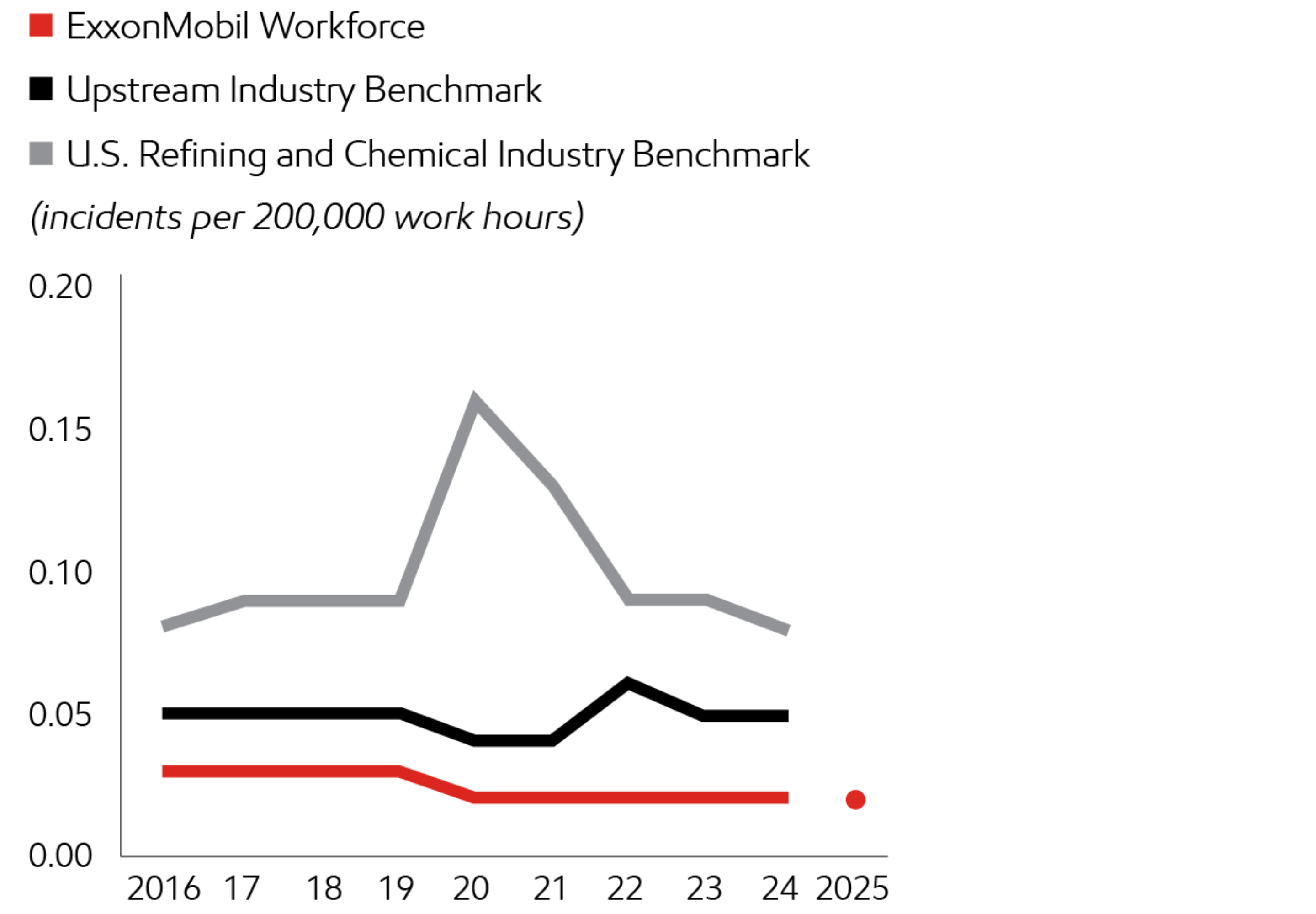
In 2025, we built on five consecutive years of industry-leading personnel safety performance with a Lost Time Incident Rate (LTIR) of 0.02 per 200,000 work hours.1,2
We track injuries and illnesses for both employees and contractors. This includes fatalities, fatal incident rate, lost time incident rate, and total recordable incident rate. These safety metrics can be found in our Sustainability Performance Data Table.
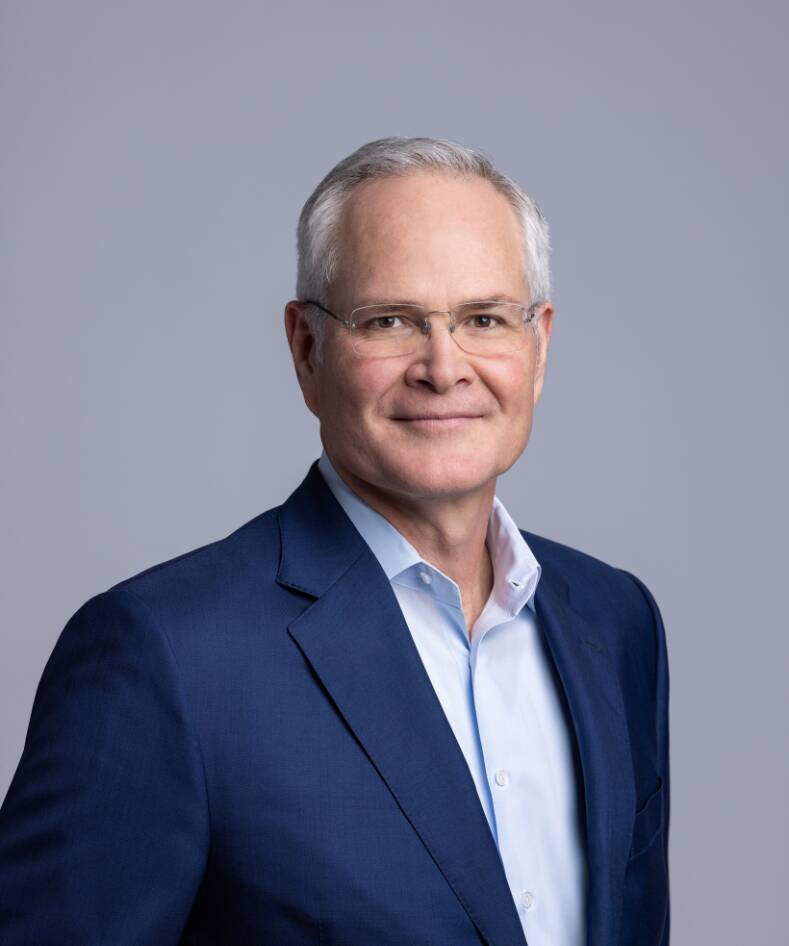
“Nothing is more important than the safety of our people. Keeping them safe requires intense focus and relentless discipline, 24 hours a day, every single day.”
Setting expectations for excellence
For more than 30 years, our Operations Integrity Management System (OIMS) has guided the daily activities of our global workforce by setting clear expectations for managing the risks inherent to our business. Third-party providers and contractors are also included in the OIMS framework, and we incorporate specific safety and health expectations in our contracts. In 2024, we reviewed and refreshed our OIMS Framework to include specific expectations related to our new Personnel Safety Management System (PSMS).
Leaders engage with their teams to drive effective application of OIMS. Each business unit has defined management systems, work processes, and observable leadership behaviors to help meet operations objectives.
Our OIMS process meets the requirements of ISO 14001/45001 as certified/attested by Lloyd’s Register Quality Assurance. The ISO management system helps us further manage potential impacts, fulfill compliance obligations, and identify opportunities for improvement. Our Incident Investigation Framework is consistent with International Association of Oil & Gas Producers (IOGP) Report 621 and makes use of enhanced techniques and learning standards.
Human performance
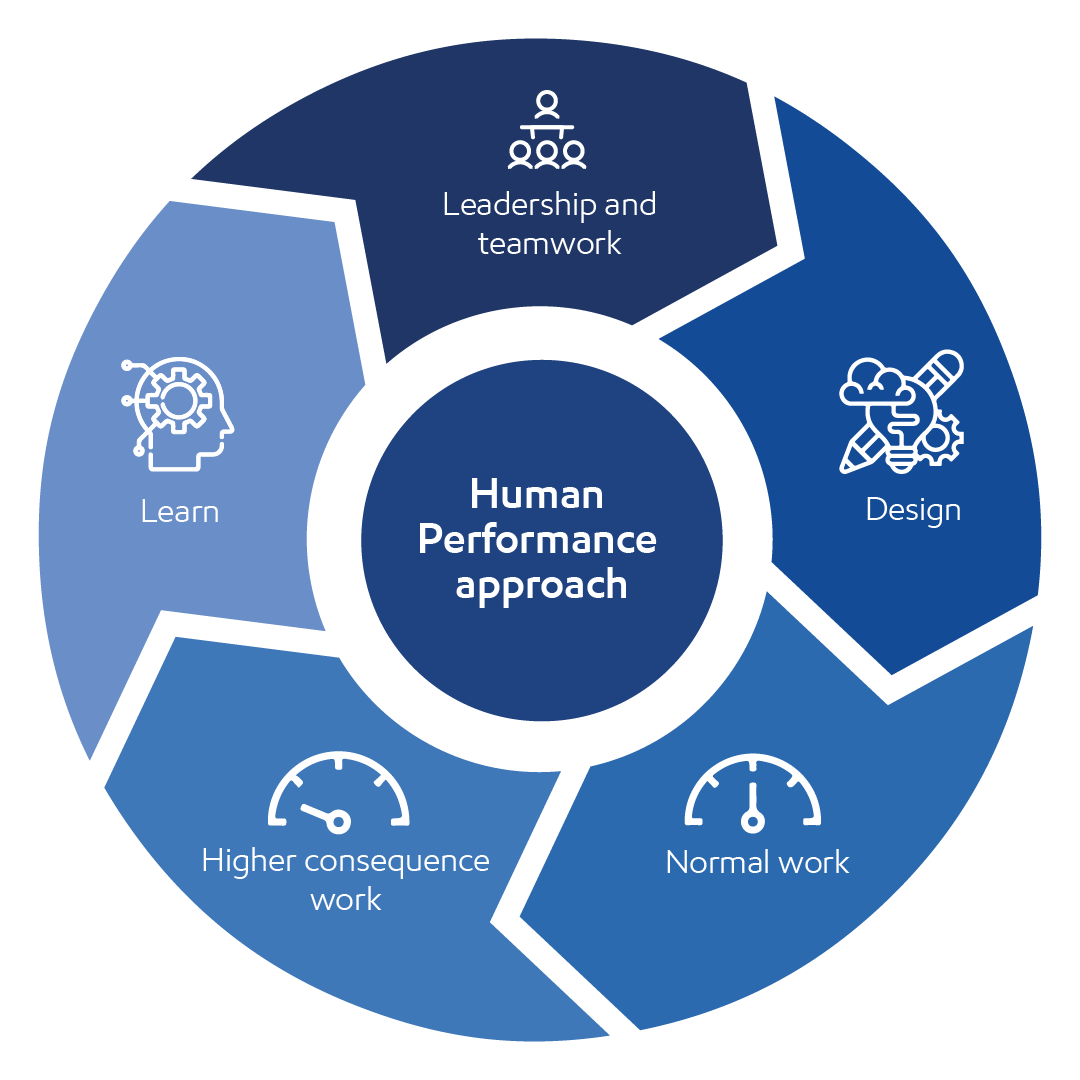
Human performance principles have been integrated into our operations and the processes and tools we use to perform our work. It starts with a simple principle: People make mistakes.
With that acknowledgement, we strive to understand when, how, and why mistakes are made - even when the appropriate processes and tools are in place - as a first step in enhancing the resilience of our facilities, systems, and people. These concepts are a key feature of OIMS and the way we maintain the safety and reliability of our operations, and how we learn and improve proactively from work and events if they occur.
In March 2026, we jointly sponsored a Safety Collaboration Forum with others in the industry, with a specific focus on four key applications of human performance concepts including leadership, design, work execution, and learning. Centered on the new International Oil and Gas Producers (IOGP) Report 810, members of the forum leveraged their community of practice to maintain focus on this issue and share practices that effectively embed human performance principles within their operations and across our industry.
The growing body of knowledge on human factors and human performance in our industry is the result of many years of research and collaboration.
-
Work execution
Personnel Safety Management System
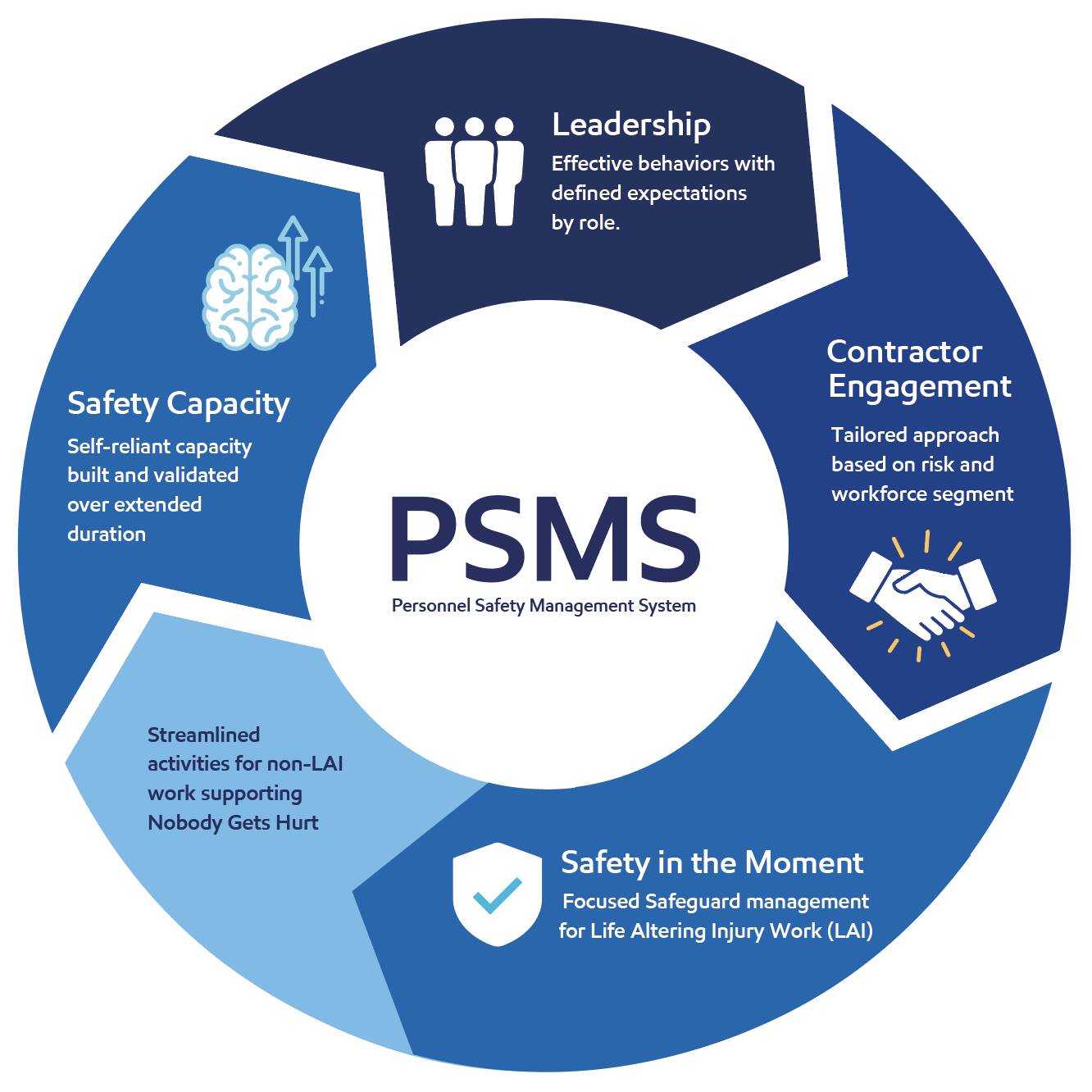
In 2023, a cross-functional team at ExxonMobil completed a multiyear project to create an integrated, end-to-end safety standard for our operations. This new Personnel Safety Management System (PSMS) is designed to consistently deliver “safety in the moment.”
The team engaged both inside and outside the company to discover, benchmark, and evaluate the latest in safety best practices. This work was anchored in OIMS, grounded in behavioral science, and drawn from best practices in the industry and our own field experience. Over 80% of our sites deployed PSMS by year-end 2025. Rollout is expected to be completed by the end of 2026. In addition, several progress checks are being conducted at each major operating site during the first two years post-deployment to verify that PSMS has been implemented effectively.
Absence of incidents is, of course, a key measure of success. Leading indicators such as safeguard effectiveness, leader engagements, and worker engagements help us verify and validate the effectiveness of PSMS as it is further embedded into our practices.
PSMS also features a heightened focus on eliminating life-changing injuries, or “life-altering injuries” (LAIs). These injuries are those with the highest potential to result in permanent impairment for those affected. The International Oil and Gas Producers (IOGP), in consultation with safety experts from across the industry, developed comprehensive definitions for these injuries in 2022.
The system provides a suite of processes and tools to enable effective management of safeguards before and during higher-risk work by:
- Proactively learning from work.
- Building and validating the safety capacity of our workforce.
- Driving effective safety engagement across interfaces.
- Leveraging the latest human performance concepts.
It all ties back to our core value of Care. The PSMS clarifies expectations at every level to teach people how to be safety leaders no matter where they work. It establishes a streamlined personnel safety standard with common language, processes, and tools. And it prioritizes our efforts according to risk and life-altering potential. Through repetition and coaching, the PSMS is helping to further build the safety capacity of our workforce.
The key components of PSMS include:
Start to finish: Life-saving rules & actions and learning from work
Life Saving Rules & Actions (LSRAs) are an important part of our PSMS. Our employees and contractors work together to execute the LSRAs for routine and non-routine work with higher-risk potential. LSRAs also work to enhance our understanding of key safeguards for higher-risk work like confined-space entry, mechanical lifting, and working at heights. This helps to verify that safeguards are in place before work begins and through the end of the process.
Our LSRAs fully integrate the language of the IOGP Life Saving Rules program (IOGP Life Saving Rules Report 459).
Start Work Checks support our LSRAs. These checks are designed to help supervisors and crew leaders lead interactive, detailed safeguard verification discussions before higher-risk work even begins. This process is aligned with concepts in IOGP Start Work Checks Report 459-1.
Continuous learning is key to continuous improvement, and we strive to learn from our work when incidents occur – and when they don’t. After Action Reviews (AARs) are a tool that help us to proactively learn in this space through a simple, informal discussion after the task is complete. AARs guide the team to discuss four key questions including what was supposed to happen, what actually happened, what were the differences, and what we can learn. The learnings help the team identify and embed improvements for the next time the work is performed.
In addition, Verification and Validation (V&V) is a structured process we use to strengthen safety performance for tasks with high potential consequences. Verification confirms that safeguards – both physical and behavioral – are present, while validation ensures those safeguards are effective and functioning as intended.
Culture of Health
To improve the health, quality of life, and productivity of employees, we provide a comprehensive Culture of Health program. This program provides an environment and resources that actively and consistently promote healthy and safe behaviors. This includes biometric screenings, health surveys, well-being champions, resources to help employees with resiliency, and more.
See Investing in People for more information on how ExxonMobil supports our people.
Workplace Security
Protecting our people at all levels of the organization is our top priority in security. Our security programs are risk-based, flexible, responsive to the places we operate, and comply with applicable laws.
Periodic security reviews at our sites address current and potential threats. Each assessment looks at factors such as:
- Location.
- Community relationships.
- Criminal activity.
- Political climate.
We monitor local conditions and keep detailed readiness plans for many risks, including:
- Emergency response.
- Evacuation and intruder response.
- Bomb threat response.
- Active shooter response.
We provide tailored guidance for employees in higher-risk countries with challenging security environments. Our teams continue to work to improve our risk management methodologies, threat-assessment capabilities, and technical security management processes through drills, training programs, and industry forums.
Training
Our global training system delivers role-based safety, health, and security training to employees. Progress and completion are tracked and stewarded, and refresher training is offered as needed. ExxonMobil-specific and other relevant training is shared with contractors and others if required for services in our facilities. Non-operated joint ventures also have access to certain training materials if they have written agreements with us.
Collaboration
We participate in a wide range of forums to help improve practices across the industry and around the world. We have representatives on more than 40 committees and forums related to health, safety, and security in groups that include:
- Energy Institute: The Energy Institute is a professional membership body that provides training, shares knowledge, and supports energy professionals globally.
- International Association of Oil and Gas Producers (IOGP): The IOGP works to improve safety, environmental, and social performance in our industry.
- American Fuels and Petrochemical Manufacturers (AFPM): AFPM represents refiners and manufacturers, with a focus on industry safety and policy.
- Texas Chemical Council: The Texas Chemical Council promotes the interests of the industry in Texas, emphasizing safety and environmental responsibility.
- American Petroleum Institute (API): API is the primary trade association for the oil and natural gas industry in the United States, with focused safety efforts that include the Onshore Safety Alliance and the Center for Offshore Safety.
- Center for Chemical Process Safety (CCPS): CCPS develops and promotes best practices in process safety management for the chemical and petroleum industries.
“We have integrated human performance principles into our new Personnel Safety Management System (PSMS) to help reduce the potential for life-altering injuries. By understanding human behavior and how work normally gets done, we are strengthening how we verify safeguards before and during work and building a learning culture focused on setting our people up for success.”



Publications
Explore more
Content index
Data
•
6 min read
• May 21, 2026
Enhancing process safety
Report
•
3 min read
• May 5, 2026About our Advancing Climate Solutions and Sustainability Reports and Cautionary Statement
Report
•
4 min read
• May 5, 2026
Improving air quality
Report
•
2 min read
• May 5, 2026
Integrating sustainability into what we do
Report
•
8 min read
• May 5, 2026
Metrics and data
Report
•
8 min read
• May 5, 2026
FOOTNOTES:
- Industry benchmark: International Association of Oil & Gas Producers (IOGP) safety performance indicators and the American Fuel & Petrochemical Manufacturers (AFPM) Report of Occupational Injuries and Illnesses are the Upstream and Downstream industry benchmarks, respectively. IOGP safety performance indicators data converted from incidents per 1 million work hours to incidents per 200,000 work hours. ExxonMobil analysis of data published by AFPM and IOGP. 2025 industry data not available at time of publication. Performance data may include rounding.
- Our workforce Lost-Time Incident Rate (LTIR) for 2020-2025 was 0.02 per 200,000 work hours, based on ExxonMobil 2020, 2021, 2022, 2023, 2024, and 2025 full-year performance data as of March 12, 2026. Performance data may include rounding. Incidents include injuries and illnesses. ExxonMobil workforce includes employees, contractors, and recent acquisitions (Denbury data beginning November 2, 2023, and Pioneer data beginning May 3, 2024).
FORWARD-LOOKING STATEMENT WARNING
CAUTIONARY STATEMENT RELEVANT TO FORWARD LOOKING INFORMATION FOR THE PURPOSE OF THE “SAFE HARBOR” PROVISIONS OF THE PRIVATE SECURITIES LITIGATION REFORM ACT OF 1995 AND OTHER IMPORTANT LEGAL DISCLAIMERS
Images or statements of future ambitions, aims, aspirations, plans, goals, events, projects, projections, opportunities, expectations, performance, potential addressable markets or conditions in the publications, including plans to reduce, abate, avoid or enable avoidance of emissions or reduce emissions intensity, sensitivity analyses, estimates, the development of future technologies, business plans, and sustainability efforts are dependent on future market factors, such as customer demand, continued technological progress, stable policy support and timely rule-making or continuation of government incentives and funding, and represent forward-looking statements. Similarly, emission-reduction roadmaps to drive toward net zero and similar roadmaps for emerging technologies and markets, and water management roadmaps to reduce freshwater intake and/or manage disposal, are forward-looking statements. These statements are not guarantees of future corporate, market or industry performance or outcomes for ExxonMobil or society and are subject to numerous risks and uncertainties, many of which are beyond our control or are even unknown.
Actual future results, including the achievement of ambitions to reach Scope 1 and 2 net zero from operated assets by 2050, to reach Scope 1 and 2 net zero in integrated Upstream Permian Basin unconventional operated assets by 2035, to eliminate routine flaring in-line with World Bank Zero Routine Flaring, to reach near zero methane emissions from operated assets and other methane initiatives to meet ExxonMobil’s greenhouse gas emission reduction plans and goals, divestment and start-up plans, and associated project plans as well as technology advances, including in the timing and outcome of projects to capture, transport and store CO2, produce hydrogen and ammonia, produce lower-emission fuels, produce ProxximaTM systems, produce carbon materials, produce lithium, and use plastic waste as feedstock for advanced recycling; future debt levels and credit ratings; business and project plans, timing, costs, capacities and profitability; resource recoveries and production rates; planned Denbury and Pioneer integrated benefits; detection, measurement and quantification of emissions including obtaining or reporting of that data or updates to previous estimates and progress in sustainability focus areas could vary depending on a number of factors. These include, global or regional changes or imbalances in the supply and demand for oil, gas, petrochemicals, and feedstocks and other market factors; economic conditions and seasonal fluctuations that impact prices, differentials, and volume/mix for our products; new market products and services; future cash flows; our ability to execute operational objectives on a timely and successful basis; the ability to realize efficiencies within and across our business lines; developments or changes in local, national, or international treaties, laws, regulations, taxes, trade sanctions, trade tariffs, or policies affecting our business, such as government policies supporting lower-carbon and new market investment opportunities, or policies limiting the attractiveness of investments such the punitive European taxes on the oil and gas sector and unequal support for different technological methods of emissions reduction or evolving, ambiguous, and unharmonized voluntary and mandatory standards and extraterritorial laws and regulations imposed by various jurisdictions related to sustainability and greenhouse gas reporting and evolving measurement standards for these topics; timely granting of governmental permits, licenses, and certifications; uncertain impacts of deregulation on the legal and regulatory environment; trade patterns and the development and enforcement of local, national and regional mandates; unforeseen technical or operational difficulties; the outcome of research efforts and future technology developments, including the ability to scale projects and technologies such as electrification of operations, advanced recycling, carbon capture and storage, hydrogen and ammonia production, ProxximaTM systems, carbon materials or direct lithium extraction on a commercially competitive basis; the development and competitiveness of alternative energy and emission reduction technologies; unforeseen technical or operating difficulties, including the need for unplanned maintenance; availability of feedstocks for lower-emission fuels, hydrogen, or advanced recycling; changes in the relative energy mix across activities and geographies; the actions of co-venturers or competitors; changes in regional and global economic growth rates and consumer preferences including willingness and ability to pay for reduced emissions products; actions taken by governments and consumers resulting from a pandemic; changes in population growth, economic development or migration patterns; timely completion of construction projects; war, civil unrest, attacks against the Company or industry, and other political or security disturbances, including disruption of land or sea transportation routes; decoupling of economies, realignment of global trade and supply chain networks, and disruptions in military alliances; and other factors discussed here and in Item 1A. Risk Factors of our Annual Report on Form 10-K and under the heading “Factors affecting future results” available under the “Earnings” tab through the “Investors” page of our website at www.exxonmobil.com. The Advancing Climate Solutions Report includes 2025 greenhouse gas emissions performance data as of March 13, 2026, and Scope 3 Category 11 estimates for full year 2025 as of March 13, 2026. The greenhouse gas intensity and greenhouse gas emission estimates include Scope 2 market-based emissions. The Sustainability Report, the Advancing Climate Solutions Report, and combined Executive Summary were issued on May 5, 2026. The content and data referenced in these publications focus primarily on our operations from Jan. 1, 2025 – Dec. 31, 2025, unless otherwise indicated. Tables on our “Metrics and data” page were updated to reflect full year 2025 data. Information regarding some known events or activities in 2026 and historical initiatives from prior years are also included. No party should place undue reliance on these forward-looking statements, which speak only as of the dates of these publications. All forward-looking statements are based on management’s knowledge and reasonable expectations at the time of publication. ExxonMobil assumes no duty to update these statements or materials as of any future date, and neither future distribution of this material nor the continued availability of this material in archive form on our website should be deemed to constitute an update or re-affirmation of these figures or statements as of any future date. Any future update will be provided only through a public disclosure indicating that fact.
See “ABOUT THE ADVANCING CLIMATE SOLUTIONS AND SUSTAINABILITY REPORTS” at the end of this document for additional information on these reports and the use of non-GAAP and other financial measures.
ABOUT THE ADVANCING CLIMATE SOLUTIONS AND SUSTAINABILITY REPORTS
The Advancing Climate Solutions Report contains terms used by the third-party disclosure frameworks. In doing so, ExxonMobil is not obligating itself to use any terms in the way defined or interpreted by any third-party, nor is it obligating itself to comply with any specific recommendation of such parties or to provide any specific disclosure. For example, with respect to the term “material,” individual companies are best suited to determine what information is material, under the long-standing U.S. Supreme Court definition, and whether to include this information in U.S. Securities and Exchange Act filings. The Sustainability Report and Advancing Climate Solutions Report are each a voluntary disclosure and are not designed to fulfill any U.S., foreign, or third-party required reporting framework.
Forward-looking and other statements regarding environmental and other sustainability efforts and aspirations are not intended to communicate any material investment information under the laws of the United States or elsewhere or represent that these are required disclosures in any other context or jurisdiction. These publications are not intended to imply that ExxonMobil has access to any significant non-public insights on future events that the reader could not independently research. In addition, historical, current, and forward-looking environmental, climate-related, and other sustainability-related statements may be based on standards for measuring progress that are still developing, internal controls and processes that continue to evolve, and assumptions that are subject to change in the future, including future laws and rulemaking. Forward-looking and other statements regarding environmental and other sustainability efforts and aspirations are for informational purposes only and are not intended as an advertisement for ExxonMobil’s equity, debt, businesses, products, or services and the reader is specifically notified that any investor-requested disclosure or future required disclosure is not and should not be construed as an inducement for the reader to purchase any product, services, or security. The statements and analysis in these publications represent a good faith effort by the Company to address these investor requests despite significant unknown variables and at times inconsistent market data, government policy signals, and calculation methodologies and reporting standards.
Actions needed to advance ExxonMobil’s 2030 greenhouse gas emission-reductions plans are incorporated into its medium-term business plans, which are updated annually. The reference case for planning beyond 2030 is based on the Company’s Global Outlook research and publication. The Global Outlook is reflective of the existing global policy environment and an assumption of increasing policy stringency and technology improvement to 2050. However, the Global Outlook does not attempt to project the degree of required future policy and technology advancement and deployment for the world, or ExxonMobil, to meet net zero by 2050. As future policies and technology advancements emerge, they will be incorporated into the GIobal Outlook, and the Company’s business plans will be updated as appropriate. References to projects or opportunities may not reflect investment decisions made by the corporation or its affiliates. Individual projects or opportunities may advance based on a number of factors, including availability of stable and supportive policy, permitting, technological advancement for cost-effective abatement, insights from the company planning process, and alignment with our partners and other stakeholders. Capital investment guidance in lower-emission and other new investments is based on our corporate plan; however, actual investment levels will be subject to the availability and attractiveness of investment opportunities, market conditions, stable public policy support, other factors, and focused on returns.
Energy demand modeling is forward-looking by nature aims to replicate integrated dynamics of the global energy system but necessarily involves simplifications to simulate its complexity. The reference to any modeled scenario or any pathway for an energy transition or expansion, including any potential net-zero scenario, does not imply ExxonMobil views any particular scenario as likely to occur. In addition, energy demand scenarios require assumptions on a variety of parameters. As such, the outcome of any given scenario using an energy demand model comes with a high degree of uncertainty. Third-party scenarios discussed in these reports reflect the modeling assumptions and outputs of their respective authors, not ExxonMobil, and their use or inclusion herein is not an endorsement by ExxonMobil of their underlying assumptions, likelihood, or probability. Investment decisions are made on the basis of ExxonMobil’s separate planning process but may be secondarily tested for robustness or resiliency against different assumptions, including against various scenarios. These reports contain information from third parties. ExxonMobil makes no representation or warranty as to the third-party information. Where necessary, ExxonMobil received permission to cite third-party sources, but the information and data remain under the control and direction of the third parties. ExxonMobil has also provided links in this report to third-party websites for ease of reference. ExxonMobil’s use of the third-party content is not an endorsement or adoption of such information.
ExxonMobil reported emissions, including reductions and avoidance performance data, are based on a combination of measured and estimated data. We assess our performance to support continuous improvement throughout the organization using our Environmental Performance Indicator (EPI) manual. The reporting guidelines and indicators in the Ipieca, the American Petroleum Institute (API), the International Association of Oil and Gas Producers Sustainability Reporting Guidance for the Oil and Gas Industry (5th edition, 2025) and key chapters of the GHG Protocol inform the EPI and the selection of the data reported. Emissions reported are estimates only, and performance data depends on variations in processes and operations, the availability of sufficient data, the quality of those data and methodology used for measurement and estimation. Emissions data is subject to change as methods, data quality, and technology improvements occur, and changes to performance data may be updated. Emissions, reductions, abatements and enabled avoidance estimates for non-ExxonMobil operated facilities are included in the equity data and similarly may be updated as changes in the performance data are reported. ExxonMobil’s plans to reduce emissions are good-faith efforts based on current relevant data and methodology, which could be changed or refined. ExxonMobil works to continuously improve its approach to estimate, detect, measure, and address emissions. ExxonMobil actively engages with industry, including API and Ipieca, to improve emission factors and methodologies, including measurements and estimates.
Any reference to ExxonMobil’s support of, work with, or collaboration with a third-party organization within these publications do not constitute or imply an endorsement by ExxonMobil of any or all of the positions or activities of such organization. ExxonMobil participates, along with other companies, institutes, universities and other organizations, in various initiatives, campaigns, projects, groups, trade organizations, and other collaborations among industry and through organizations like the United Nations that express various ambitions, aspirations and goals related to climate change, emissions, sustainability, and an energy transition or expansion. ExxonMobil’s participation or membership in such collaborations is not a promise or guarantee that ExxonMobil’s individual ambitions, future performance or policies will align with the collective ambitions of the organizations or the individual ambitions of other participants, all of which are subject to a variety of uncertainties and other factors, many of which may be beyond ExxonMobil’s control, including government regulation, availability and cost-effectiveness of technologies, and market forces, geopolitical, realignment, conflicts and other risks and uncertainties. Such third parties’ statements of collaborative or individual ambitions and goals frequently diverge from ExxonMobil’s own ambitions, plans, goals, commitments and investments. ExxonMobil will continue to make independent decisions regarding the operation of its business, including its climate-related and sustainability-related ambitions, plans, goals, commitments, and investments. ExxonMobil’s future ambitions, plans, goals commitments, and investments reflect ExxonMobil’s current plans, and ExxonMobil may unilaterally change them for various reasons, including adoption of new reporting standards or practices, market conditions; changes in its portfolio; and financial, operational, regulatory, reputational, legal and other factors.
References to “resources,” “resource base,” and similar terms refer to the total remaining estimated quantities of oil and natural gas that are expected to be ultimately recoverable. The resource base includes quantities of oil and natural gas classified as proved reserves, as well as quantities that are not yet classified as proved reserves, but that are expected to be ultimately recoverable. The term “resource base” is not intended to correspond to SEC definitions such as “probable” or “possible” reserves. For additional information, see the “Frequently Used Terms” on the Investors page of the Company’s website at www.exxonmobil.com under the header “Modeling Toolkit.” References to “oil” and “gas” include crude, natural gas liquids, bitumen, synthetic oil, and natural gas. The term “project” as used in these publications can refer to a variety of different activities and does not necessarily have the same meaning as in any government payment transparency reports.
Exxon Mobil Corporation has numerous affiliates, many with names that include ExxonMobil, Exxon, Mobil, Esso, and XTO. For convenience and simplicity, those terms and terms such as “Corporation,” “company,” “our,” “we,” and “its” are sometimes used as abbreviated references to one or more specific affiliates or affiliate groups. Abbreviated references describing global or regional operational organizations, and global or regional business lines are also sometimes used for convenience and simplicity. Nothing contained herein is intended to override the corporate separateness of affiliated companies. Exxon Mobil Corporation’s goals do not guarantee any action or future performance by its affiliates or Exxon Mobil Corporation’s responsibility for those affiliates’ actions and future performance, each affiliate of which manages its own affairs. For convenience and simplicity, words like venture, joint venture, partnership, co-venturer and partner are used to indicate business relationships involving common activities and interests, and those words may not indicate precise legal relationships. These publications cover Exxon Mobil Corporation’s owned and operated businesses and do not address the performance or operations of our suppliers, contractors or partners unless otherwise noted. In the case of certain joint ventures for which ExxonMobil is the operator, we often exercise influence but not control. Thus, the governance, processes, management and strategy of these joint ventures may differ from those in these reports. ExxonMobil completed the acquisitions of Denbury Inc. and Pioneer Natural Resources Company in 2023 and 2024, respectively. These reports and the data therein do not speak of these companies’ pre-acquisition governance, risk management, strategy approaches, or emissions or sustainability performance unless specifically referenced.
These reports or any material therein are not to be used or reproduced without the permission of Exxon Mobil Corporation. All rights reserved
SUPPLEMENTAL INFORMATION FOR NON-GAAP AND OTHER MEASURES
The Positioned for Growth in a Lower-Emission Future section of the Advancing Climate Solutions Report mentions our assessment of the strength our business and investment portfolio against a range of future outcomes, including third-party scenarios. The Company believes this can be helpful in assessing the resiliency of the business to generate cash from different potential future markets. The performance data presented in the Advancing Climate Solutions Report and Sustainability Report, including on emissions, is not financial data and is not GAAP data.