Navigate to:
We promote economic development by building trust through meaningful engagement with community and stakeholders, local partnerships, and targeted socioeconomic investment. We respect human rights and expand opportunities for the people of Mozambique.
We work to contribute to the economic and social development of the countries in which we operate. We believe local content – the added economic and social value brought to a host nation through the activities of the oil and gas industry – provides shared value to ExxonMobil and to local communities.
ExxonMobil Mozambique is fully committed to working together with the Government of Mozambique to assist in the development of opportunities for the people and businesses of Mozambique by bringing its global expertise in community development projects that focus on health, education, agriculture and other support programs.
We apply robust management systems to identify, assess, manage and monitor our socioeconomic impacts, risks and opportunities. The early identification of potential socioeconomic risks, coupled with comprehensive planning and the implementation of measures that avoid, reduce or remedy the impacts are fundamental.
Looking back
-
$15 million USD
invested by the Project in community programs -
100,000
people receiving safe water access, strengthening community inclusion -
Female-focused programs
highlighting economic initiatives, boosting sustainable income to benefit themselves and their families -
3,800 households
receiving access to electricity
Looking forward
-
85% Mozambican
operations-phase staff within 15 years of start-up -
5,000 gas burners and stoves
will be provided to help families in the Afungi area -
17,000 tons LPG
to be added annually to local markets by Rovuma LNG equating to ~37% of the country's current LPG imports
Resettlement Action Plan
An LNG processing plant, such as the proposed Afungi LNG park, requires a large area of land for the safe construction of the onshore and near shore LNG facilities. Once the construction phase of the project commences, it will also mark the beginning of land clearance, excavations and earth moving activities.
The project’s health and safety standards, guided by international health and safety guidelines and industry good practice, indicate that the nature and scale of construction activities will not allow for communities to remain and continue their subsistence livelihoods in close proximity to the LNG processing plant. As a precautionary safety measure, project-affected communities in the project Industrial Zone will need to be resettled.
Resettlement includes both physical and economic displacement.
Physical displacement involves the loss of shelter and assets resulting from acquisition of land associated with the Project that requires the affected persons to move to another location.
Economic displacement involves the loss of income streams or means of livelihood resulting from land acquisition or obstructed access to economic resources (land, water, forest) resulting from the construction or operation of the Project or its associated facilities.
A comprehensive resettlement action plan has been designed jointly to cover Area 1 and Area 4, however the implementation and operation of this plan is being led by the Area 1 operator.
Human rights
Respecting human rights is important to the well-being of our communities and our workforce – and it’s simply the right thing to do.
Our approach to human rights is guided by the goals of universally recognized human rights principles and frameworks. Our commitment to respecting human rights is embedded throughout our policies, statements, and expectations, and reinforced through training.
ExxonMobil Moçambique, Limitada (EMML) the Operator of Rovuma LNG has adopted the policies, practices and expectations of ExxonMobil consistent with the Statement on Human Rights. EMML is unwavering in our commitment to respecting human rights as a core principle in our operations.
- We strive to have a positive influence on our workforce and in the communities where we operate.
- We do not use forced or compulsory labor in our operations, and we forbid the use of child labor in our workforce.
- We condemn human rights violations in any form, and we actively express these views in our engagements with governments and other stakeholders.
Review the Rovuma LNG Human Rights Impact Assessment summary report →


Community grievance mechanism
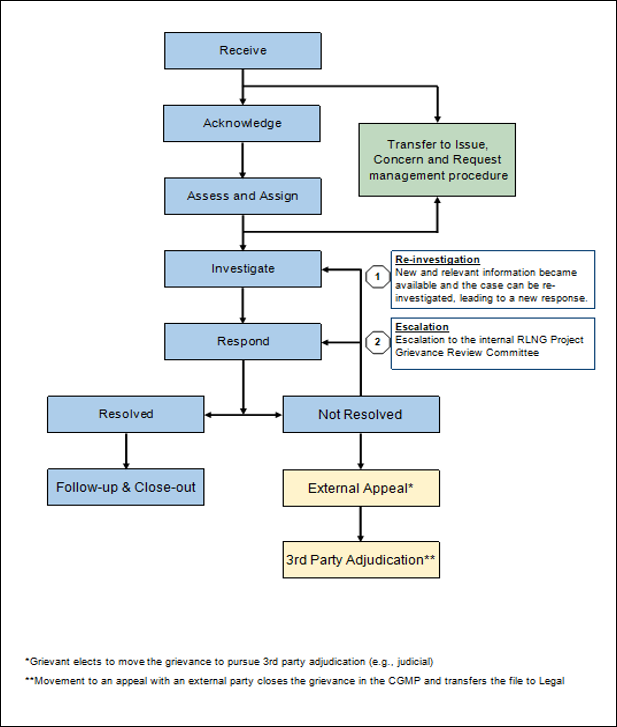
The Project has established a community grievance mechanism to receive and facilitate resolution of the affected communities' concerns related to the Project's environmental and social performance. The community grievance mechanism will be scaled to the risks and impacts that will address concerns promptly through a clear, transparent and culturally appropriate process. The Project will inform the affected communities about the grievance mechanism during its community engagement process.
In addition to the community grievance mechanism, the Project has established complementary grievance mechanisms to address concerns arising in different contexts. These are requirements for contractors, workplace grievance mechanism for workers, and a camp grievance mechanism to address issues related to worker accommodation and camp conditions. Together, these mechanisms form a comprehensive framework to ensure that all stakeholder groups have access to appropriate, accessible and context specific avenues for raising and resolving grievances.
Any stakeholder can submit grievance to the Project. This includes individuals, communities, NGOs, and others. The initial receipt of a grievance may come through any Project representative but is most likely to be through the Community Liaison Officer (CLO) during regular community engagements.
Grievance process
Feedback may be submitted verbally (face-to-face or phone call interactions) or in writing through any of the following channels:
- Community Liaison Officers (CLO) or Village Liaison Officers (VLO)
- Any Project contactor or subcontractor representatives
- Communication to Village Leaders, Community Committees representatives, or Community Facilitators/Village Liaison Assistants
- Complaint boxes available in villages
- Community grievance phone number
- EMML office (Av. Julius Nyerere, Nº 3412, Maputo, Mozambique)
- Dedicated grievance email: RovumaLNG.Reclamacao@exxonmobil.com
Explore more about Rovuma LNG
-
Rovuma LNG project
Topic -
Rovuma LNG project overview
Article •2 min read
-
Environmental and social management
Article •2 min read
-
Project resources
Article •8 min read


