Article
5 min read
Our history
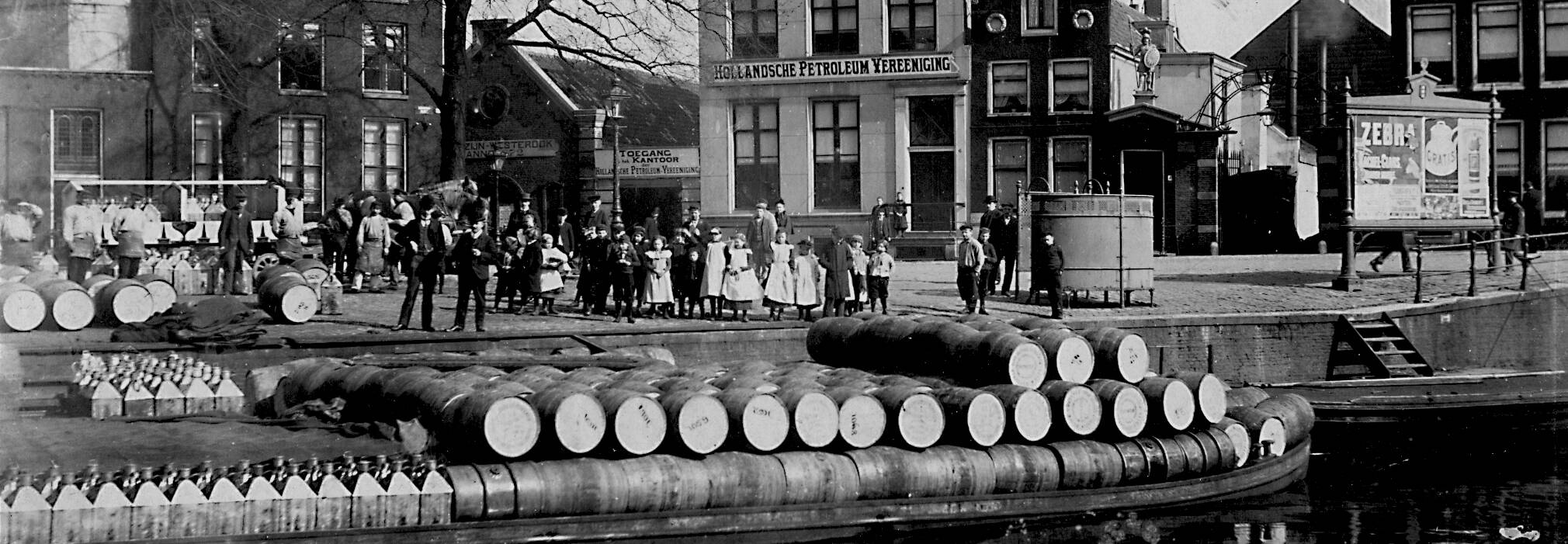
We are one of the few contemporary companies that were already operating during the nineteenth century.
Article
5 min read
Navigate to:
Current Benelux-based organization
Our current organization has its roots in Antwerp, Rotterdam and the United States. In 1882, John D. Rockefeller, the well-known tycoon, founded the Standard Oil Company, the predecessor of the present ExxonMobil company. In those days, three commercial companies, Horstmann & Co. in Rotterdam, Fréderic Speth & Co. and Graf & Maquinay in Antwerp, imported lamp oil from Standard Oil, through an intermediary, the Stursberg Company. On 11 March 1891 these five companies set up a new corporation, the American Petroleum Company (APC), with offices both in Antwerp and in Rotterdam. The three oil-importing companies pooled their oil tankers, storage installations and offices. They had an initial capital of five million guilders and a workforce of twenty. One hundred shares were issued, of which the Standard Oil Company did not have the majority. ExxonMobil is the oldest hydrocarbons company still operating in the Benelux.
In 1911, The American Supreme Court ordered the division of the Rockefeller monopoly. This resulted in multiple Standard Oils. One of these, Standard Oil of New Jersey also called Jersey Standard, continued the APC activities in the Benelux. For 30 years, APC operated exclusively in the Benelux, but from 1902 they also sold oil products in Luxembourg. In 1920, the Dutch and the Belgian-Luxembourg subsidiaries of Jersey Standard went their separate ways. This continued until the mid-eighties of the twentieth century, when the Benelux organization was formed in Breda.
Decades later we would also see one of the other Standard Oil Company successors, Standard Oil of New York or SOCONY, return to the Benelux countries under the name Mobil Oil. The merger between Esso - Exxon in the United States - and Mobil to form the Exxon Mobil Corporation in December 1999 thus reunited two major heirs to the historic Rockefeller oil empire.
Mobil: over a century
Until the creation of ExxonMobil in 1999, Mobil Oil operated as an independent oil company, including operations in the Benelux.
The roots of both this company and Exxon (Esso) are found in Rockefeller's Standard Oil Trust. Two of the many 'Baby Standard Oils' that were created in 1911 as a result of the anti-trust judgement by the American Supreme Court were called the Vacuum Oil Company and Standard Oil of New York (Socony). In 1931 these two companies merged to form Socony Vacuum. At that time, Vacuum Oil was already selling petrol under the brand name Mobilgas, while Socony was using Pegasus, the mythical flying horse, as a symbol of strength and flexibility.
The merger resulted in the marriage of word and symbol to form a logo that, despite some changes, has remained ever since. In 1955 the name of the company changed to Socony Mobil Oil, a hundred years after the creation of the Vacuum Oil Company, and in 1966 it was simplified to Mobil Oil.
In Europe
Mobil was already operating in Europe in the nineteenth century. It started with trading activities, importing oil products and setting up sales networks, but local production facilities were created over the years, such as refineries, lubricant plants and, from the sixties, petrochemical installations. After the oil crisis in the seventies and eighties, Mobil decided to substantially restructure its operations. The company closed or sold several production facilities, including the refinery in Amsterdam, to improve its profitability. The European network of Mobil petrol stations disappeared following a joint venture with BP to sell fuels and lubricants to companies, organizations and consumers.
Mobil's petroleum and natural gas extraction operations have always remained independent, including those in the Netherlands. In the years preceding the merger with Exxon, the company also invested in advanced chemical production facilities such as the polypropylene plants in Virton (Belgium) and Kerkrade (The Netherlands) and the ester plant in Amsterdam.
After the merger
One of the demands set by the competition regulatory authorities before they would approve the merger between Exxon and Mobil was the division of the joint venture between Mobil and BP. This resulted in Mobil retaining the lubrication business and BP holding onto all the remaining production and marketing activities that were involved in the joint venture. Since then, ExxonMobil has been responsible for the European production of Mobil lubricants and retail sales through different channels, e.g. via the Esso petrol stations network.
Our presence in the Netherlands and Europe
Explore more
ExxonMobil to build CCS pilot plant with FuelCell Energy using carbonate fuel cell technology
News
•
2 min read
• Dec. 18, 2023
Neptune Energy, ExxonMobil, Rosewood and EBN to cooperate on L10 carbon capture and storage
News
•
2 min read
• June 20, 2022
Our operations
Article
•
4 min read
Max Verstappen surprises ExxonMobil employees in Rotterdam
Article
•
2 min read
Our products
Article
•
2 min read