
Report
3 min read
• May 5, 2026Enhancing process safety
“Look after each other.”
As one of the driving principles behind our core value of Care, it sounds simple.
Report
3 min read
• May 5, 2026Navigate to:
In practice, it drives us to manage risks in a proactive, disciplined way, with a focus on the inherent hazards associated with the vast equipment and complex processes that are essential to our business.
A process safety event could potentially impact our workforce, the community, and the environment. Because of this, we set a high bar for ourselves.

Our approach
Our objective is to help protect our people, communities, and the environment by successfully managing and enhancing process safety.
The primary purpose of process safety is to keep hydrocarbons, chemicals, and process water controlled and safely managed through all phases of our operations.
Our Operations Integrity Management System (OIMS) is the core of how we manage process safety risks.
Everyone at ExxonMobil plays a role in process safety excellence
Risk management strategies and higher-consequence process safety risks are stewarded by our Management Committee as part of our approach to enterprise risk management. Our Upstream, Product Solutions, and Low Carbon Solutions business lines develop and execute these strategies.
Execution excellence in process safety relies not only on technology but also on the collaboration with centralized support across multiple groups, each playing an essential role.
- ExxonMobil Technology and Engineering Company integrates process safety considerations into equipment designs.
- Our Sustainability team provides strategic oversight and alignment.
- Our Global Operations team, with support from field teams, implements and maintains our systems with discipline and rigor.
OIMS establishes overarching and detailed standards and expectations, with safeguards applied to the ways we design, operate, and maintain our sites.
We manage and verify safeguards through:
- Regular inspections.
- Ongoing maintenance.
- Competency demonstrations.
- Emergency preparedness.
In line with OIMS expectations, we also monitor the performance of our operated and non-operated assets (e.g., joint ventures). Where we see opportunities for improvement of our non-operated assets, we encourage operators to consider them.
We apply industry standards, including the API Recommended Practice 754 and the International Association of Oil & Gas Producers (IOGP) No. 456 Recommended Practice. Our process safety indicators classify and track incidents by severity from “Tier 1” to “Tier 3.” Tier 1 process safety events are analyzed through our “Learning from Incidents” process, and corrective actions are identified to guide further improvement. Our recently acquired Pioneer assets were brought into this process and began reporting internally in 2025 – see our Metrics and Data table for our reporting on prior years.
Our Enhancing Process Safety Program
The company-wide enhancing process safety initiative we launched in 2018 laid the foundation for our current Enhancing Process Safety Program. The program continues to drive measurable improvements in process safety performance for the company, building on the standards set by OIMS with further expectations related to:
-
Leadership
Managers and supervisors are responsible for setting clear expectations, providing necessary resources, and ensuring accountability for the effective execution of key systems. They identify, communicate, and manage process safety hazards and safeguards, while also verifying and proactively managing operators’ knowledge of major risks and scenarios. -
Human performance
People are our most important safeguard. Our human performance principles focus on the human factors that can contribute to safe operations or potentially lead to a safety incident. Our people play a vital role, and we create a learning environment so that our employees can ask for help, pause work if needed, and report issues to management. Our open-door communication procedures provide avenues for anonymous reporting of employee concerns, if needed. -
Scenario management
Effective scenario management is key to preventing and mitigating process safety events and responding if one occurs. This includes understanding major hazards, their causes, and how events can unfold so that critical safeguards can be defined and managed. For higher-consequence-potential scenarios, this approach is applied through the life of an asset, facility, or site – it is not a one-time exercise. -
Precise execution
Identifying critical tasks in which human error could possibly lead to a process safety event is the first step toward putting additional safeguards in place. “Precise Execution” helps teams manage their work effectively with pauses for verification of tasks and safeguards, providing independent confirmation that work is safe to proceed. -
Continuous learning
We believe in learning from every opportunity – whether it’s a success, a challenge, a near miss, direct experience, or an assessment. By openly sharing what we’ve learned, listening to each other, and continuously improving how we work, we help keep our people and operations safe.
Our zero-spill mindset
Our products are critical to global prosperity and quality of life, and we recognize that making them comes with a certain level of risk. That’s why we train our employees to have a zero-spill mindset, and we design and operate our facilities with that objective in mind.
Our objective is to prevent unplanned releases to the environment.
We are committed to:
- Prevention, mitigation, and elimination of spills from our operations.
- Maintaining processes, resources, and personnel to respond to spills.
We actively manage spill reductions, and we continually seek to apply best practices based on our own research and the work of others in the industry.
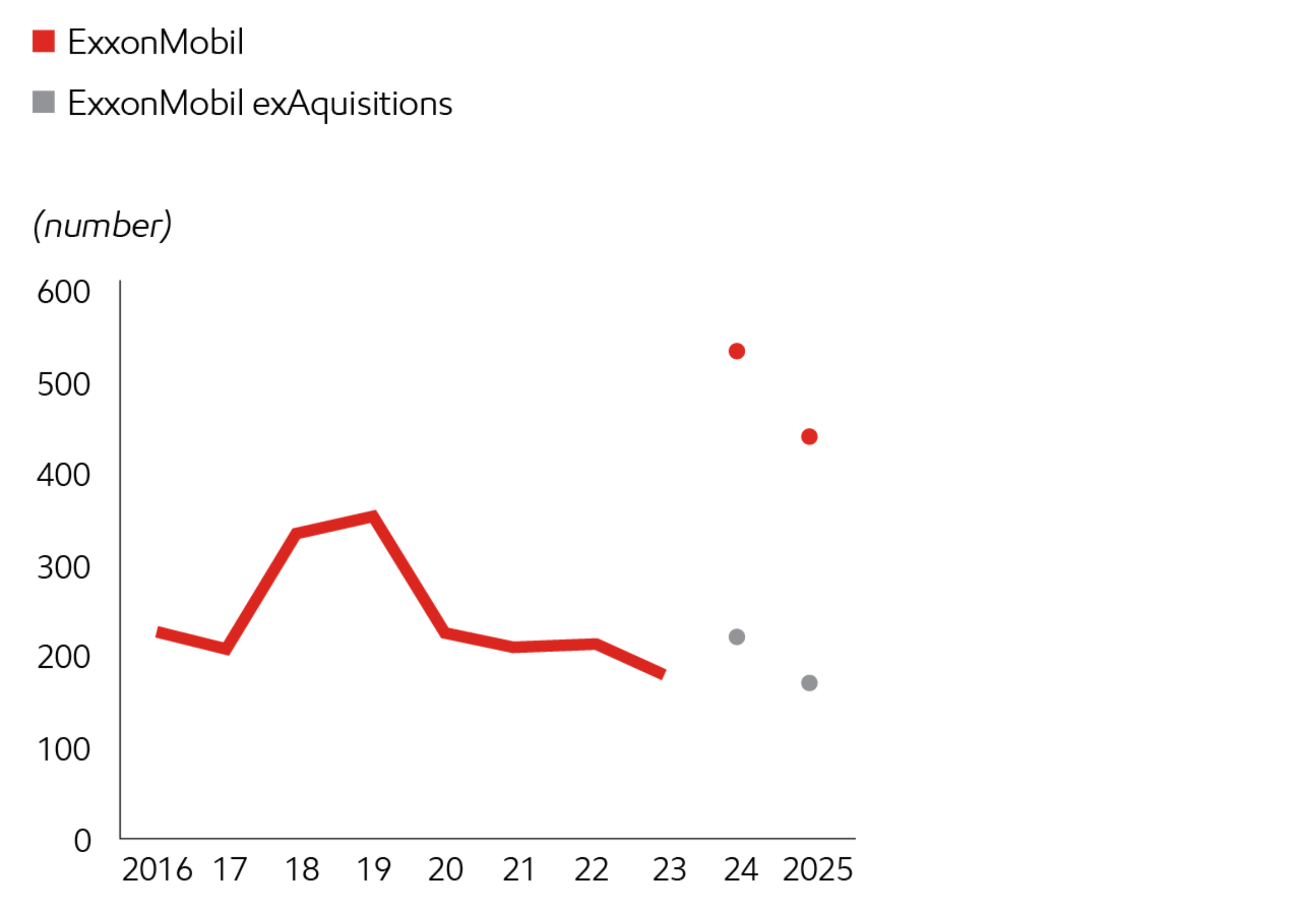
As our footprint has grown through recent acquisitions, we’ve welcomed new assets – each with its own operational history and characteristics. We are applying our spill reduction expertise to the unique conditions of these new facilities. As integration progresses, we’re focused on learning, adapting, and applying good practices to extend our zero-spill mindset across our growing operations.
Transport of our products is also an important focus. Millions of barrels of petroleum and chemical products move through thousands of miles of pipeline around the world. The integrity of this process is overseen through comprehensive management programs. In the United States, for example, this includes monitoring and testing for corrosion and other integrity concerns with ground and air patrols, state-of-the-art detection systems, alarms, and other technologies to continuously control and monitor pipeline operations.
Actively managing spill reduction; 17% below 2024 including recent acquisitions1
Spills > Barrel (BBL)
Prevention
Our Spill Prevention Program sets procedures across the company to:
- Inspect and maintain equipment.
- Train our people on safe practices.
- Conduct practice drills and communicate lessons learned.
All types of spills are covered, using the overarching principles of our internal frameworks described in OIMS. The program addresses a wide range of scenarios, considering the many human and non-human factors that could potentially lead to a spill.
Emergency preparedness
We are prepared for a wide range of events, including natural disasters, pandemics, and operational incidents. Each of our facilities has access to trained responders and resources.
Centralized and cross-functional teams develop and practice emergency response tactics through incident management teams and emergency support groups around the world.
Response
In case of a spill, we want to be ready. Rapid, comprehensive response is how we work to minimize impacts.
In January 2026, we brought our existing Regional Response Teams (RRTs) together into a new, centralized Global Response Team (GRT). This new organization includes approximately 500 employees from 30 countries, with subject matter experts, technical experts, and experienced responders from business lines and functions across the company.
Emergency simulations, like our “tabletop” and field exercises, help us ensure readiness. Globally, these are conducted in accordance with guidelines in the U.S. FEMA Incident Command (ICS) framework, as well as regulatory requirements where we operate. Each year, we conduct comprehensive exercises that span several days. At sites around the world, emergency response teams and hundreds of employees, contractors, and specialists run through realistic, higher-consequence scenarios. These exercises often include participation from local authorities and agencies.
In 2025, we conducted five of these drills covering a range of hypothetical incidents, including simulating a tank boilover and a subsea loss of containment. Local organizations, government agencies, and industry groups collaborated to prepare and test our shared capabilities, with peer companies involved as observers and evaluators to advance industry learning. In October, simultaneous drills were run in Belgium and Guyana, successfully testing our abilities to respond to multiple events at the same time.

Global Response Team drills.
Collaborations
We work with others in our industry to share best practices, improve capabilities, and facilitate global spill response and management. We also pursue innovative solutions and advance fundamental scientific understanding of spill response through collaboration. Research currently underway includes potential of chemical herders and next-generation dispersants for managing oil spills, testing innovative boom designs, and more.
ExxonMobil is a founding member of the Advancing Process Safety Initiative, a collaboration between the American Petroleum Institute (API) and the American Fuel and Petrochemical Manufacturers (AFPM). We also participate in API’s Process Safety Group, which develops assessment programs and performance indicators for process safety.
Other groups we work with include:
- International Association of Oil & Gas Producers (IOGP), an industry group that promotes process safety and spill prevention in upstream oil and gas operations.
- American Chemistry Council (ACC), an organization representing chemical companies that focuses on advancing process safety and emergency preparedness through its Responsible Care® program, which includes performance tracking, crisis management planning, and spill prevention protocols.
- Center for Chemical Process Safety (CCPS), a membership-based organization within the American Institute of Chemical Engineers that advances process safety and emergency response by developing technical guidance, training, and best practices for operations involving hazardous materials.
- Marine Spill Response Corporation, the largest joint industry group focused solely on oil spill and emergency response in the United States, providing access to their STARs network of trained contractors in about 250 locations.
- Marine Well Containment Company, a not-for-profit focused on deepwater well containment response in the U.S. Gulf of Mexico. We are a founding member.
- Oil Spill Global Response Network, a global collaboration among oil-response companies to provide centers of expertise for spill preparedness, response, and recovery.
- Oil Spill Response Limited, an industry-owned spill-response cooperative with members representing more than two-thirds of the world’s oil production, and their Global Oiled Wildlife Response Service System.
- Western Canada Spill Services Ltd., which supplements member companies’ programs with additional training and equipment.
- Oil Spill Combat Team, the largest spill response center in Indonesia.
- Eastern Canada Response Corporation, which provides services and equipment to ships and oil-handling facilities under Canadian law.
- Multi-Partner Research Initiative, a collaborative effort to enhance oil spill response capabilities through collaborative research by bringing together government agencies, academia, oil spill response organizations, oil and gas companies, indigenous communities, and other experts worldwide.


Publications
Explore more

Content index
Data
•
6 min read
• May 21, 2026
Leading in personnel safety
Report
•
3 min read
• May 5, 2026About our Advancing Climate Solutions and Sustainability Reports and Cautionary Statement
Report
•
4 min read
• May 5, 2026
Improving air quality
Report
•
2 min read
• May 5, 2026
Integrating sustainability into what we do
Report
•
8 min read
• May 5, 2026
Metrics and data
Report
•
8 min read
• May 5, 2026FORWARD-LOOKING STATEMENT WARNING
CAUTIONARY STATEMENT RELEVANT TO FORWARD LOOKING INFORMATION FOR THE PURPOSE OF THE “SAFE HARBOR” PROVISIONS OF THE PRIVATE SECURITIES LITIGATION REFORM ACT OF 1995 AND OTHER IMPORTANT LEGAL DISCLAIMERS
Images or statements of future ambitions, aims, aspirations, plans, goals, events, projects, projections, opportunities, expectations, performance, potential addressable markets or conditions in the publications, including plans to reduce, abate, avoid or enable avoidance of emissions or reduce emissions intensity, sensitivity analyses, estimates, the development of future technologies, business plans, and sustainability efforts are dependent on future market factors, such as customer demand, continued technological progress, stable policy support and timely rule-making or continuation of government incentives and funding, and represent forward-looking statements. Similarly, emission-reduction roadmaps to drive toward net zero and similar roadmaps for emerging technologies and markets, and water management roadmaps to reduce freshwater intake and/or manage disposal, are forward-looking statements. These statements are not guarantees of future corporate, market or industry performance or outcomes for ExxonMobil or society and are subject to numerous risks and uncertainties, many of which are beyond our control or are even unknown.
Actual future results, including the achievement of ambitions to reach Scope 1 and 2 net zero from operated assets by 2050, to reach Scope 1 and 2 net zero in integrated Upstream Permian Basin unconventional operated assets by 2035, to eliminate routine flaring in-line with World Bank Zero Routine Flaring, to reach near zero methane emissions from operated assets and other methane initiatives to meet ExxonMobil’s greenhouse gas emission reduction plans and goals, divestment and start-up plans, and associated project plans as well as technology advances, including in the timing and outcome of projects to capture, transport and store CO2, produce hydrogen and ammonia, produce lower-emission fuels, produce ProxximaTM systems, produce carbon materials, produce lithium, and use plastic waste as feedstock for advanced recycling; future debt levels and credit ratings; business and project plans, timing, costs, capacities and profitability; resource recoveries and production rates; planned Denbury and Pioneer integrated benefits; detection, measurement and quantification of emissions including obtaining or reporting of that data or updates to previous estimates and progress in sustainability focus areas could vary depending on a number of factors. These include, global or regional changes or imbalances in the supply and demand for oil, gas, petrochemicals, and feedstocks and other market factors; economic conditions and seasonal fluctuations that impact prices, differentials, and volume/mix for our products; new market products and services; future cash flows; our ability to execute operational objectives on a timely and successful basis; the ability to realize efficiencies within and across our business lines; developments or changes in local, national, or international treaties, laws, regulations, taxes, trade sanctions, trade tariffs, or policies affecting our business, such as government policies supporting lower-carbon and new market investment opportunities, or policies limiting the attractiveness of investments such the punitive European taxes on the oil and gas sector and unequal support for different technological methods of emissions reduction or evolving, ambiguous, and unharmonized voluntary and mandatory standards and extraterritorial laws and regulations imposed by various jurisdictions related to sustainability and greenhouse gas reporting and evolving measurement standards for these topics; timely granting of governmental permits, licenses, and certifications; uncertain impacts of deregulation on the legal and regulatory environment; trade patterns and the development and enforcement of local, national and regional mandates; unforeseen technical or operational difficulties; the outcome of research efforts and future technology developments, including the ability to scale projects and technologies such as electrification of operations, advanced recycling, carbon capture and storage, hydrogen and ammonia production, ProxximaTM systems, carbon materials or direct lithium extraction on a commercially competitive basis; the development and competitiveness of alternative energy and emission reduction technologies; unforeseen technical or operating difficulties, including the need for unplanned maintenance; availability of feedstocks for lower-emission fuels, hydrogen, or advanced recycling; changes in the relative energy mix across activities and geographies; the actions of co-venturers or competitors; changes in regional and global economic growth rates and consumer preferences including willingness and ability to pay for reduced emissions products; actions taken by governments and consumers resulting from a pandemic; changes in population growth, economic development or migration patterns; timely completion of construction projects; war, civil unrest, attacks against the Company or industry, and other political or security disturbances, including disruption of land or sea transportation routes; decoupling of economies, realignment of global trade and supply chain networks, and disruptions in military alliances; and other factors discussed here and in Item 1A. Risk Factors of our Annual Report on Form 10-K and under the heading “Factors affecting future results” available under the “Earnings” tab through the “Investors” page of our website at www.exxonmobil.com. The Advancing Climate Solutions Report includes 2025 greenhouse gas emissions performance data as of March 13, 2026, and Scope 3 Category 11 estimates for full year 2025 as of March 13, 2026. The greenhouse gas intensity and greenhouse gas emission estimates include Scope 2 market-based emissions. The Sustainability Report, the Advancing Climate Solutions Report, and combined Executive Summary were issued on May 5, 2026. The content and data referenced in these publications focus primarily on our operations from Jan. 1, 2025 – Dec. 31, 2025, unless otherwise indicated. Tables on our “Metrics and data” page were updated to reflect full year 2025 data. Information regarding some known events or activities in 2026 and historical initiatives from prior years are also included. No party should place undue reliance on these forward-looking statements, which speak only as of the dates of these publications. All forward-looking statements are based on management’s knowledge and reasonable expectations at the time of publication. ExxonMobil assumes no duty to update these statements or materials as of any future date, and neither future distribution of this material nor the continued availability of this material in archive form on our website should be deemed to constitute an update or re-affirmation of these figures or statements as of any future date. Any future update will be provided only through a public disclosure indicating that fact.
See “ABOUT THE ADVANCING CLIMATE SOLUTIONS AND SUSTAINABILITY REPORTS” at the end of this document for additional information on these reports and the use of non-GAAP and other financial measures.
ABOUT THE ADVANCING CLIMATE SOLUTIONS AND SUSTAINABILITY REPORTS
The Advancing Climate Solutions Report contains terms used by the third-party disclosure frameworks. In doing so, ExxonMobil is not obligating itself to use any terms in the way defined or interpreted by any third-party, nor is it obligating itself to comply with any specific recommendation of such parties or to provide any specific disclosure. For example, with respect to the term “material,” individual companies are best suited to determine what information is material, under the long-standing U.S. Supreme Court definition, and whether to include this information in U.S. Securities and Exchange Act filings. The Sustainability Report and Advancing Climate Solutions Report are each a voluntary disclosure and are not designed to fulfill any U.S., foreign, or third-party required reporting framework.
Forward-looking and other statements regarding environmental and other sustainability efforts and aspirations are not intended to communicate any material investment information under the laws of the United States or elsewhere or represent that these are required disclosures in any other context or jurisdiction. These publications are not intended to imply that ExxonMobil has access to any significant non-public insights on future events that the reader could not independently research. In addition, historical, current, and forward-looking environmental, climate-related, and other sustainability-related statements may be based on standards for measuring progress that are still developing, internal controls and processes that continue to evolve, and assumptions that are subject to change in the future, including future laws and rulemaking. Forward-looking and other statements regarding environmental and other sustainability efforts and aspirations are for informational purposes only and are not intended as an advertisement for ExxonMobil’s equity, debt, businesses, products, or services and the reader is specifically notified that any investor-requested disclosure or future required disclosure is not and should not be construed as an inducement for the reader to purchase any product, services, or security. The statements and analysis in these publications represent a good faith effort by the Company to address these investor requests despite significant unknown variables and at times inconsistent market data, government policy signals, and calculation methodologies and reporting standards.
Actions needed to advance ExxonMobil’s 2030 greenhouse gas emission-reductions plans are incorporated into its medium-term business plans, which are updated annually. The reference case for planning beyond 2030 is based on the Company’s Global Outlook research and publication. The Global Outlook is reflective of the existing global policy environment and an assumption of increasing policy stringency and technology improvement to 2050. However, the Global Outlook does not attempt to project the degree of required future policy and technology advancement and deployment for the world, or ExxonMobil, to meet net zero by 2050. As future policies and technology advancements emerge, they will be incorporated into the GIobal Outlook, and the Company’s business plans will be updated as appropriate. References to projects or opportunities may not reflect investment decisions made by the corporation or its affiliates. Individual projects or opportunities may advance based on a number of factors, including availability of stable and supportive policy, permitting, technological advancement for cost-effective abatement, insights from the company planning process, and alignment with our partners and other stakeholders. Capital investment guidance in lower-emission and other new investments is based on our corporate plan; however, actual investment levels will be subject to the availability and attractiveness of investment opportunities, market conditions, stable public policy support, other factors, and focused on returns.
Energy demand modeling is forward-looking by nature aims to replicate integrated dynamics of the global energy system but necessarily involves simplifications to simulate its complexity. The reference to any modeled scenario or any pathway for an energy transition or expansion, including any potential net-zero scenario, does not imply ExxonMobil views any particular scenario as likely to occur. In addition, energy demand scenarios require assumptions on a variety of parameters. As such, the outcome of any given scenario using an energy demand model comes with a high degree of uncertainty. Third-party scenarios discussed in these reports reflect the modeling assumptions and outputs of their respective authors, not ExxonMobil, and their use or inclusion herein is not an endorsement by ExxonMobil of their underlying assumptions, likelihood, or probability. Investment decisions are made on the basis of ExxonMobil’s separate planning process but may be secondarily tested for robustness or resiliency against different assumptions, including against various scenarios. These reports contain information from third parties. ExxonMobil makes no representation or warranty as to the third-party information. Where necessary, ExxonMobil received permission to cite third-party sources, but the information and data remain under the control and direction of the third parties. ExxonMobil has also provided links in this report to third-party websites for ease of reference. ExxonMobil’s use of the third-party content is not an endorsement or adoption of such information.
ExxonMobil reported emissions, including reductions and avoidance performance data, are based on a combination of measured and estimated data. We assess our performance to support continuous improvement throughout the organization using our Environmental Performance Indicator (EPI) manual. The reporting guidelines and indicators in the Ipieca, the American Petroleum Institute (API), the International Association of Oil and Gas Producers Sustainability Reporting Guidance for the Oil and Gas Industry (5th edition, 2025) and key chapters of the GHG Protocol inform the EPI and the selection of the data reported. Emissions reported are estimates only, and performance data depends on variations in processes and operations, the availability of sufficient data, the quality of those data and methodology used for measurement and estimation. Emissions data is subject to change as methods, data quality, and technology improvements occur, and changes to performance data may be updated. Emissions, reductions, abatements and enabled avoidance estimates for non-ExxonMobil operated facilities are included in the equity data and similarly may be updated as changes in the performance data are reported. ExxonMobil’s plans to reduce emissions are good-faith efforts based on current relevant data and methodology, which could be changed or refined. ExxonMobil works to continuously improve its approach to estimate, detect, measure, and address emissions. ExxonMobil actively engages with industry, including API and Ipieca, to improve emission factors and methodologies, including measurements and estimates.
Any reference to ExxonMobil’s support of, work with, or collaboration with a third-party organization within these publications do not constitute or imply an endorsement by ExxonMobil of any or all of the positions or activities of such organization. ExxonMobil participates, along with other companies, institutes, universities and other organizations, in various initiatives, campaigns, projects, groups, trade organizations, and other collaborations among industry and through organizations like the United Nations that express various ambitions, aspirations and goals related to climate change, emissions, sustainability, and an energy transition or expansion. ExxonMobil’s participation or membership in such collaborations is not a promise or guarantee that ExxonMobil’s individual ambitions, future performance or policies will align with the collective ambitions of the organizations or the individual ambitions of other participants, all of which are subject to a variety of uncertainties and other factors, many of which may be beyond ExxonMobil’s control, including government regulation, availability and cost-effectiveness of technologies, and market forces, geopolitical, realignment, conflicts and other risks and uncertainties. Such third parties’ statements of collaborative or individual ambitions and goals frequently diverge from ExxonMobil’s own ambitions, plans, goals, commitments and investments. ExxonMobil will continue to make independent decisions regarding the operation of its business, including its climate-related and sustainability-related ambitions, plans, goals, commitments, and investments. ExxonMobil’s future ambitions, plans, goals commitments, and investments reflect ExxonMobil’s current plans, and ExxonMobil may unilaterally change them for various reasons, including adoption of new reporting standards or practices, market conditions; changes in its portfolio; and financial, operational, regulatory, reputational, legal and other factors.
References to “resources,” “resource base,” and similar terms refer to the total remaining estimated quantities of oil and natural gas that are expected to be ultimately recoverable. The resource base includes quantities of oil and natural gas classified as proved reserves, as well as quantities that are not yet classified as proved reserves, but that are expected to be ultimately recoverable. The term “resource base” is not intended to correspond to SEC definitions such as “probable” or “possible” reserves. For additional information, see the “Frequently Used Terms” on the Investors page of the Company’s website at www.exxonmobil.com under the header “Modeling Toolkit.” References to “oil” and “gas” include crude, natural gas liquids, bitumen, synthetic oil, and natural gas. The term “project” as used in these publications can refer to a variety of different activities and does not necessarily have the same meaning as in any government payment transparency reports.
Exxon Mobil Corporation has numerous affiliates, many with names that include ExxonMobil, Exxon, Mobil, Esso, and XTO. For convenience and simplicity, those terms and terms such as “Corporation,” “company,” “our,” “we,” and “its” are sometimes used as abbreviated references to one or more specific affiliates or affiliate groups. Abbreviated references describing global or regional operational organizations, and global or regional business lines are also sometimes used for convenience and simplicity. Nothing contained herein is intended to override the corporate separateness of affiliated companies. Exxon Mobil Corporation’s goals do not guarantee any action or future performance by its affiliates or Exxon Mobil Corporation’s responsibility for those affiliates’ actions and future performance, each affiliate of which manages its own affairs. For convenience and simplicity, words like venture, joint venture, partnership, co-venturer and partner are used to indicate business relationships involving common activities and interests, and those words may not indicate precise legal relationships. These publications cover Exxon Mobil Corporation’s owned and operated businesses and do not address the performance or operations of our suppliers, contractors or partners unless otherwise noted. In the case of certain joint ventures for which ExxonMobil is the operator, we often exercise influence but not control. Thus, the governance, processes, management and strategy of these joint ventures may differ from those in these reports. ExxonMobil completed the acquisitions of Denbury Inc. and Pioneer Natural Resources Company in 2023 and 2024, respectively. These reports and the data therein do not speak of these companies’ pre-acquisition governance, risk management, strategy approaches, or emissions or sustainability performance unless specifically referenced.
These reports or any material therein are not to be used or reproduced without the permission of Exxon Mobil Corporation. All rights reserved
SUPPLEMENTAL INFORMATION FOR NON-GAAP AND OTHER MEASURES
The Positioned for Growth in a Lower-Emission Future section of the Advancing Climate Solutions Report mentions our assessment of the strength our business and investment portfolio against a range of future outcomes, including third-party scenarios. The Company believes this can be helpful in assessing the resiliency of the business to generate cash from different potential future markets. The performance data presented in the Advancing Climate Solutions Report and Sustainability Report, including on emissions, is not financial data and is not GAAP data.